

Agentic AI & Gen AI Framework for Automated Fishing Regulations & Reports
85%
Reduction in manual effort10x
Faster regulation updates~30%
Lower operational overhead
Customer Overview
A US-based company of passionate anglers partnered with TenUp to create Android and iOS apps that help recreational fishers identify their catches and access region-specific fishing regulations. TenUp developed AI-powered apps that use image recognition to identify fish species and provide catch regulations such as open seasons, bag limits, and min/max sizes. The apps also allow users to log their catches, check marine weather, and store digital fishing licenses. They have now evolved into reliable, all-in-one fishing companions for enthusiasts across the US, Australia, and Mexico.
Project Overview
As user adoption grew, the client re-engaged TenUp to enhance key app features. With coverage expanding across multiple regions, maintaining accurate fishing regulations became increasingly complex. Rules varied by species and changed frequently. Tracking and updating over 4,000 regulatory records manually was time-intensive and difficult to scale. The client also wanted to introduce a new Fishing Reports feature to help users plan trips better with location-based forecasts, updated regulations, and preparation tips. The goal was to build a system that could autonomously track, analyze, and flag regulation updates to keep information reliable and generate Fishing Reports to help users plan smarter trips.
Challenges
Building an automated, accurate, and scalable system to manage frequent regulatory updates and generate location-based Fishing Reports without increasing operational complexity.
- Manually tracking and updating over 4,000 regulatory entries was difficult to scale and prone to delays and errors. The goal was to automate the detection and flagging of regulatory changes.
- The manual update process lacked visibility into history and status, making it difficult to identify and correct errors.
- The client also wanted to build a new Fishing Reports feature to give users a location-based preview of what to expect and how to plan their fishing trips.
- To reduce reliance on engineering support, the client sought an automation system that allowed non-technical operators to fully control and manage the workflow.
Solution
TenUp built an automation framework using Agentic AI and Generative AI to simplify regulations management and Fishing Reports generation for the client’s Android and iOS apps.
- Designed a modular AI framework leveraging region-specific AI Agents to autonomously search, analyze, and flag regulation updates as per scheduled intervals.
- Utilized OpenAI’s Web Search capabilities to enable AI Agents to fetch the latest regulations updates. Created a workflow for AI Agents to analyze the existing regulations system and update regulations when changes were found.
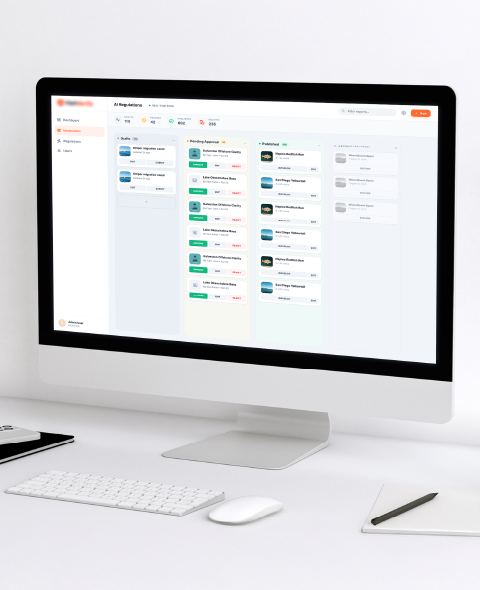
- Created an AI Knowledge Base within the admin console to collect and organize AI-generated outputs and activity logs, and enabled AI Agents to flag new regulations under the AI Regulations tab for full traceability.
- Implemented human-in-the-loop techniques to ensure accuracy and created features for admins to review or edit AI-generated regulations before publishing.
- Built a Gen AI-based workflow that enables AI Agents to generate detailed, location-based Fishing Reports weekly, stored under the AI Fishing Reports tab. Admins can review and publish these reports directly from the console.
- Created an AI Settings UI that allows non-tech admins to create, configure, and control AI Agents for Regulations and Fishing Reports generation. They can select fishing regions, AI models, schedules, prompts, and parameters to fully manage automation.
Benefits
- Automated regulation tracking and generation reduced manual effort by nearly 85%, minimizing errors and ensuring faster updates across all regions.
- Enabled 10x faster regulation updates, keeping the app database continuously current and reliable.
- The new AI-driven Fishing Reports feature boosted app engagement by nearly 2x, adding tangible value for users.
- Reduced dependency on engineering support, cutting operational overhead by about 30% through a self-managed automation system.
Technology
- Python
- Angular
- OpenAI APIs
Industry
- Fishing
Conclusion
TenUp built an AI-driven automation solution to manage rapidly changing fishing regulations at scale while introducing a reliable Fishing Reports capability for users. By deploying region-specific AI Agents with human-in-the-loop controls, the platform continuously tracks, analyzes, and updates regulatory data with full visibility and traceability. This reduced manual effort and dependency on engineering teams, while ensuring regulations remained accurate and timely across multiple geographies. The AI-generated Fishing Reports improved trip planning and engagement for anglers by delivering location-specific insights directly within the app. The solution established a scalable foundation for AI agent-based automation and content generation, aligned with a reliable AI solution for consumer-facing applications.
Frequently asked questions
What does “AI for fishing regulations & reports” actually mean in practical terms?

AI for fishing regulations and reports uses automation, computer vision, and data analytics to track rule changes, detect illegal fishing, and generate real-time compliance reports. It reduces manual effort by 85%, ensures accurate, up-to-date regulation data, and helps both regulators and fishers make faster, smarter, and more sustainable decisions.
How can automating fishing regulations reduce manual effort by ~85%?
Automating fishing regulations reduces manual effort by up to 85% through AI-driven data collection, real-time monitoring, and automatic report generation. Instead of manually tracking rules or vessel activity, AI systems analyze data, flag updates, and generate reports instantly, cutting repetitive work, minimizing errors, and freeing teams for higher-value decision-making.
Why are fishing regulation updates 10× faster with AI-powered systems?
Fishing regulation updates are 10× faster with AI-powered systems because automation replaces manual data checks. AI continuously monitors rule changes, analyzes vessel and environmental data in real time, and automatically flags updates, eliminating delays from human review and keeping regulations accurate, current, and instantly actionable across all regions.
What key challenges does a fishing‐app company face when managing thousands of regulation entries manually?
Manually managing thousands of fishing regulations leads to frequent data errors, high operational costs, and poor scalability. Continuous rule changes make updates slow and inconsistent, while manual entry limits accuracy and speed. As the app expands across regions, maintaining real-time, reliable data becomes nearly impossible without AI automation.
What role does “human-in-the‐loop” play in ensuring accuracy of AI-generated fishing regulations and reports?
Human-in-the-loop ensures AI-generated fishing regulations remain accurate, ethical, and transparent. Experts review, validate, and refine AI outputs, correcting edge cases, reducing bias, and maintaining legal compliance. This hybrid approach combines AI speed with human judgment, building trust and accountability while ensuring every regulation update is reliable and contextually sound.
How can region-specific AI agents help scale fishing regulation automation across multiple geographies?
Region-specific AI agents scale fishing regulation automation by adapting to local laws, ecosystems, and data sources. They analyze region-specific patterns, flag violations, and generate localized reports in real time. This modular, adaptive approach enables consistent accuracy and faster enforcement across diverse geographies without rebuilding systems for each region.
What metrics should companies track when implementing AI automation for fishing regulations and reporting?
Companies should track metrics that measure compliance accuracy, operational efficiency, and sustainability impact. Key indicators include reduction in manual effort, faster update cycles, lower operational costs, and improved data accuracy. Together, these metrics show how effectively AI automation enhances regulatory reliability and long-term environmental performance.
Get this Case Study
Thank You for Downloading!

Contact Us with Any Questions.