

AI Watchlist Screening Software for Enhanced Financial Compliance
<1%
False Positives5M+
Records/Day Processed100%
Watchlist Data Freshness
Customer Overview
Our client is a US-based FinTech development company focused on building solutions for financial institutions. These institutions must follow strict Anti-Money Laundering (AML) regulations and ensure their customers, both individuals and entities, are not linked to financial crimes such as terrorist financing, fraud, narcotics trafficking, or other illicit activity. Non-compliance exposes them to heavy fines, loss of licenses, legal action, and long-term reputational damage. To avoid these risks, continuous monitoring and strong internal controls are essential. However, manual workflows and outdated systems are slow, error-prone, and unable to keep up with the volume and frequency of checks required today. To help financial institutions address this challenge, our client aimed to build an automated watchlist screening software.
Project Overview
The client partnered with TenUp to build a Watchlist Screening Software that supports multiple AML compliance use cases, including initial and recurring KYC verification, transaction monitoring and verification, risk profiling and management, routine or enhanced due diligence, and Suspicious Transaction Reporting (STR). The system needed to match both individual and entity customers’ risk profiles and transactions against global watchlists in real time or through scheduled batches. It also needed to process customer data against continuously updated lists, such as OFAC/OSFI sanction lists, Politically Exposed Person (PEP) and Financially Exposed Person (FEP) lists, other official watchlists (e.g., Interpol), and country-, region-, and institution-specific lists. The goal was to help financial institutions detect AML red flags more accurately, reduce false alerts, and minimize manual workload, ultimately strengthening regulatory compliance and enabling faster, more confident decision-making.
Challenges
Building a Watchlist Screening Software that delivers fast, reliable AML red flag results for individual/entity customers across diverse use cases, while keeping false alerts low and supporting both real-time and batch processing.
- Developing a solution that processes high volumes of customer data, for both individuals and entities, matches them with watchlist entries in real-time or batch schedules, and generates accurate AML red flags.
- Minimizing false positives and negatives arising from redundant or missed AML red flag alerts to reduce compliance workload and risk exposure for financial institutions.
- Maintaining data freshness by updating all watchlists before every screening and match analysis cycle, in line with frequent updates from global and regional authorities.
- Supporting diverse compliance workflows, from KYC verification to enhanced due diligence and STR reporting, with configurable search scopes by geography and risk category.
- Enabling easy deployment across financial institutions of varying technical maturity through seamless compatibility with both legacy and modern infrastructures.
Solution
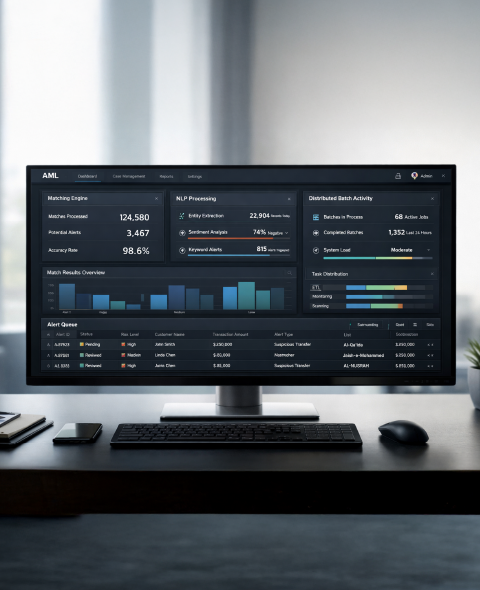
TenUp developed an AI-powered Watchlist Screening Software by building an advanced matching algorithm, integrating an always-updated AML sanctions database, and enabling both real-time and batch processing for accurate AML red flag alert generation.
- Built a scalable, distributed system that supports both batch and real-time screening of large customer datasets with configurable processing options.
- Created a proprietary ML-driven algorithm, combining text mining, NLP, and heuristic matching, to accurately analyze customer attributes like names, aliases, contact details, dates of birth, and other relevant details against multiple watchlists, and assign a risk score.
- Incorporated fuzzy logic, phonetic matching, and Levenshtein distance–based string similarity to detect variations and near matches, significantly minimizing false positives and false negatives.
- Designed the system to work with a regularly refreshed watchlists’ database covering OFAC/OSFI, PEP, Interpol, regional, and internal lists, ensuring that every screening cycle uses the latest available data.
- Created and exposed a web service for screening workflows that could process data synchronously/asynchronously and easily integrate with other solutions for KYC verification, transaction monitoring, enhanced due diligence, and STR reporting, with customizable search scopes by geography and risk type.
- Created an event-based alert system that automatically generates cases when a customer's or transaction’s risk score exceeds the configured risk threshold, allowing compliance teams to investigate and close alerts.
Benefits
The Watchlist Screening Software enabled our client to offer a high-performance, configurable AML compliance solution that delivers measurable accuracy gains for financial institutions. The solution provided the following benefits:
- Automated multiple compliance workflows from KYC and recurring checks to due diligence and STR reporting, across both individual and entity customers.
- Reduced false positives to under 1%, significantly cutting manual review workload and helping compliance teams focus on genuine risks.
- Delivered scalable performance, processing over 5 million records daily through an optimized batch architecture or in real-time with high availability.
- Provided high configurability, enabling each institution to customize thresholds, algorithms, and internal watchlists to suit their compliance strategy and risk appetite.
Technology
- Rest API
- Heuristic Algorithm
- Distributed Batch Processing
- NLP
- Text Mining
- OpenSearch
Industry
- FinTech
Conclusion
TenUp’s Watchlist Screening Software delivers accurate, timely, and configurable AML checks that help financial institutions manage compliance obligations with greater confidence. By combining AI-driven matching, real-time and batch processing, and continuously refreshed watchlists, the system improves detection quality while keeping manual review efforts low. Its ability to integrate with both legacy and modern infrastructures ensures easy adoption, giving compliance teams a dependable foundation for KYC, due diligence, and STR workflows. With this solution, institutions can respond faster to regulatory demands and maintain a consistent, high-quality approach to monitoring financial risk.
Frequently asked questions
What makes AI-driven watchlist screening more accurate than traditional rule-based systems?

AI-driven screening is more accurate because it understands context, not just rules. Instead of relying on fixed logic, AI analyzes name variations, aliases, spelling differences, language patterns, and behavioral context to identify real matches and ignore noise. It learns from past outcomes, adapts to new risks, and uses fuzzy matching + NLP to reduce false positives dramatically, something static rule-based systems can’t do.
How does watchlist screening software deal with customers who have common names?
AI-powered screening handles common names by combining fuzzy matching, phonetic similarity, and contextual identifiers, like date of birth, nationality, and aliases, to separate real risks from look-alikes. Instead of flagging every “John Smith,” the system evaluates multiple data points and scoring signals, reducing duplicate alerts and ensuring only meaningful matches reach compliance teams.
Why do banks need real-time watchlist screening instead of batch-only processing?
Real-time screening protects banks by checking customers and transactions against the latest sanctions data before money moves. It prevents high-risk payments from being processed, reduces regulatory exposure, and catches newly sanctioned entities that batch systems might miss. Batch reviews are useful for periodic checks, but real-time screening provides the immediate, preventive controls modern compliance requires.
What is the difference between PEP screening and sanctions screening?
PEP screening identifies individuals with political influence who require higher monitoring due to elevated corruption risk, while sanctions screening checks customers against legally restricted lists that you cannot transact with. In simple terms: PEP = risk to monitor, Sanctions = entities you must not deal with.
How does AI reduce false positives in AML screening workflows?
AI reduces false positives by analyzing name variations, customer context, and behavioral patterns together, not in isolation. By using fuzzy matching, NLP, and dynamic risk scoring, AI filters out look-alike matches and low-risk activity before alerts reach analysts. This keeps noise low and helps teams focus only on genuine risks.
What types of financial institutions benefit most from automated AML screening?
Automated AML screening is most beneficial for institutions with high transaction volume or fast onboarding, like digital banks, fintech lenders, MSBs, crypto exchanges, and payment platforms. These organizations rely on automation to reduce false positives, speed up due diligence, and stay compliant without expanding compliance teams.
How does watchlist screening integrate with KYC and transaction monitoring systems?
Watchlist screening plugs into KYC and transaction monitoring via APIs that trigger checks during onboarding and every transaction. KYC screens new customers against sanctions and PEP lists, while transaction monitoring re-screens activity in real time. Together, they create an automated, continuous compliance loop that blocks high-risk activity early.
What should small or mid-size financial institutions look for when choosing AML screening software?
Small and mid-size institutions should choose AML software that delivers high accuracy with low false positives, offers flexible APIs for easy integration, supports both real-time and batch screening, and updates watchlists automatically. Scalable pricing, customizable risk scoring, and a simple case-management workflow are also essential so smaller teams can stay compliant without adding extra staff.
Get this Case Study
Thank You for Downloading!

Contact Us with Any Questions.