

ML-Driven Forecast Matching for a Global Supply Chain Platform
70,000+
Historical Records Analyzed3-Stage
Matching Engine~85%
False Alerts Eliminated
Customer Overview
Our client is a global supply chain management software provider serving process manufacturers and their component suppliers. The platform enables suppliers to manage downstream operations such as order management and fulfillment based on long-term component forecasts shared through EDI systems. Manufacturers frequently revise requirements closer to shipment dates, requiring the platform to continuously update forecasts and notify all trading partners. As transaction volumes and partner networks expanded, managing forecast updates accurately while maintaining clear communication across buyers and suppliers became increasingly complex.
Project Overview
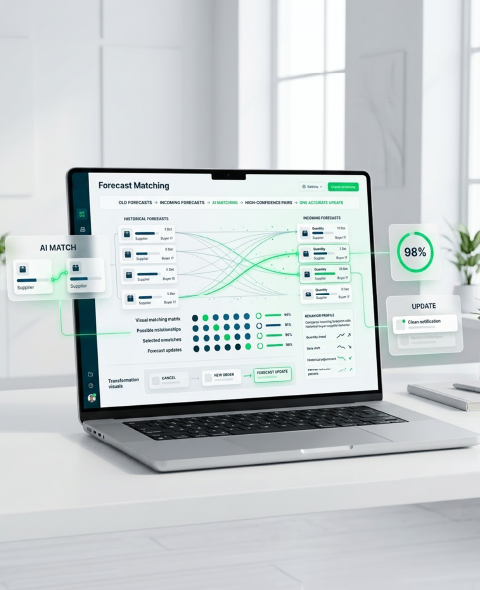
The client aimed to build an intelligent mechanism to distinguish forecast updates from actual order cancellations or new orders. The existing system treated every revised forecast as a cancellation followed by a new order, creating confusion and excessive notifications across the supply chain. They partnered with TenUp Software Services to develop a smart matching solution that compares historical and incoming forecasts to determine true intent, ensuring accurate updates while maintaining reliability and scalability within existing supply chain workflows.
Challenges
Maintaining forecast revision accuracy and notification reliability across high-volume supply chain forecasting workflows spanning hundreds of trading partners.
- Forecast revisions were misclassified as cancellations followed by new orders, regardless of actual buyer intent, generating inaccurate transactional signals across the platform.
- Buyers and suppliers received false cancellation and creation notifications, causing confusion and leading to duplicate orders, demand inconsistencies, and eroded trust in platform alerts.
- As trading partner networks and transaction volumes scaled, the volume of misclassified events and manual corrections grew proportionally, with no automated reconciliation layer to contain it.
Solution
TenUp integrated a Smart Match API into the platform's EDI workflow to accurately classify forecast revisions, cancellations, and new orders at scale.
- Developed a Smart Match API as a three-stage engine: offline behavioral profiling, model training, and online execution, combining ML-based probability scoring and optimal assignment logic.
- In the offline behavioral profiling stage, we built a look-up table from 70,000+ forecast records across 1,100+ buyers and 600+ suppliers, capturing partner-specific adjustment patterns as the foundation for model training and online matching.
- Structured behavioral profiles at three levels of granularity: buyer-product-lane, buyer-supplier, and global default, ensuring accurate matching for new trading relationships with limited transaction history.
- In the model training stage, we trained an XGBoost classifier on the profiled dataset, engineering 22+ behavioral features including directional shift statistics, buyer-specific quantity change patterns, and normalized behavioral ratios against historical baselines.
- Generated per-forecast comparison signals, like shipment date proximity, quantity variance, and partner-specific adjustment patterns, to produce a complete buyer-supplier-product-lane matching matrix as model input.
- Applied a Hungarian and an advanced custom-built ML algorithm within the matching engine to optimally assign matches between incoming and existing forecasts, maximizing accuracy across high-volume datasets.
- Introduced confidence thresholds so only high-probability matches triggered update classifications, with ambiguous cases defaulting to cancellations or new orders to preserve transactional integrity.
- Integrated the Smart Match API into the platform's existing EDI workflow without disrupting transaction flows, enabling automated forecast reconciliation at scale.
- Updated notification logic to align platform alerts with actual supply chain activity, replacing false cancellation and creation signals with accurate update notifications.
Benefits
TenUp's Smart Match API brought measurable accuracy and reliability to supply chain forecasting operations across a large trading network.
- Reduced false cancellation notifications by ~85%, correctly classifying forecast revisions across buyer–supplier workflows.
- Cut duplicate forecast incidents by ~70% during deployment, ensuring trading partners received accurate demand signals.
- Replaced two-notification cancel-and-create pairs with a single notification, reducing per-revision alert volume by 50%.
- Cut manual verification interventions by ~60% post-deployment, strengthening trading partners’ trust in notifications.
Technology
- XGBoost
- Scikit-Learn
- Pandas
- FastAPI
- AWS Sagemaker
- AWS Lambda
Industry
- Supply Chain & Logistics
Conclusion
TenUp built the Smart Match API as a three-stage engine: offline behavioral profiling, model training, and online execution, to solve a fundamental misclassification problem generating false cancellation signals across large trading networks. By combining ML-based probability scoring with optimal assignment logic, the system accurately distinguishes routine forecast revisions from genuine transactional changes without disrupting existing EDI workflows. The client's platform can now manage high-volume supply chain forecasting activity across hundreds of buyers and suppliers with accuracy and operational confidence.
Frequently asked questions
What is the difference between a forecast update and an order cancellation in supply chain management?

A forecast update adjusts expected demand or delivery timing without canceling the underlying relationship. An order cancellation removes a confirmed commitment entirely. The distinction matters in EDI workflows—misclassification creates duplicate signals, disrupts planning, and reduces data reliability, so systems must accurately differentiate predictive changes from transactional reversals.
What are EDI systems in supply chain management and what are their limitations for modern forecast management?
EDI (Electronic Data Interchange) systems exchange standardized supply chain documents (orders, forecasts, ASNs) between partners automatically. However, they’re transaction-focused and lack context awareness—treating each update as a new event. This limits real-time forecasting, often misclassifying revisions as cancellations, requiring additional matching or intelligence layers for accurate interpretation.
How does behavioral profiling improve machine learning accuracy in supply chain forecasting?
Behavioral profiling improves ML forecasting by learning how each buyer–supplier pair typically adjusts forecasts: frequency, magnitude, and timing. These patterns become features that help models distinguish routine revisions from true demand changes or cancellations, reducing misclassification and significantly increasing forecast accuracy versus models trained only on aggregated historical data.
What causes duplicate orders in supply chain platforms and how can they be prevented?
Duplicate orders arise from misclassified forecast revisions, EDI/API retries, system latency, and missing deduplication controls. Prevention requires idempotency checks, intelligent matching to distinguish updates vs. new orders, and real-time reconciliation against existing commitments—ensuring the same demand signal isn’t processed multiple times.
How do confidence thresholds work in ML-based supply chain decision systems?
Confidence thresholds set the minimum probability required for an ML prediction to trigger automatic action. In supply chains, high-confidence outputs are executed (e.g., classifying a forecast update), while low-confidence cases are routed to fallback logic or human review—balancing automation speed with risk control and preventing errors from uncertain predictions.
How can supply chain platforms scale ML-based matching without disrupting existing workflows?
Scale ML matching by inserting a lightweight API layer between EDI ingestion and order systems. It intercepts events, applies matching logic, and returns decisions without altering core workflows. Using serverless scaling and versioned models enables independent updates, testing, and rollout—ensuring high-volume processing without disrupting existing operations.
Get this Case Study
Thank You for Downloading!

Contact Us with Any Questions.