

Building a News Aggregator for Real-Time Intelligence and AML Compliance
20K+
Global News Sources1 Hour
Content Extraction Window3 Hours
Full Refresh Cycle
Customer Overview
The client is a US-based FinTech development company building compliance and risk management solutions for banks and financial institutions operating under AML regulations. They partnered with TenUp to build an AI-driven watchlist screening platform supporting KYC verification, transaction screening, ongoing monitoring, and STR investigations for individual and entity customers. The platform helps financial institutions ensure customers are not linked to crimes, like fraud and other illicit activities, and operates under compliance standards set by FATF, OFAC, FinCEN, the UN Security Council, and EU AMLD regulatory frameworks.
Project Overview
To strengthen the watchlist screening platform's utility, the client needed an adverse media intelligence layer feeding selected news into its AML risk intelligence database to support bank compliance decisions. Additionally, they wanted a news feature on their application and website to provide users with real-time global information as a value-added service. The client engaged TenUp to build a news aggregator serving both purposes: enriching the user experience with real-time news and closing the adverse media gap in AML screening workflows.
Challenges
Building a news aggregator to serve both end users and AML compliance workflows required solving distinct engineering problems at scale.
- Aggregating feeds from over 20,000 global news sources across the US, Canada, UK, and Europe, spanning inconsistent structures, formats, and update frequencies.
- Discovering new RSS feed URLs continuously across thousands of news sites, even as source structures and page rendering changed frequently.
- Extracting clean article content from full news pages at scale while preserving accurate, readable text for downstream processing and compliance review.
- Ensuring continuous data collection without interruption from anti-scraping controls on news publishers.
- Surfacing related news stories from different outlets covering the same event as a unified view, even when headlines, writing styles, and publication times vary.
- Completing content extraction within a one-hour window to sustain a three-hour refresh cycle, keeping news current.
- Ensuring the AML risk intelligence database receives only compliance-relevant news to support KYC, re-KYC, and ongoing customer due diligence.
Solution
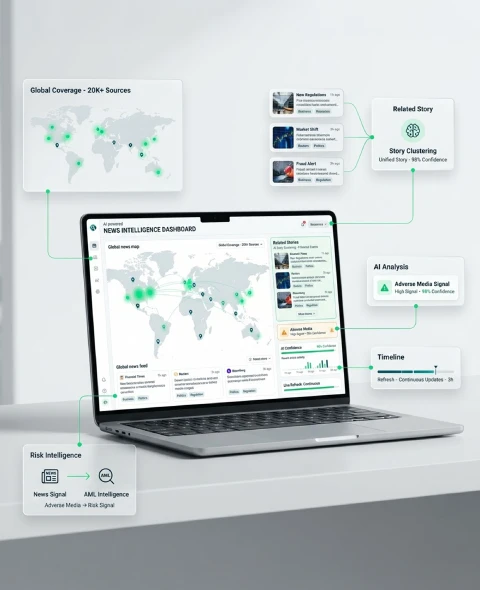
TenUp built a dual-purpose news aggregator solving engineering problems across source discovery, content extraction, clustering, and adverse media routing at scale.
- Deployed Apache Nutch to crawl thousands of news sites and continuously discover new RSS feed URLs.
- Built a proxy management layer to maintain uninterrupted data collection against anti-scraping controls on news publishers.
- Ingested RSS feeds from over 20,000 global sources using Kafka for high-throughput message streaming.
- Processed raw feed data at scale using Apache Spark, enabling parallel extraction to complete content extraction within a one-hour window and sustain a three-hour refresh cycle.
- Applied a rules-based parser layer to extract clean article content from full news pages, removing ads, navigation elements, and boilerplate.
- Applied similarity heuristics to group related news stories from different outlets into a unified view across politics, finance, crime, business, and other categories.
- Stored raw and processed news article content in S3, with structured metadata maintained in SQL Server.
- Indexed processed news content in OpenSearch to support search and retrieval for both the user-facing feature and compliance workflows.
- Applied keyword matching and rules-based filtering to identify compliance-relevant news and route it into the AML risk intelligence database.
- Deployed the news aggregator platform on Docker containers.
Benefits
- Expanded the platform's utility by delivering real-time news across politics, finance, crime, business, and other categories to end users.
- Ensured continuous adverse media coverage across thousands of sources, supporting customer onboarding and ongoing due diligence decisions.
- Ensured only compliance-relevant news reached the AML risk intelligence database, improving signal accuracy for downstream screening.
- Sustained a three-hour refresh cycle across all sources, ensuring both end users and compliance workflows always had current news.
Technology
- Apache Nutch
- Kafka
- Apache Spark
- OpenSearch
- SQL Server
- S3
- Docker
Industry
- Fintech
Conclusion
TenUp built a dual-purpose news aggregator ingesting from over 20,000 global sources on a three-hour refresh cycle, delivering categorized real-time news to end users while feeding curated adverse media into the client's AML risk intelligence database. Compliance teams conducting KYC, re-KYC, transaction screening, and ongoing customer due diligence rely on a continuously refreshed, signal-accurate adverse media layer. The client now operates a more complete AML platform with a news experience feature that extends its utility beyond compliance.
Frequently asked questions
What is a news aggregator platform, and how does it work?

A news aggregator platform automatically collects news from multiple publishers, RSS feeds, and websites, then organizes, deduplicates, categorizes, and indexes it into a single searchable interface. It uses web crawlers, feed ingestion, and content processing to deliver real-time news for applications such as market intelligence, compliance, and research.
Why do banks and financial institutions use news aggregators for AML compliance?
Banks and financial institutions use news aggregators to identify adverse media linked to customers, helping detect financial crime, fraud, sanctions exposure, corruption, and other AML risks. This supports KYC, customer due diligence (CDD), enhanced due diligence (EDD), transaction monitoring, and ongoing risk assessments with timely, evidence-based intelligence beyond traditional watchlists.
What challenges arise when aggregating news from thousands of global sources?
Aggregating news from thousands of sources requires continuously discovering new feeds, handling inconsistent formats, extracting clean content, removing duplicate stories, overcoming anti-scraping measures, and processing large data volumes. Maintaining scalability, data quality, low latency, and reliable refresh cycles becomes increasingly challenging as source coverage grows.
What technologies are commonly used to build a scalable news aggregation platform?
Scalable news aggregation platforms use web crawlers, message streaming, parallel data processing, search indexing, cloud storage, and containerized deployment. Common technologies include Apache Nutch, Kafka, Apache Spark, OpenSearch or Elasticsearch, object storage, and Docker or Kubernetes to collect, process, index, and deliver real-time news efficiently.
How often should a real-time news aggregation platform refresh its content?
A real-time news aggregation platform should refresh content based on business requirements and source update frequency. High-priority applications, such as AML compliance, financial intelligence, and cybersecurity, often run refresh cycles in the one- to three-hour range or faster, depending on risk appetite, data providers, and system capacity.
What is adverse media screening, and why is it important for AML programs?
Adverse media screening identifies publicly available news linking individuals or organizations to financial crime, fraud, corruption, sanctions, or other AML risks. It helps financial institutions strengthen customer due diligence, enhanced due diligence (EDD), ongoing monitoring, and risk assessments by identifying potential concerns beyond sanctions and watchlists.
What factors improve the accuracy of a news aggregation platform?
News aggregation accuracy depends on reliable source discovery, clean content extraction, metadata normalization, duplicate detection, entity recognition, and relevance filtering. Continuous quality monitoring helps reduce false positives, improve search results, and ensure users receive accurate, up-to-date, and contextually relevant news.
What should businesses consider before building a custom news aggregation platform?
Before building a custom news aggregation platform, businesses should evaluate source coverage, content licensing, refresh frequency, scalability, search capabilities, duplicate detection, compliance requirements, multilingual support, infrastructure costs, and integration with existing systems. Defining these requirements early improves performance, maintainability, and long-term scalability.
Get this Case Study
Thank You for Downloading!

Contact Us with Any Questions.