

Building a Unified Digital Ecosystem for Fine Art Logistics
70%+
Reporting delays reduced50%
Insurance disputes decreased25%
Workforce efficiency improved
Customer Overview
Our client is a premium logistics company specializing in the movement and storage of fine art and collectibles across all sizes and mediums, supported by a purpose-built fine art logistics software ecosystem. They work with museums, galleries, collectors, auctioneers, and interior designers, offering comprehensive services that include crating, packing, transportation, delivery, and installation. Each artwork demands specialized handling, precision packing, and secure transport to maintain its condition and value — requirements that generic logistics systems cannot adequately support without dedicated art logistics management software. The company also provides dedicated storage facilities for high-value and climate-sensitive items. Their operations span across the UK, the US, and Europe, including both local and international moves.
Project Overview
To manage high-value and sensitive artworks, while mitigating risk, our client needed control over every step of the logistics process, from pickup and packing to storage and delivery —through a centralized fine art logistics software platform. However, their operations relied on manual coordination, paper-based records, and fragmented communication between field teams and managers, limiting real-time visibility and accountability across fine art movements. They needed full visibility for managers to track on-ground activity, manage crews, and ensure timely, high-quality job completion, along with a 360-degree digital view of items collected and delivered through a secure artwork tracking system. To bring efficiency, transparency, and accountability across their fine art logistics operations, they approached TenUp to design a scalable and reliable digital system.
Challenges
The client’s fine-art logistics operations faced many inefficiencies, leading to delays, accountability gaps, and reduced service quality.
- Manual, paper-based processes led to delays, inconsistent documentation, and frequent rework, making it difficult to scale fine art logistics operations securely.
- Managers lacked real-time visibility into item movement and crew activity, limiting progress tracking, proactive issue resolution, and customer response during fine art transportation. Poor time and resource tracking caused inefficiencies and wage calculation issues.
- Condition reports were often incomplete, leading to higher insurance claims and disputes over damage responsibility.
- Lack of proof of work or a verifiable digital audit trail made it difficult to validate how, when, and by whom sensitive items were handled.
- Communication between managers and on-ground teams was fragmented, causing missed instructions and quality lapses in specialized handling.
- Customers using storage facilities had no visibility into their stored items and relied on paper records or manager communication for updates. Moving or item access requests were handled offline, adding delays and manual effort.
- Customers got no real-time status updates of their items during moves or installations, reducing trust and weakening the premium experience expected from a fine art logistics provider.
Solution
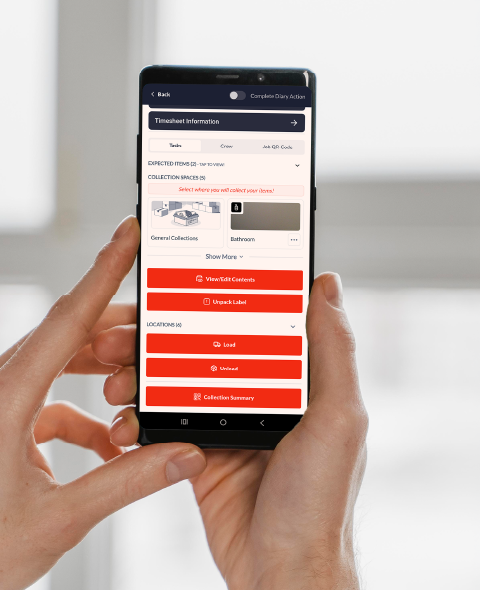
TenUp built an integrated fine art logistics software ecosystem, combining a web portal for managers and customers with a mobile app for field crews, ensuring real-time data flow across every stage of fine-art logistics.
- Built a web portal that fetches data from the third-party system used by managers to assign jobs to crew and updates the manager’s dashboard with all scheduled jobs.
- Developed a mobile app that pulls job and special handling details from the third-party system via API and enables crews to perform tasks digitally, while capturing all activities (packing, unpacking, loading, unloading) to generate logs and audit trails.
- Enabled a communication module in the mobile app, allowing crew members to share real-time in-transit and on-the-job updates with customers and managers.
- Enabled end-to-end artwork traceability using unique QR codes across artworks, packaging boxes, transport vehicles, and warehouse handovers, delivering real-time location tracking and a verifiable audit trail.
- Integrated Gen AI and Vision AI into the mobile app to help crew members capture item images and generate AI-powered condition reports, ensuring precise documentation and significantly reducing insurance claim risk.
- Generated proof of work by digitizing the customer review form in the mobile app, enabling crews to capture digital sign-off and feedback after completing a job, and integrating photos, signatures, and timestamps into the manager’s dashboard.
- Built job summaries in the web portal to update managers and customers on job progress, items collected, special handling details, and pending pickups. Managers also got task durations and time spent per job updates for wage calculation.
- Digitized warehouse handover forms in the mobile app, ensuring smooth coordination and transparency between logistics and warehouse teams.
- Enabled a digital storage view in the web portal for customers to access item images, details, and condition reports, and submit digital requests for tasks such as moves, temporary installations, or returns after display.
Benefits
- Cut reporting delays by over 70% by enabling real-time visibility into field operations through centralized fine art logistics software dashboards.
- Insurance disputes dropped by nearly 50% with AI-driven condition reports, digital proof of work, and verifiable handling records.
- Automated crew tracking improved resource utilization, driving ~25% higher workforce efficiency.
- Customer trust strengthened through transparent fine-art logistics updates and verifiable records.
Technology
- Flutter
- Realm
- OpenAI
- Claude 3.5
- MongoDB
- Firebase Analytics
- Amazon Redshift
- Amazon S3
- Amazon Recognition
- Amazon SQS
- Amazon Lambda
- Tableau
- MySQL
- OpenSearch
- Java & JVM Frameworks
Industry
- Logistics
Conclusion
TenUp delivered an integrated fine art logistics software platform that gave the client full operational control and real-time visibility across the entire fine-art logistics lifecycle, from pickup and handling to storage and delivery. The platform replaced fragmented, paper-based workflows with digital crew management, item traceability, AI-driven condition documentation, and verified proof of work, ensuring accountability at every handoff. By centralizing operations and enabling transparent customer access to item status, records, and requests, the fine art logistics software strengthened service reliability, reduced operational risk, and supported premium delivery standards at scale.
Frequently asked questions
What is fine art logistics software, and how is it different from standard logistics software?

Fine art logistics software is a specialized digital platform for managing the handling, transport, storage, and documentation of high-value and fragile artworks. Unlike standard logistics software, it is built for irreplaceable items and focuses on condition reporting, chain-of-custody tracking, audit trails, and insurance-ready proof of handling rather than speed or volume.
How does fine art logistics software reduce insurance claims and disputes?
Fine art logistics software reduces insurance claims and disputes by creating a verifiable digital record of an artwork’s condition and handling at every stage. AI-assisted condition reports, time-stamped images, custody logs, and digital sign-offs clearly establish when and how an item was handled, minimizing ambiguity and disputes over damage responsibility.
Can fine art logistics software track artworks in real time during transport and storage?
Yes. Fine art logistics software can track artworks in real time throughout transport, storage, and installation using unique identifiers such as QR codes across items, crates, vehicles, and warehouses. This provides continuous visibility into an artwork’s location, handling status, and custody history for logistics teams, managers, and customers.
What role does AI play in fine art logistics software?
AI in fine art logistics software is primarily used to automate and standardize condition documentation, validate handling data, and reduce human error. Vision AI generates consistent, image-based condition reports, while Gen AI structures logs and records, improving accuracy, traceability, and insurance readiness across art transport and storage.
How does fine art logistics software improve transparency for customers?
Fine art logistics software improves customer transparency by giving clients real-time visibility into artwork location, handling status, and condition records through a secure digital portal. Customers can view images, reports, and updates, and submit service requests digitally—removing reliance on manual communication and increasing trust.
Is fine art logistics software suitable for international art transportation?
Yes. Fine art logistics software is well suited for international art transportation because it centralizes documentation, tracks cross-border movements in real time, and maintains consistent handling and condition records across regions. This ensures compliance, reduces delays, and protects artwork integrity during global shipments.
How does fine art logistics software improve workforce efficiency?
Fine art logistics software improves workforce efficiency by digitizing job assignments, task execution, time tracking, and proof of work in one system. This reduces manual coordination, gives managers real-time insight into crew activity and task durations, and enables more accurate resource planning and wage calculation.
When should a fine art logistics company invest in custom fine art logistics software?
A fine art logistics company should invest in custom fine art logistics software when manual processes limit visibility, insurance risk increases, or premium clients require greater transparency and control. Custom software enables scalable operations, consistent handling records, and compliance while supporting high-value, complex art movements.
Get this Case Study
Thank You for Downloading!

Contact Us with Any Questions.