


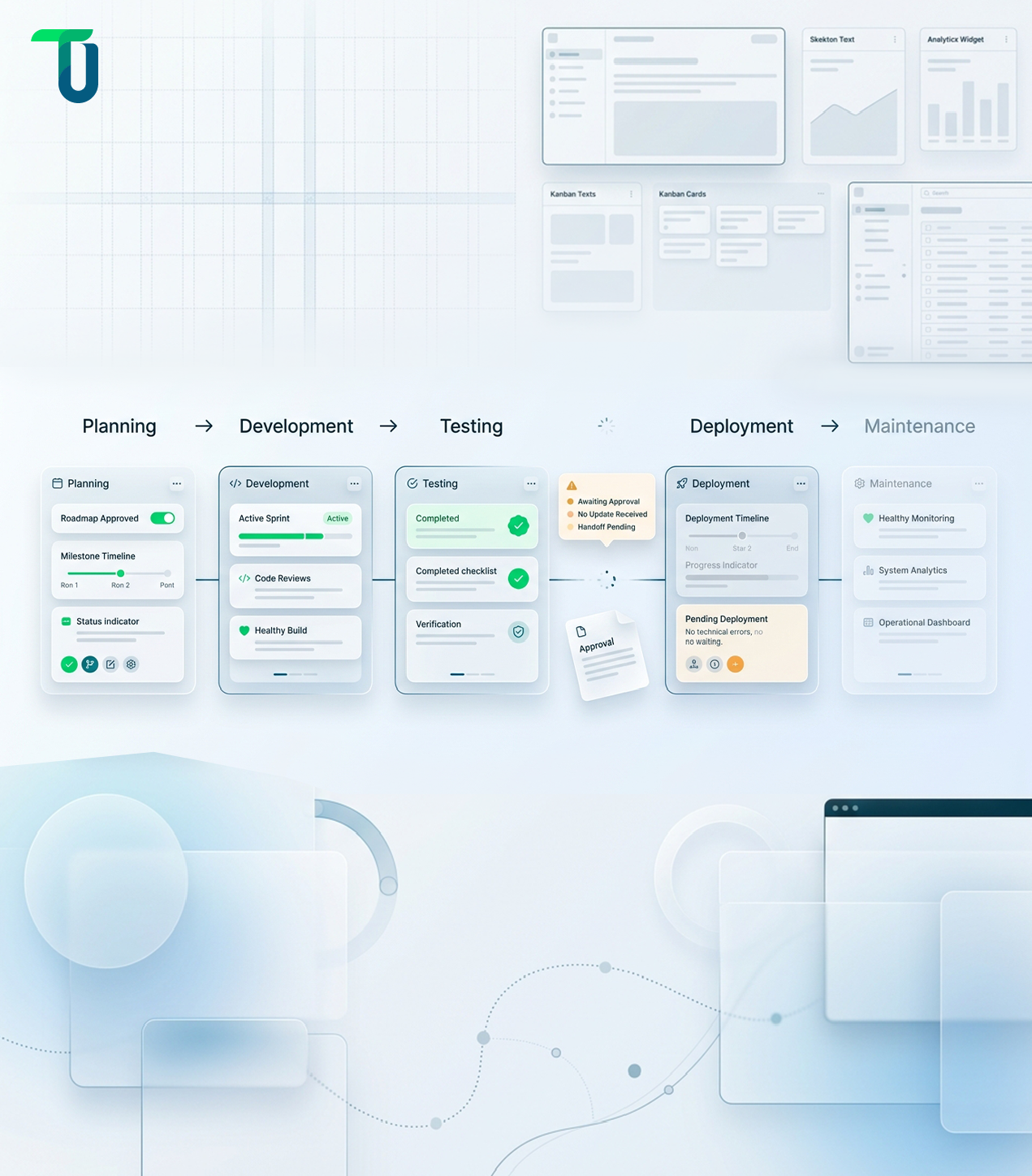
Application Lifecycle Management (ALM) failures are usually blamed on architecture, tooling, or scope. Communication receives far less attention, yet it drives a disproportionate share of ALM breakdowns across every stage.
Research on distributed software teams links communication gaps to most failed sprints. While individual productivity remains high in remote settings, GitLab’s research reveals a massive alignment gap, finding that only 37% of organizations feel they are successfully aligning work across distributed projects.
Industry responses focus on more tools, more meetings, or stronger project management. None address the structural root cause. The problem persists because communication in ALM is rarely governed. Enterprises invest in ALM platforms, Agile frameworks, and DevOps pipelines, then treat communication as a people issue instead of a governance function. The result is requirements drift, invisible defects, failed adoption, and security vulnerabilities compounding over time. This blog examines why communication breaks down across the ALM lifecycle and what high-performing enterprises do structurally to fix it.
What Is Application Lifecycle Management And Why It's More Than a Development Process
Application lifecycle management is the end-to-end governance framework for managing software from initial planning through retirement, covering requirements definition, design, development, testing, deployment, maintenance, and decommissioning. ALM governs communication, traceability, and accountability across every stage, not just development.
Three business outcomes follow directly from disciplined ALM:
- Faster release cycles through structured handoffs
- Reduced compliance risk through audit-ready traceability
- Cross-team accountability that survives personnel changes
None of these materialize when communication is treated as a soft skill rather than a governance function.
ALM vs SDLC: Why Conflating the Two Creates Post-Deployment Blind Spots
The software development lifecycle (SDLC) ends at deployment. ALM continues through maintenance, compliance audits, version governance, and application retirement. Enterprises that treat ALM as an SDLC extension over-invest in CI/CD tooling and under-invest in post-deployment governance, precisely where audit failures and production surprises originate.
The gap compounds in agile contexts. Agile application lifecycle management compresses development cycles, producing more handoffs, more stakeholder touchpoints, and more opportunities for information to drop between stages. The communication burden in agile ALM is higher than in traditional ALM. The same post-deployment governance rigor that applies to cloud engineering applies to every application touching production.
The SDLC is a method. ALM is a management discipline. Enterprises that skip ALM governance lose auditability when regulators ask for it.
The 5 Stages of Application Lifecycle Management Where Communication Breaks Down
The five stages of application lifecycle management are planning, development, testing, deployment, and maintenance. Each has a distinct communication failure mode. A blanket "improve communication" directive addresses none of them.
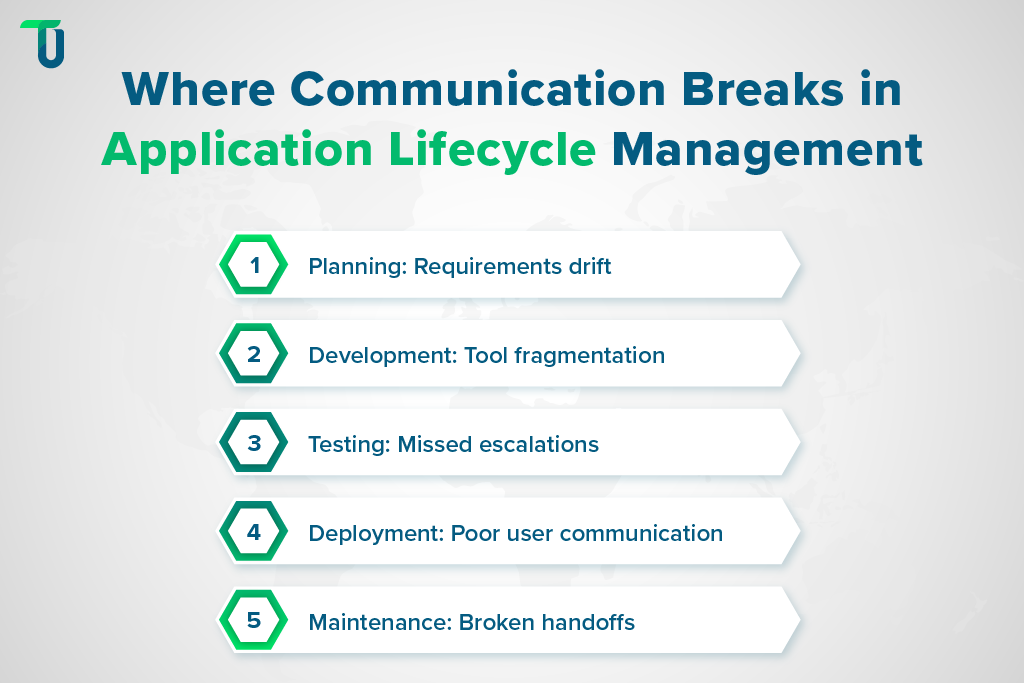
1. Planning: When Stakeholders and Developers Speak Different Languages
Business stakeholders define requirements in outcome terms. Developers interpret them in technical terms. The gap produces requirements drift before a line of code is written.
This is a vocabulary failure, not a process failure. Without a shared requirements traceability framework, sign-off does not mean alignment. Signed documents and shared understanding are not the same artifact. When developers and product owners interpret the same document differently, the ALM governance has a structural gap, not a personnel problem.
2. Development: Tool Fragmentation Creates the Illusion of Communication
Teams running Jira for tasks, Slack for discussion, Confluence for documentation, and email for approvals have four sources of truth, which means zero sources of truth.
Teams averaging five to eight disconnected tools report the highest rates of missed updates and duplicated work. Activity across those tools feels like communication. Decisions made in one tool are invisible in another. That invisibility is where delivery failures begin.
3. Testing: The Bug That Everyone Knew About
QA teams log defects. Developers triage them. The escalation path to product owners and business stakeholders is typically informal or nonexistent. Known bugs reach production because no one with authority to delay the release was formally notified.
Defect leakage is not a testing failure. It is a communication governance failure. The bug existed. The knowledge existed. The escalation path did not.
4. Deployment: No One Told the End Users
Technical deployment succeeds. Adoption fails. Change communication to end users, support teams, and downstream system owners is consistently the last item planned and the first item cut.
This is where ITSM (Information Technology Service Management) and ALM governance should intersect, and usually do not. Deployment without a stakeholder communication plan is an adoption risk, not an operational formality. Blue-green and canary strategies manage technical rollout risk. They do not manage the risk of users encountering an undocumented change.
5. Maintenance: The Handoff Black Hole
Issues identified during testing but not formally closed are handed to maintenance teams with no documented status. Maintenance teams inherit undocumented assumptions from people they may never meet.
Security vulnerabilities compound in undocumented maintenance environments. A communication gap at handoff accumulates until an audit or incident forces it into the open, at which point the cost is a compliance exposure.
Enterprises need stage-specific communication protocols built into ALM governance. General guidance and additional tools solve neither.
Communication Is a Governance Problem: Not a People Problem
The standard response to ALM communication failures is better tools or more meetings. Both miss the root cause: communication fails because it is not governed. It is assumed.
Three structural deficiencies drive most ALM communication failures, none of them fixed by a new Slack channel or a daily standup.
1. No Stakeholder Communication Plan as a Governance Artifact
Most enterprises produce a project plan, a technical architecture document, and a test plan. Almost none produce a document specifying who receives what information, at what ALM stage, in what format, through which documented channel. That absence is a governance gap.
2. No Defined Escalation Path for Defects, Blockers, or Scope Changes
When a defect surfaces in testing, the path from QA to the release decision-maker should be documented, not improvised. When it is improvised, known defects reach production.
3. No Traceability Requirement Linking Planning Decisions to Maintenance Outcomes
When a production incident occurs twelve months after a requirement was written, the trace either exists or it does not. Without it, root cause analysis is guesswork. The organization cannot determine whether the failure originated in requirements, development, testing, or deployment.
Requirements traceability is communication infrastructure. It makes information visible across all five ALM stages rather than siloed within each one. Every requirement traces to a test case, which traces to a release record, which traces to a maintenance log.
Stage gate reviews enforce the same governance function. Between each ALM stage, a formal review with defined attendees, documented outputs, and signed sign-offs structurally prevents the vocabulary gap in planning and the handoff black hole in maintenance.
One emerging gap warrants specific attention: AI-generated artifacts entering ALM pipelines without traceability. As AI tools generate code, documentation, and test cases, those outputs enter development and testing workflows without human review or traceability linkage. An AI-generated requirement that no human validated is indistinguishable from a human-authored one in the pipeline, until something fails.
TenUp's Take: AI-generated artifacts require the same review and traceability standards as human-authored ones. The governance gap is not in the AI tool. It is in ALM frameworks built before AI-generated content existed. Enterprises adopting AI-assisted software development need to update their traceability requirements before those tools reach production pipelines, not after.
Governance turns communication from a cultural aspiration into an auditable process. Enterprises that treat communication as a people problem keep applying the wrong interventions and continue to experience the same failures.
Are Communication Gaps Slowing Your ALM Program?
TenUp builds stage-specific communication governance into ALM-aligned software delivery, engineering structured governance from the start.
Why Distributed ALM Teams Fail: The Communication Variables Most Leaders Miss
Distributed teams fail because asynchronous work requires more structured communication discipline than co-located work, and most ALM frameworks were designed for the latter.
The damage concentrates at specific ALM stages, not uniformly across the lifecycle.
1. Planning: Sign-Off Without Clarification
Asynchronous requirement reviews mean stakeholder sign-off happens without real-time clarification. Ambiguities get locked into the requirements document rather than resolved. The fix requires asynchronous review protocols with mandatory clarification windows before sign-off is accepted, not just a shared glossary.
2. Testing: Defect Triage Invisible Across Timezones
Defect triage decisions made in one timezone are invisible to the deployment team in another until the deployment window has passed. A critical defect identified Tuesday morning in London may not reach the release decision-maker in San Francisco until Wednesday, after the release has gone out.
3. Maintenance: The Highest-Risk Handoff
The handing-off team and the receiving team are separated by timezone, working hours, and documentation gaps that neither fully understands. In co-located teams, informal conversation catches vocabulary mismatches before they reach a requirements document. In distributed teams, those mismatches survive across sprint cycles and compound at maintenance handoff.
When module ownership is explicitly assigned, and interfaces are clearly documented, cross-team communication failures decrease materially. Independent ownership with documented boundaries replaces informal coordination. The communication improvement is a governance outcome, not a cultural shift.
AI tools are adding a new distributed communication risk. AI-generated standup summaries, sprint reports, and documentation create the appearance of communication without the substance. Teams in different time zones consume those artifacts as authoritative without knowing what context was omitted or what decisions were paraphrased inaccurately.
The structural fix for distributed ALM communication requires three things:
- Documentation discipline enforced at every stage gate
- Escalation paths designed to function asynchronously
- Traceability requirements that do not depend on synchronous conversation to work
ALM Tools With Built-In Collaboration Features: What Enterprise CTOs Should Evaluate
The right question before selecting an ALM platform is not "which tool has the most features." It is "which stack ensures information cannot get lost between ALM stages." Those evaluations produce different vendor selections.
Three criteria should govern enterprise ALM tool decisions before any contract is signed.
1. Audit-Ready Traceability
Does the tool produce traceability linking requirements to test results to release records? Feature richness is irrelevant if governance outputs are not auditable. Enterprises operating under HIPAA, SOC 2, PCI-DSS, or ISO 27001 have no choice but to treat traceability as a non-negotiable selection criterion.
2. Integration Architecture That Eliminates Human Transfer Steps
Does the integration architecture reduce context switching, or add another silo? The question is not whether a platform has a Slack integration. It is whether the stack eliminates human transfer steps between tools. Those transfer steps are where ALM communication fails.
3. AI Roadmap With Traceable Outputs
Does the vendor's AI roadmap produce traceable, auditable outputs, or is AI being bolted onto a legacy platform as a feature release? AI that generates without traceability is a governance liability.
Integrated platforms like Azure DevOps and Jira with Confluence maintain decision traceability within a single data model. Point solutions, standalone Slack, standalone email, and standalone test management tools require human bridges between data. An integrated stack does not guarantee good governance, but a fragmented stack structurally prevents it.
By ALM stage, the tool landscape breaks down as follows:
Requirements and planning: Jira and Azure DevOps for general enterprise; Jama Software for regulated industries where traceability must meet compliance standards.
Documentation and traceability: Confluence and SharePoint, effective only when their use is mandated, not optional.
Real-time communication: Slack and Microsoft Teams for daily coordination, with one non-negotiable caveat: real-time tools must feed into a documented record. A Slack message resolving a requirements ambiguity must become a documented requirements update.
CI/CD and deployment: GitHub Actions, Jenkins, and Azure Pipelines automate delivery. They do not automate communication about what changed, to whom, or why. That remains a governance responsibility.
Regulated and on-premises: IBM Engineering Lifecycle Management and OpenText ALM for industries where data sovereignty and compliance require on-premises control that cloud-native platforms need custom configuration to replicate.
Cloud-based ALM platforms now dominate enterprise procurement. The governance advantage over on-premises is specific: continuous, version-controlled audit trails accessible across distributed teams in real time, a capability that requires significant custom engineering to replicate on-premises.
What makes an ALM tool enterprise-grade is audit trail depth and cross-stage traceability, not feature count. A platform with two hundred features and no requirements-to-release traceability is a point solution with a marketing budget.
Application Lifecycle Management Best Practices: What High-Performing Enterprises Do Differently
The three measurable benefits of a disciplined ALM strategy are faster release cycles through structured handoffs, lower compliance risk through audit-ready traceability, and organizational accountability that does not depend on specific individuals. Those outcomes require specific governance practices, not general principles.
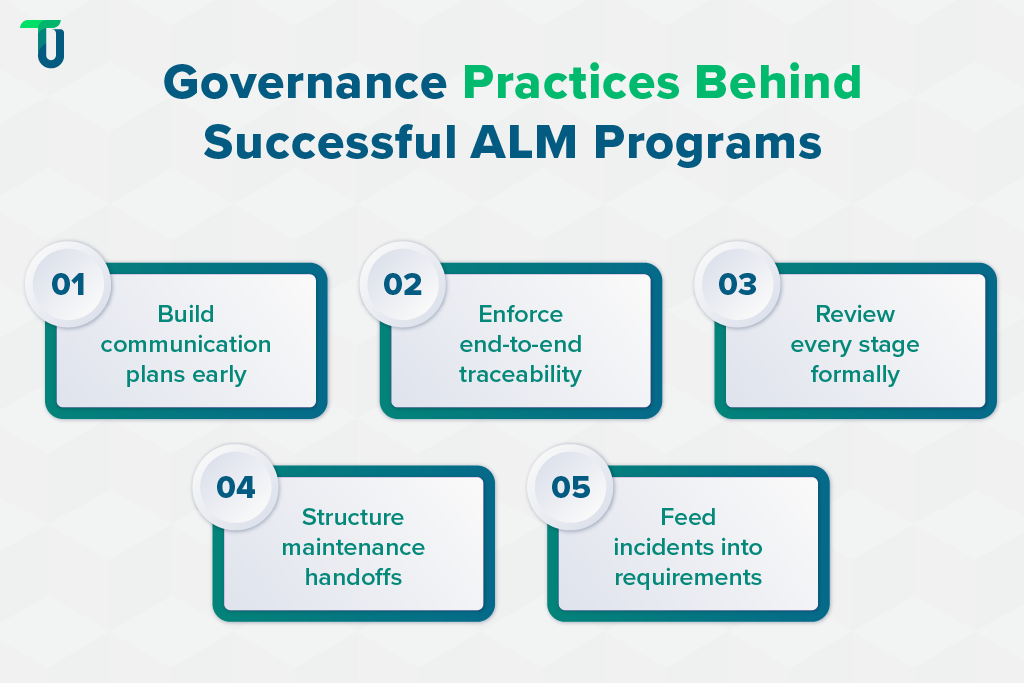
1. Build the Stakeholder Communication Plan at Kickoff
Create the stakeholder communication plan at project kickoff as a governance artifact, not at deployment as an afterthought. The plan specifies who receives what information, at what stage, in what format, through which documented channel. It is versioned, reviewed at each stage gate, and updated when scope changes.
2. Enforce Requirements Traceability Across All Five Stages
Every requirement traces to a test case, which traces to a release record, which traces to a maintenance log. When a defect appears in production, the trace either exists or the governance gap is visible. Traceability forces the escalation path into existence, structurally preventing the "known bug in production" failure described in stage three.
3. Run Stage Gate Reviews as Governance Checkpoints
Stage gate reviews are communication governance checkpoints, not project management ceremonies. A formal review between each ALM stage, with defined attendees, documented outputs, and signed sign-offs, prevents the vocabulary gap in planning and the handoff black hole in maintenance. Sign-off is not bureaucracy. It is the moment informal understanding becomes a documented commitment.
4. Treat Maintenance Onboarding as a Formal Deliverable
Before handoff, the maintenance team receives a structured briefing covering known issues, open defects with current status, deferred features with rationale, and integration dependencies with documented behavior. Source code is not a handoff. It is the artifact that handoff documentation makes interpretable.
5. Route Production Incidents Back to the Requirements Stage
High-performing ALM programs route production incidents formally back to the requirements stage. When an incident traces to a requirements ambiguity, that ambiguity is documented and the traceability requirement updated to prevent the same gap from producing the same defect in the next release cycle.
These practices separate ALM programs that scale from those that accumulate technical debt disguised as operational incidents. The difference is not talent. It is governance discipline applied consistently at every stage.
The Application Lifecycle Management Market in 2026: What Buying Decisions Look Like Now
According to Grand View Research, the global application lifecycle management market is projected to grow at a CAGR of 10.7% to USD 7.72 billion by 2030. This growth is driven by enterprises prioritizing governance, compliance, and delivery velocity simultaneously.
Point-solution ALM tools are being absorbed into broader DevOps platforms. Enterprises buying standalone ALM tools today risk a forced migration within three to five years. The consolidation is already visible:
- Microsoft has consolidated around Azure DevOps
- Atlassian has unified Jira and Confluence into a single governance and delivery platform
- GitLab has built end-to-end ALM capabilities into its DevSecOps platform
Cloud-based ALM services dominate enterprise procurement. The governance advantage over on-premises is practical: real-time, version-controlled audit trails accessible across distributed teams without custom engineering overhead, available out of the box on leading cloud platforms.
AI and ML integration into ALM is accelerating. Vendors are embedding AI for requirements analysis, defect prediction, and release risk scoring. The evaluation question is not whether a platform has AI features. It is whether those features produce traceable, auditable outputs that fit within existing governance frameworks. AI-driven requirements analysis without traceability linkage creates the same governance gap as AI-generated code without review. Evaluate vendor AI roadmaps against governance requirements, not productivity claims.
For regulated industries, including healthcare, financial services, and government, or enterprises with complex multi-system dependencies, custom ALM service implementations consistently outperform generic platforms. Governance rules encoded directly into workflow cannot be circumvented. Governance rules bolted onto a generic platform as configuration can be. When compliance is non-negotiable, the architecture of enforcement matters.
Deferring vendor evaluation is not preserving optionality. It is inheriting a migration problem that compounds with every passing procurement cycle.
Communication Governance Is the ALM Fix Enterprises Keep Skipping
Application lifecycle management failures are communication governance failures. Technology, talent, and process exist inside most enterprise ALM programs. What fails is the governance layer that makes communication auditable, traceable, and stage-specific.
Each ALM stage carries a distinct failure mode. Planning fails at vocabulary. Development fails at fragmentation. Testing fails at escalation. Deployment fails at change communication. Maintenance fails at handoff. Treating these as people problems produces people-level interventions, better hiring, more training, different team structures, none of which change the governance architecture that allowed the failure.
High-performing enterprises fix this by engineering communication governance in from the start: stakeholder communication plans as formal artifacts, requirements traceability as infrastructure, stage gate reviews as accountability checkpoints, and maintenance handoff documents as non-negotiable deliverables.
TenUp builds enterprise application lifecycle management solutions where communication protocols, requirements traceability, and governance are engineered into the delivery process. If your ALM program produces the same failures at the same stages, the governance architecture needs to change.
Build ALM Governance That Holds at Every Stage
You need a partner who starts with your current communication gaps. TenUp's ALM engagements are structured around governance architecture.
Frequently asked questions
What is application lifecycle management and how does it differ from SDLC?

Application lifecycle management (ALM) is the governance framework for managing software from initial planning through retirement. The SDLC covers the build phases: planning, development, testing, and deployment. ALM extends beyond SDLC to include post-deployment maintenance, compliance governance, version management, and application retirement. Enterprises that treat ALM as synonymous with SDLC consistently under-govern the maintenance and compliance stages.
What is the lifecycle of an application?
The lifecycle of an application spans five core stages: planning, development, testing, deployment, and maintenance, followed by decommissioning. ALM governs all five stages, ensuring requirements traceability, stakeholder communication, quality accountability, and compliance documentation at each transition. The lifecycle ends when the application no longer serves its business purpose and is formally retired with data archived or migrated.
Why do software projects fail due to miscommunication in ALM?
Software projects fail due to miscommunication in ALM because communication is assumed rather than governed. Three structural failures drive most outcomes: no formal stakeholder communication plan, no documented escalation path for defects and blockers, and no traceability requirement linking planning decisions to maintenance outcomes. Adding tools or meetings without fixing the governance structure produces the same failures on a new platform.
What are the best ALM tools with built-in collaboration features for distributed enterprise teams?
Integrated platforms outperform point solutions for distributed teams. Azure DevOps and Jira with Confluence provide unified traceability. Jama Software supports regulated industries needing compliance-grade requirements traceability. GitHub Actions, Jenkins, and Azure Pipelines automate delivery but still require governance protocols. The key criterion is eliminating human transfer steps between tools, where communication breaks down.
What does a stakeholder communication plan for application deployment include?
A stakeholder communication plan specifies who receives information at each ALM stage, in what format, through which channel, and what documented record confirms receipt. It covers end users, support teams, downstream system owners, compliance stakeholders, and the maintenance team receiving the handoff. Its absence creates a governance gap no deployment tool compensates for.
What are the benefits of implementing an ALM strategy?
Primary benefits include faster release cycles through structured stage handoffs, reduced compliance risk through audit-ready requirements traceability, and organizational accountability across teams. Secondary benefits include earlier defect detection, lower maintenance costs through structured handoff documentation, and portfolio-level visibility into application health, risk, and business value.
What should enterprises look for in an ALM service partner to avoid handoff failures?
Look for a partner that treats communication governance as an engineering function, not an advisory one. The key question is whether the partner builds stage gate reviews, traceability requirements, and stakeholder communication plans into the delivery framework. The testing-to-maintenance handoff is the most expensive ALM failure point and must be addressed structurally through documented handoff deliverables.
Share the Article


