

AI Workflow Automation through Vibe Coding and Agentic AI for a US Distributor
60%
Faster Lead Identification75%
Faster Payment Reconciliation2
Core Processes Automated
Customer Overview
Our client is a US-based distributor, partnering with a leading global manufacturer of fluid system components. They provide a wide range of high-quality products, including fittings, valves, regulators, gauges, hoses, and tubing, to meet the needs of various industries. The client observed that most of their processes across sales, accounting, and other departments were manual, resource-intensive, and time-consuming. With the intention of reducing turnaround time, minimizing manual efforts, and increasing productivity, they aimed to automate recurring and lengthy processes.
Project Overview
The goal was to automate as many processes as possible after determining the viability and value of automating them. They partnered with TenUp and jointly identified two key processes that could generate measurable value if automated — the lead generation process for their sales department and the customer payment reconciliation process for their accounting department. It was decided to automate these two processes first and use the experience to automate many more processes. The criteria were to build automated workflows quickly using a small tech team, without compromising on accuracy, reliability, or scalability.
Challenges
The client’s sales and accounting operations relied heavily on manual processes, resulting in delayed decisions, missed opportunities, and limited scalability as data volumes and business complexity grew.
- The sales team analyzed customer data, such as purchase orders, quotations, and enquiries that didn’t convert to purchase orders, along with call discussions recorded in the CRM, to identify new leads or cross-sell opportunities.
- The accounting team reconciled customer payments against bank statements and related purchase orders. For discrepancies, they contacted customers to recover shortfalls or issue refunds.
- The timeliness of data was critical for lead generation because any delay in identifying an opportunity often resulted in a lost sale.
- The manual nature of processes made them difficult to scale with company growth, as they became increasingly resource-intensive and error-prone, slowing down business cycles.
Solution
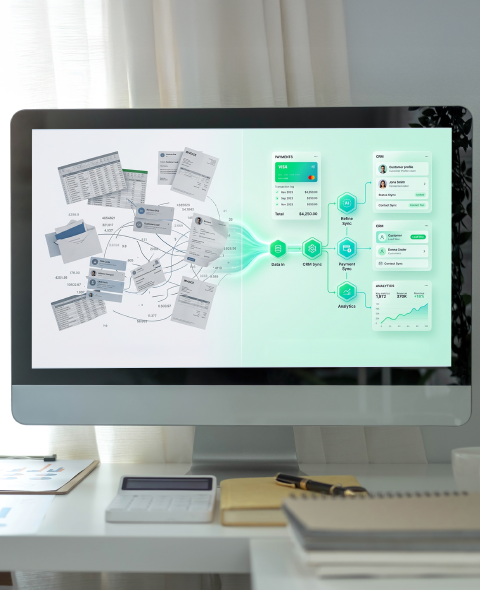
TenUp automated lead generation and payment reconciliation workflows using n8n, integrating internal and external systems with AI-assisted logic and vibe coding to drive efficiency and accuracy.
- TenUp selected the low-code automation platform n8n to build end-to-end workflows, chosen for its flexibility in integrating with multiple systems and supporting agentic AI-powered workflow execution.
- Designed a modular automation framework so that once a use case proved valuable — by improving efficiency, reducing manual effort, or enhancing accuracy — new workflows could be developed and deployed rapidly without extensive engineering involvement.
- Stored CRM call transcripts in PostgreSQL and built a product intelligence database detailing machinery parts, related components, competitor replacements, and assembly-level relationships.
- Integrated these databases, along with internal and external systems such as Salesforce, SAP, CRM, and banking applications, through a centralized automation layer implemented using n8n.
- For lead generation, designed a workflow that analyzes purchase orders, quotations, enquiries, and CRM call transcripts using product intelligence data to extract insights and understand the items or systems customers might be interested in.
- Built logic to identify dependencies — for example, if a customer purchased a specific part, the system could recommend related or complementary items. It also used conversation and purchase data to generate precise cross-sell and upsell opportunities automatically.
- For the payment reconciliation process, designed a workflow that matches payment receipts, invoices, and bank statements with related purchase orders, automatically flagging discrepancies for manual review.
- Incorporated logic to handle sales returns, part payments, miscalculated discounts, and overpayments, ensuring each mismatch was accurately classified for quick resolution.
- Leveraged vibe coding, connected through MCP servers in n8n and the Cursor tool, to automate workflow creation and testing, enabling AI-assisted logic generation, regression testing, and debugging, which significantly reduced developer effort.
- Maintained high standards of code reliability and QA, addressing the known limitations of Vibe Coding to ensure the stability of all deployed workflows in production.
- Optimized the data ingestion pipeline to minimize latency and maintain timeliness in lead generation, ensuring opportunities were surfaced and acted upon while still relevant.
Benefits
TenUp’s workflow automation solution provided the following benefits:
- Reduced manual workload across sales and accounting through end-to-end process automation.
- Improved lead conversion rates by ensuring timely identification of new and cross-sell opportunities.
- Accelerated payment reconciliation, enabling faster discrepancy resolution and improved cash flow visibility.
- Enabled rapid development of new automation workflows using a modular framework, scaling efficiency across departments.
Technology
- N8n
- Cursor
- PostgreSQL
- Claude 4.5
Industry
- Manufacturing
Conclusion
Using n8n and vibe coding, TenUp delivered AI-assisted development of automated workflows for lead generation and payment reconciliation, connecting multiple systems within a modular framework. The platform reduced manual effort, accelerated lead identification and financial reconciliation, and provided accurate, timely insights for decision-making. It also established a scalable foundation, allowing new workflows to be introduced quickly without increasing engineering overhead, improving operational efficiency and organizational responsiveness.
Frequently asked questions
How do we use AI workflow automation, and how does it improve sales and finance operations?

AI workflow automation streamlines sales and finance by handling repetitive tasks like data entry, lead analysis, and payment matching automatically. It keeps CRM and financial records updated, reduces errors, and surfaces opportunities faster so teams can focus on selling and decision-making, not manual work.
How does Agentic AI enhance workflow automation platforms like n8n?
Agentic AI adds reasoning, decision-making, and adaptive execution to n8n workflows. It lets automations understand goals, analyze context, and choose the best next steps, going beyond fixed rules to create smarter, more autonomous processes with less manual effort.
Can AI workflow automation help companies with large volumes of transactional or payment data?
Yes. AI workflow automation can process high-volume payment data to match invoices, detect discrepancies, and classify issues automatically. This reduces reconciliation time, improves cash-flow accuracy, and minimizes manual errors in large B2B transaction environments.
How does AI automation identify new leads or cross-sell opportunities automatically?
AI scans purchase history, CRM interactions, and intent signals to predict what a customer is likely to need next. It then surfaces high-probability leads and relevant cross-sell or upsell suggestions, uncovering opportunities that manual reviews often miss.
Is low-code automation with n8n reliable for enterprise-grade workflows ?
Yes. n8n is reliable for enterprise use when built with modular workflows, proper QA, and governance. It scales well, supports secure self-hosting, integrates with ERPs, CRMs, and banking systems, and when paired with Agentic AI, it offers faster debugging and more stable automation across large organizations.
What challenges do manufacturing distributors typically solve using AI workflow automation?
AI automation helps distributors eliminate manual delays by streamlining quoting, order processing, inventory updates, and payment reconciliation. It also predicts demand, surfaces product recommendations, and improves supply-chain visibility, creating faster sales cycles, fewer errors, and greater operational scalability.
Can AI workflow automation work even if legacy systems like SAP or old CRMs are involved?
Yes. AI automation can integrate with legacy systems using APIs, webhooks, database connectors, or lightweight middleware. AI then enriches these connections by interpreting data, predicting actions, and automating decisions, enabling modern automation even in mixed or outdated environments.
How does AI workflow automation reduce developer or engineering workload?
AI assists with logic building, testing, and error detection that helps generate workflows and fix issues with reduced manual effort. This lets engineering teams focus on architecture and improvements instead of repetitive development tasks, speeding up delivery and reducing bottlenecks.
Get this Case Study
Thank You for Downloading!

Contact Us with Any Questions.