




Gartner forecasts worldwide public-cloud services to grow by 21.3% in 2026, driven partly by accelerating demand for AI integration. The market is projected to reach $1.48 trillion by 2029. As SaaS products scale for a multi-region client base, organizations must design scalable architectures and cloud security solutions that can handle increasing user demand and distributed data across regions. This is a core aspect of application modernization with multi-region data support, where legacy systems are refactored or replatformed to operate efficiently and compliantly across geographies.
Scaling a SaaS product globally involves more than adding servers. Teams must address performance consistency, network latency, cross-region data replication, and regulatory compliance. Multi-region SaaS architecture enables high availability, fault tolerance, low latency, and secure data management by deploying applications across multiple cloud regions. This blog outlines the key architectural considerations and best practices, including active-active deployment, high availability, and network performance optimization, to help organizations build resilient, scalable, and compliant global SaaS platforms.
What is Multi-Region SaaS Architecture and Why Does It Matter?
Multi-Region SaaS Architecture refers to a Software-as-a-Service application hosted on cloud infrastructure and deployed across multiple global regions. Instead of operating from a single location, the application runs in several data centers worldwide. This setup improves availability, reduces latency, and supports scale.
By using a multi-region approach, businesses can serve users closer to their location while keeping the service reliable. It helps maintain data consistency, meet regional compliance needs, and reduce the impact of outages. When traffic grows or a region faces an issue, the system continues to operate smoothly. Popular platforms like Netflix and Slack use multi-region deployments to deliver fast performance and high uptime to users around the world. Global education platforms also rely on this approach to provide consistent access while following region-specific regulations.
In practice, Multi-Region SaaS Architecture involves running application instances across multiple regions within cloud and multi-cloud deployment models to support:
- Load balancing for even traffic distribution
- Failover to keep services running during regional issues
- Redundancy to minimize downtime
Application Modernization Paths
Not every application reaches multi-region the same way. While there are four modernization paths, the right one depends on how deeply the existing architecture assumes a single region.
1. Rehosting: Lift-and-Shift Into a Second Region
Rehosting moves an existing application into a new region with minimal architectural change. It can be the fastest way to establish regional redundancy, but it also carries forward the scaling, state-management, and consistency limitations of the original single-region design.
2. Replatforming: Swapping Components for Multi-Region-Native Services
Replatforming preserves most application logic while replacing region-constrained components. For example, a single-region database with services that support cross-region replication or deployment. It is often a pragmatic middle path because it can improve multi-region behavior without requiring a full rewrite. However, the application may still retain hidden single-region assumptions.
3. Refactoring: Redesigning for Distributed State
Refactoring changes the application’s internal design to handle distributed state, regional failures, and cross-region coordination explicitly. This may involve microservices, but it can also involve a modular monolith, event-driven workflows, data partitioning, or other patterns. It is usually the highest-effort path and is the most likely to remove single-region assumptions from the application layer.
4. Incremental Modernization: Migrating Service by Service
Incremental modernization applies rehosting, replatforming, or refactoring to selected services in a priority order rather than changing the entire application at once. This limits risk and lets teams validate multi-region behavior on lower-risk services before modifying revenue-critical components.
The right path depends on how much single-region behavior is embedded in the architecture and codebase, as well as the application’s recovery objectives, compliance requirements, and tolerance for consistency trade-offs, not simply on how much time is available before a customer contract requires a second region.
This design improves resilience and performance while addressing challenges such as network latency, data replication, and compliance. Common techniques like distributed databases, caching, and automated failover help ensure reliable and consistent service across all regions.
How Can Platforms Ensure Scalability and High Availability in Multi-Region SaaS Architecture?
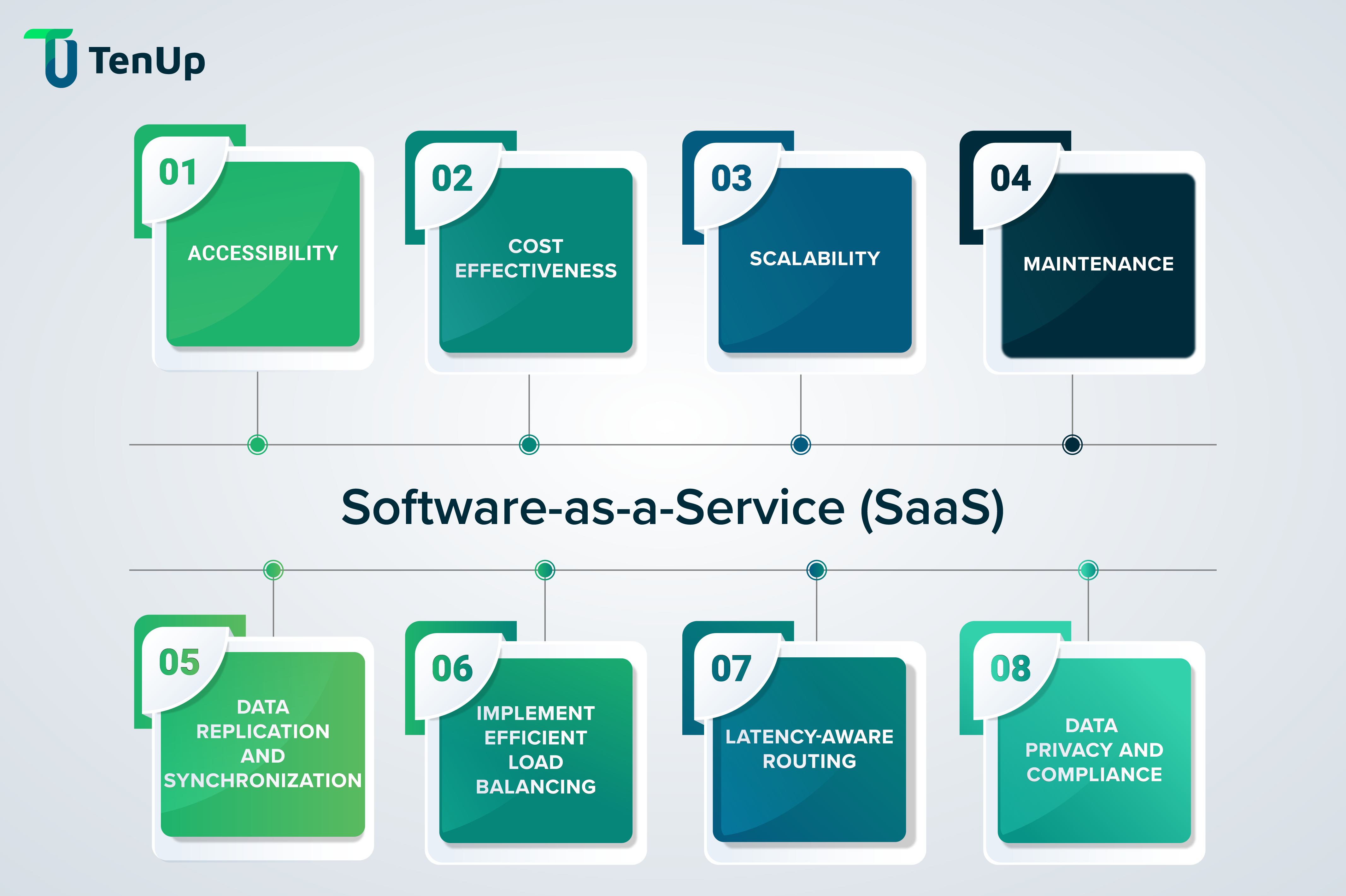
Need for Scalability
- Scalability enables applications to properly handle increasing workloads and user expectations. Explore our cloud-native microservices architecture guide to see how microservices can further improve scalability, fault isolation, and agility in cloud application development.
- Multi-region deployments serve a global user base; hence, the flexibility to expand resources across regions is required. Platforms must be built to support rapid scaling into new regions using automated provisioning, global load balancing, and multi-cloud tooling to accelerate time-to-market while controlling cost.
- Horizontal scaling, adding extra instances or nodes, is the process of sharing the workload across the application architecture.
- In a multi-region SaaS architecture, scalability also means ensuring that each region can scale independently, avoiding a single point of capacity limitation and maintaining performance consistency for global users.
Importance of High Availability:
- High availability ensures that applications are available and operational even when there are faults or disruptions.
- By distributing resources over many regions, multi-region deployments reduce the danger of a single point of failure.
- Load balancing evenly distributes incoming traffic among instances, reducing overloading and ensuring availability.
- Organizations often use DEMO active-active vs active-passive deployment strategies with failover mechanisms to achieve near-zero downtime and meet strict SLAs. Teams also support these setups with SaaS quality management tools such as SLA monitoring, synthetic checks, and automated incident playbooks to proactively maintain uptime and reliability across regions.
Load Distribution:
- To enhance resource consumption and performance, load balancing spreads user requests across multiple instances or regions.
- It reduces reaction time, avoids bottlenecks, and improves the user experience.
- For efficient load balancing, techniques such as round-robin, least connections, and latency-based routing can be used.
- Modern SaaS platforms often use global traffic managers or DNS-based load balancing to intelligently route users to the nearest or healthiest region, further improving user experience and reducing latency.
Auto-Scaling:
- Auto-scaling adapts resources dynamically based on workload demands, helping teams maintain efficiency and control spending. Explore TenUp's cloud cost optimization guide for more strategies to control costs while scaling globally.
- It ensures that the application automatically scales up or down in response to traffic changes, maximizing resource utilization and cost-effectiveness.
- When and how resources are scaled are determined by scaling policies and measurements such as CPU utilization or request count.
- Predictive auto-scaling powered by AI/ML can anticipate traffic spikes (e.g., during product launches or seasonal events), enabling proactive resource allocation and preventing downtime.
Tolerance for Errors:
- Fault tolerance ensures that systems can continue to function even when components fail.
- To reduce downtime and ensure continuous operation, redundancy, replication, and failover technologies are used.
- Multi-region deployments enable geographical redundancy, where a failure in one location can be managed by redirecting traffic to another.
- Techniques such as circuit breakers, retry policies, and eventual consistency mechanisms help prevent cascading failures and maintain seamless user experience across regions.
Disaster Relief:
- Disaster recovery is concerned with the preparation and implementation of solutions for recovering from catastrophic catastrophes.
- Backups are vital, as is data replication across regions and disaster recovery sites.
- Data replication guarantees data consistency across locations, allowing for rapid recovery in the event of data loss or infrastructure failure.
- Including automated disaster recovery drills and RTO/RPO (Recovery Time Objective / Recovery Point Objective) benchmarks ensures that recovery strategies are tested and reliable when real incidents occur.
What Multi-Region Deployment Strategy Should You Choose: Active-Active vs Active-Passive?
When designing a multi-region SaaS product, one of the most critical decisions is choosing the right deployment strategy: active-active or active-passive. This choice directly affects application availability, latency, fault tolerance, and cost.
Active-Active Deployment
Definition: All regions actively handle traffic simultaneously, sharing the load.
Benefits:
- Maximum uptime with no single point of failure
- Optimized latency for users across regions
- Seamless failover if one region fails
Challenges:
- Higher infrastructure and operational costs
- Requires careful data consistency management across regions
Use Case Example: Streaming platforms like Netflix use active-active setups to ensure uninterrupted service globally.
Active-Passive Deployment
Definition: One region serves all traffic (active), while others remain on standby (passive) until needed.
Benefits:
- Lower operational cost
- Simpler data replication and consistency management
Use Case Example: Smaller SaaS products that prioritize cost-efficiency over ultra-high availability often adopt active-passive deployment.
Challenges:
- Slight downtime during failover
- Latency may increase for users far from the active region
Key Consideration: Choosing between active-active vs active-passive deployment should balance business requirements, budget, and user experience. For enterprise-grade SaaS targeting global users, active-active deployment is usually preferred for high availability and reliability.
Migration Steps — Single Region to Multi-Region
Moving from a single region to multi-region doesn't require a full rebuild. It requires sequencing the change correctly.
1. Audit Data Dependencies Before Choosing a Second Region
Start by mapping which datasets, background jobs, and third-party integrations assume single-region latency. A payment processor call or synchronous database write that works within one region can become materially slower when it crosses long-distance network paths. Measure this latency under realistic conditions rather than assuming a fixed increase.
2. Select a Second Region Based on Compliance and Latency, Not Just Cost
The cheapest available region is not automatically the right one. Data residency requirements, user geography, and existing cloud provider footprint should decide the region before instance pricing does.
3. Bring the Second Region Online as a Replication Target First
Enable asynchronous replication into the new region without routing any live traffic to it. This isolates replication lag and consistency issues from failover risk, so the team debugs one problem at a time instead of two.
4. Test failover under production-scale conditions
A synthetic health check confirms only that the second region is reachable. Use production-like load tests, controlled failover exercises, shadow traffic, or a carefully scoped canary to verify that the region can absorb expected load and that dependent services, data stores, queues, and integrations behave correctly. Avoid directing uncontrolled customer traffic to an unproven failover path.
5. Cut over gradually using weighted or policy-based traffic routing
Shift a small, controlled percentage of traffic to the second region using DNS weighting, a global traffic manager, or another routing mechanism. Monitor error rates, latency, replication lag, data conflicts, queue behavior, and downstream dependencies before increasing the traffic share.
6. Automate rollback and repeat the exercise
Define rollback criteria, document ownership, and repeat failover testing after major infrastructure, database, or application changes.
What Are the Key Cost Considerations for Multi-Region SaaS Architecture?
The main cost considerations for multi-region SaaS architecture are duplicated infrastructure, inter-region data transfer, replication, observability, compliance, and ongoing engineering operations. The final cost depends on the number of regions, traffic distribution, failover model, replication strategy, recovery objectives, and cloud-provider pricing.
Budget overruns often occur when teams price only the additional compute and storage while overlooking the other recurring costs.
| Cost category | Primary cost driver | Why it varies |
|---|---|---|
| Infrastructure duplication | Active, warm-standby, or pilot-light design | Regions provisioned to absorb full failover load cost more than standby environments with reduced capacity |
| Cross-region data transfer | Replication volume, frequency, service, direction, and region pair | Providers price inter-region transfer differently by service, direction, geography, and pricing tier |
| Replication overhead | Synchronous or asynchronous replication and data topology | Synchronous replication can increase write latency and network dependency; asynchronous replication can reduce write latency but creates a replication-lag window |
| Monitoring and tooling | Per-region metrics, logs, traces, synthetic checks, and retention | Licensing and usage-based charges differ by observability provider, product, and plan |
| Compliance and audit | Applicable regulations, contracts, and certifications | Review frequency, scope, and evidence requirements depend on the specific framework and deployment |
| Engineering and operations | Failover runbooks, DR testing, automation, and incident coverage | Effort generally increases with region count, dependency count, recovery objectives, and failover complexity |
Is active-active always more expensive than active-passive? Usually, yes: active-active has higher baseline infrastructure and operational costs because multiple regions serve production traffic simultaneously.
Infrastructure Duplication:Every region expected to absorb the full workload during failover needs sufficient production-grade capacity. A warm-standby or pilot-light region may use less capacity during normal operations, but it must still be sized and tested against the required recovery objectives.
Cross-Region Data Transfer:Current provider pricing varies materially by service and geography; Google Cloud and Azure publish different rates for different region pairs and transfer categories.
Replication Overhead:The consistency, latency, availability, and recovery-point trade-offs between synchronous and asynchronous replication make replication a design decision as much as a cost line. Asynchronous replication can create a lag window, which affects the amount of recently committed data that may be unavailable after a regional failure.
Monitoring and Tooling:Multi-region observability increases the scope of metrics, logs, traces, synthetic checks, alerting, dashboards, and retention. Depending on the provider's pricing model, this may require more capacity, additional features, or a higher-tier plan.
Compliance and Audit:Additional regions may introduce new data-residency, contractual, regulatory, or certification requirements that did not apply to the original single-region footprint.
Engineering and Operations:Regional failover runbooks, disaster-recovery exercises, automation, and incident coverage require ongoing engineering and operations effort. Multi-region deployments generally add coordination, testing, and operational complexity beyond a single-region design.
Active-active deployments generally incur higher baseline costs because multiple regions serve production traffic simultaneously. Active-passive designs may reduce normal operating costs, depending on whether the standby region is cold, pilot light, warm, or hot, but they still require capacity, replication, testing, monitoring, and a documented failover process.
None of this argues against multi-region architecture. It argues against treating it as a one-time infrastructure decision rather than a recurring operating commitment whose costs and operational complexity generally increase as regions and dependencies are added.
How Can SaaS Providers Overcome Data Replication and Consistency Challenges in Multi-Region SaaS?
Ensuring data replication and consistency in multi-region SaaS settings is critical, but it comes with hurdles. Consider the following crucial points:
- Data replication efficiency can be impacted by network latency and restricted capacity across regions.
- Concurrent modifications to the same data in multiple locations can result in inconsistencies and disputes. For multi-tenant SaaS products, implementing proper tenant data isolation & partitioning strategies helps maintain data security, avoid cross-tenant data leakage, and simplify replication consistency across regions.
- It is difficult to strike a balance between strong data consistency and low-latency access required for global users.
- These issues are common in multi-region cloud deployments, active-active architectures, and globally distributed SaaS platforms where data needs to stay synchronized across continents.
Consider the following ways for achieving data consistency across regions:
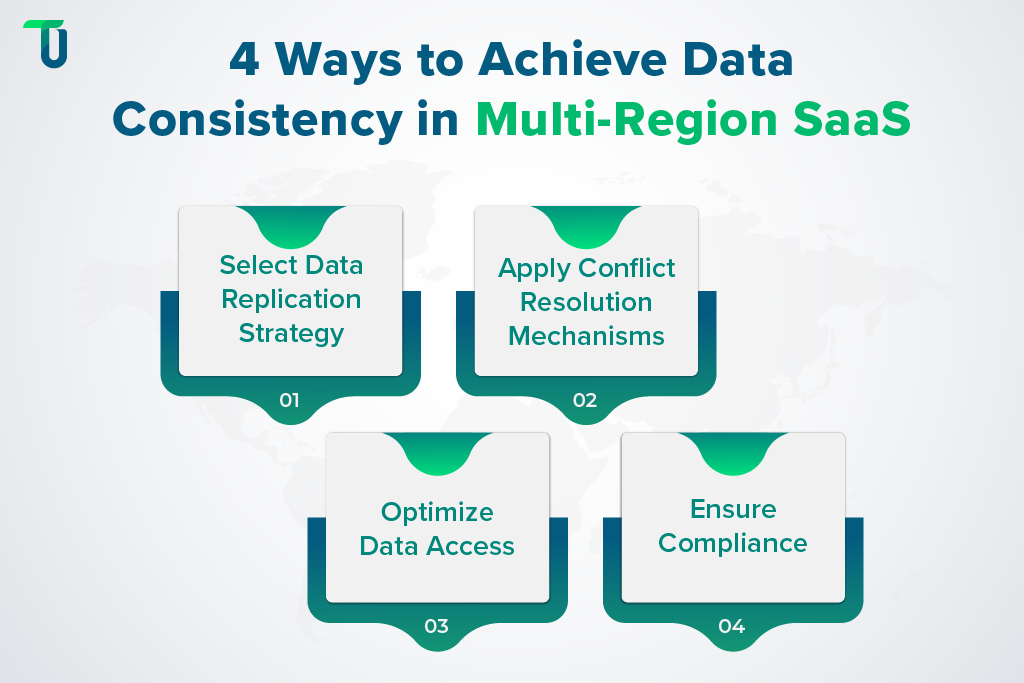
1. Choose the Right Replication Strategy
- Synchronous replication ensures that data updates are immediately synced across regions, maintaining strong consistency — but at the cost of higher write latency. Major cloud vendors also provide managed services and global databases that show how cloud providers maintain data consistency across regions, giving teams options between strong, causal, and eventual consistency models.
- Asynchronous replication allows faster writes and lower latency but may lead to temporary inconsistencies.
- Hybrid approaches such as semi-synchronous replication or quorum-based replication can balance performance with consistency for mission-critical workloads.
2. Implement Conflict Resolution Mechanisms
- To control conflicts during concurrent updates, use mechanisms such as timestamps, versioning, or last-write-wins policies.
- Advanced distributed databases (e.g., Google Spanner, CockroachDB, or DynamoDB global tables) offer multi-region consistency models and conflict-free replicated data types (CRDTs) to automatically reconcile conflicts — techniques often implemented alongside CQRS & Saga for microservices to ensure consistency and reliability in distributed systems.
3. Optimize Data Access for Performance
- Scalability, fault tolerance, and built-in replication and consistency procedures are all features of distributed databases.
- Caching methods such as CDNs and in-memory caching reduce latency by bringing frequently accessed material closer to end users.
- Use read replicas to reduce query load, apply write sharding to limit contention, and use event-driven patterns where strict consistency is not required. These approaches help keep data synchronized across regions.
- Ensure reliable data replication and access by using the right tools and processes. Centralized CMDBs, automated discovery, and sync pipelines help align asset data, remove silos, and speed up incident response and provisioning.
4. Compliance & Data Residency Considerations
When replicating data across multiple regions, organizations must comply with regulations such as GDPR, HIPAA, and CCPA, ensuring compliant multi-region data management and respecting data residency requirements. Use geo-fencing controls and encryption-at-rest/in-transit to secure sensitive data.
What Are the Best Practices for Optimizing Network Performance and Latency in Multi-Region SaaS Architecture?
The Influence of Network Latency on User Experience in Multi-Regional Deployments
High network latency can degrade user experience by increasing load times and response delays. In global SaaS platforms, latency above 200 ms can raise user churn and lower conversion rates, especially for real-time use cases such as video conferencing, e-learning, and SaaS quality management solutions that depend on consistent uptime and responsiveness.
Techniques for Reducing Network Latency: CDNs, Edge Caching, and Latency-Aware Routing
Techniques such as CDNs, edge caching, and latency-aware routing can be used to reduce network latency. At the application layer, SaaS queuing solutions handle global audiences by partitioning and replicating message topics, using geo-aware brokers, and routing work to regional consumers to preserve throughput and lower end-to-end latency.
- CDNs distribute content across servers in many areas, minimizing the amount of distance data must travel.
- Edge caching keeps frequently used content closer to the user, reducing round-trip time.
- Latency-aware routing chooses effective network paths dynamically depending on latency measurements, resulting in speedier data transfer.
- For multi-region SaaS applications, integrating with cloud provider Global Accelerator services (AWS Global Accelerator, Azure Front Door, GCP Cloud CDN) can route users to the nearest healthy endpoint. Using anycast routing and smart DNS-based traffic management helps ensure optimal performance for users regardless of geography.
The Importance of Reducing Round-Trip Time and Optimizing Data Transfer Between Regions
Reduce the time it takes data packets to travel between the client and server by minimizing round-trip time (RTT).
Latency is reduced by optimizing data flow across regions using compression, data deduplication, and effective routing techniques.
Request pipelining and parallel processing to improve data transfer efficiency even more.
Enterprises often adopt multi-cloud architecture SaaS or active-active deployments to serve users from multiple regions simultaneously, reducing dependency on a single data center. Leveraging private backbone networks (e.g., AWS Direct Connect, Azure ExpressRoute, GCP Interconnect) can further minimize latency for mission-critical workloads.
Continuous Monitoring & Benchmarking
Network performance requires ongoing monitoring of latency, jitter, packet loss, and throughput. Tools such as New Relic, Datadog, and Grafana help track user experience across regions and benchmark global SaaS performance.
Latency can be reduced using CDNs, edge caching, and latency-aware routing. Combined with predictive scaling, global traffic distribution, and performance benchmarking, these techniques support a resilient, low-latency SaaS platform that scales smoothly across regions.
Compliance and Security Considerations in Multi-Region SaaS Architecture
- It is critical to realize that compliance requirements and regulations differ among regions when deploying a multi-region SaaS architecture.
- When handling sensitive data, each location may have its own set of norms and standards that enterprises must follow.
- Regulations such as GDPR (Europe), CCPA (California), HIPAA (healthcare data), and SOC 2 compliance may apply depending on the industry.
- Data protection rules, privacy laws, industry-specific mandates, and other restrictions may be part of the compliance requirements.
- Enterprises must build a compliance strategy that includes region-specific data residency policies, secure APIs, and audit trails to maintain legal and ethical operations.
Security Measures for Multi-Region Deployments
- To protect sensitive data in multi-region deployments, security measures are critical.
- End-to-end encryption is necessary for safe data transmission and storage because it ensures that data is encrypted both in transit and at rest.
- Role-based access controls (RBAC) and zero-trust security models must be put in place to enforce correct authentication and authorization, limiting access to only authorized personnel.
- Regular penetration testing, vulnerability scanning, and security patch automation strengthen protection against cyber threats.
- Data privacy must be prioritized, with safeguards in place to protect personally identifiable information (PII) and sensitive data.
Importance of Secure Data Transmission and Storage
- Secure data transmission and storage are crucial in multi-region deployments to ensure data confidentiality, integrity, and availability (CIA triad).
- To maintain conformity to security standards and regulations, organizations should pursue compliance certifications such as ISO 27001, SOC 2 Type II, and PCI-DSS and undertake frequent audits.
- This increases client trust and displays a commitment to data security.
Implementing secure key management systems (KMS), TLS 1.3 for encrypted communication, and multi-region backup strategies lays the groundwork for ensuring data security and limiting any risks or breaches, an approach TenUp applied when building military-grade security into a client's software product.
Compliance & Data Residency Best Practices for Multi-Region SaaS
Deploying SaaS applications across multiple regions introduces complex compliance and data residency challenges. Every region may have its own regulations regarding data privacy, storage, and access, such as GDPR in Europe, HIPAA in the US healthcare sector, or CCPA in California.
Best Practices for Compliance in Multi-Region SaaS Deployments
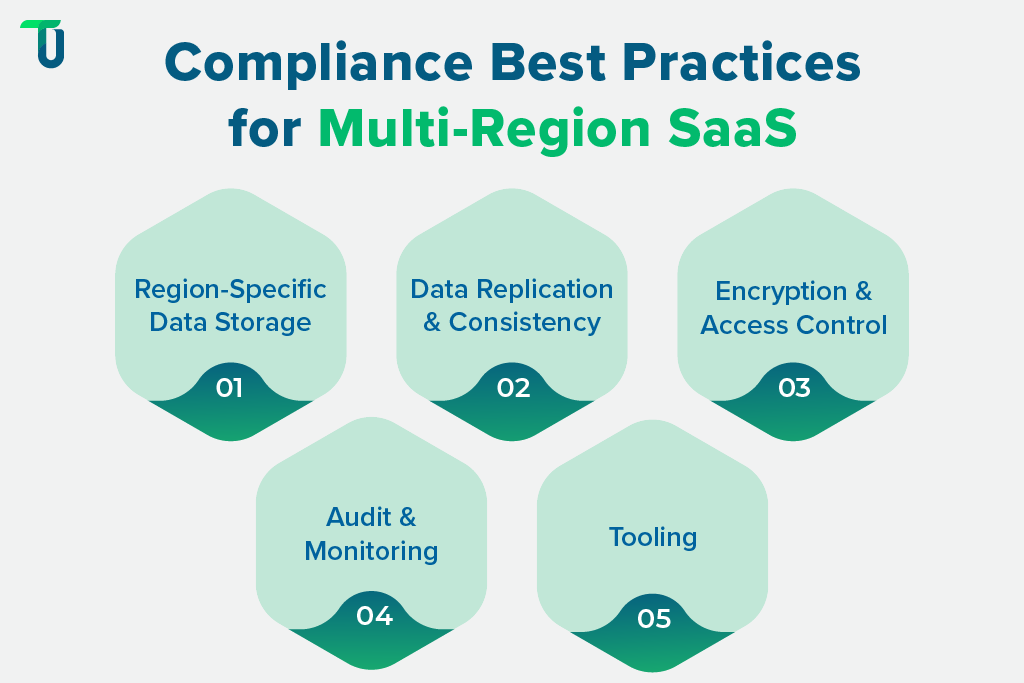
Region-Specific Data Storage:
- Store sensitive data within the region it originates to comply with local regulations.
- Example: EU customer data should reside in EU data centers.
Data Replication & Consistency:
- Use synchronous replication for critical data to ensure consistency across regions.
- Use asynchronous replication for non-critical data to reduce latency.
- Implement conflict resolution strategies like timestamps or versioning.
Encryption & Access Controls:
- Encrypt data at rest and in transit.
- Apply strict role-based access controls (RBAC) to limit who can access sensitive data.
Audit & Monitoring:
- Regularly audit systems to verify compliance with global standards.
- Monitor replication logs, latency, and data integrity across regions.
Tooling:
- AWS Control Tower, Azure Policy, and GCP Data Residency tools can help enforce compliance automatically.
Checklist for SaaS Compliance Across Regions:
- Are customer data storage and backups region-specific?
- Are encryption and access policies enforced in all regions?
- Are replication strategies optimized for both performance and compliance?
- Are monitoring and audit processes automated?
Implementing these practices ensures your SaaS product not only scales efficiently across regions but also meets global compliance standards, building trust with enterprise customers.
What Should You Ask When Evaluating a Multi-Region SaaS Platform or Vendor?
Many platforms and vendors advertise "multi-region support" without specifying what that means architecturally. The difference between real multi-region infrastructure and a single region with backups shows up only when you ask specific questions.
- Does the platform replicate data synchronously or asynchronously across regions? What replication lag or freshness guarantees are documented?
- What consistency model does the underlying database use, and does that match your application's tolerance for stale reads?
- What are the documented and contractually supported RTO and RPO for a complete regional outage, and when were those objectives last demonstrated in a failover exercise?
- Can each region scale and fail over independently, or does capacity in one region depend on another?
- Does the vendor's data residency guarantee cover both primary storage and replicated copies?
- Who owns incident response during a regional failover: your team, the vendor, or a shared runbook?
- What is the actual cost delta between single-region and multi-region tiers, including data transfer and monitoring?
- Is the multi-region capability built into the core platform, or bolted on through a separate disaster-recovery product?
The same diligence applies to evaluating a delivery partner, not just a platform. Architecture judgment shows up in how a partner answers these questions, not in their sales deck: "Stakeholders have seen successful results, and TenUp Software Services has been able to work flexibly and with very minimal involvement from the client. Above all, the company is deeply impressed with their solution architecture expertise." — Brian Amaro, CTO, OpenChannel
A platform that cannot answer these questions with specific, testable commitments should not be treated as multi-region-ready without additional technical validation. It may provide regional backups or disaster recovery rather than independently operating multi-region service delivery.
Conclusion: Key Takeaways for Building a Robust Multi-Region SaaS Architecture
Scalability is critical: when developing a scalable SaaS architecture for multiple regions, applications must efficiently handle a growing and diverse global user base.
Robust cloud security: Organizations should ensure their cloud security frameworks can manage increased user demands and data loads across multiple regions while maintaining performance and compliance.
Optimized performance: Multi-region deployments must focus on network performance, fault tolerance, and data consistency to deliver seamless user experiences worldwide.
At TenUp, we specialize in designing scalable, secure, and high-performance Multi-Region SaaS Architectures. Our cloud app development expertise ensures your infrastructure can support business growth without compromising on security, compliance, or reliability.
Get in touch today to discover how our cloud app development services can help you build a resilient, globally optimized SaaS product that meets your performance, security, and compliance requirements.
Frequently asked questions
What is multi-region SaaS architecture, and why is it critical for global applications?

Multi-region SaaS architecture deploys a SaaS application across multiple cloud regions to ensure high availability, low latency, and fault tolerance. It helps global applications deliver consistent performance, comply with regulations like GDPR, HIPAA, and CCPA, efficiently manage traffic, and recover quickly from regional outages.
How does active-active deployment improve multi-region SaaS performance?
Active-active deployment routes traffic to all regions simultaneously, reducing latency by serving users from the nearest location and eliminating single points of failure. It ensures continuous uptime, seamless failover, and consistent performance for global users, while efficiently distributing load across regions.
What are the best practices for ensuring data consistency across multiple regions?
Ensure consistency by choosing the right replication strategy (synchronous, asynchronous, or hybrid), using distributed databases with built-in consistency, applying conflict resolution like timestamps or versioning, and leveraging caching or read replicas for faster global access. Regular monitoring and recovery plans maintain integrity across regions.
How can SaaS platforms reduce network latency for global users?
SaaS platforms reduce latency by using CDNs, edge caching, and latency-aware routing, optimizing database queries, implementing request pipelining and data deduplication, and leveraging cloud services like AWS Global Accelerator or Azure Front Door. Multi-region or multi-cloud deployments with private backbone networks further minimize round-trip time, ensuring fast and consistent global performance.
What scalability strategies should enterprises consider in multi-region SaaS deployments?
Enterprises should adopt horizontal and auto-scaling, predictive AI/ML-driven resource allocation, and region-specific capacity planning. Leveraging microservices, global load balancing, and caching ensures consistent performance, supports peak workloads, and enables seamless expansion into new regions while maintaining high availability.
How can SaaS providers comply with regional data residency and privacy regulations?
SaaS providers ensure compliance by storing sensitive data within required regions, encrypting it in transit and at rest, enforcing role-based access controls, and conducting regular audits. Leveraging cloud tools like AWS Control Tower, Azure Policy, or GCP Data Residency features helps automate compliance and maintain adherence to laws like GDPR, CCPA, and HIPAA.
What tools and technologies help optimize multi-region SaaS performance monitoring?
Use observability and monitoring tools like Datadog, New Relic, Grafana, or cloud-native services (AWS CloudWatch, Azure Monitor, GCP Cloud Trace) to track latency, throughput, and availability across regions. Combine distributed tracing, synthetic monitoring, and AI/ML-powered analytics to detect anomalies, benchmark performance, and optimize global SaaS infrastructure proactively.
How can enterprises balance cost, performance, and compliance in multi-region SaaS architecture?
Enterprises can balance cost, performance, and compliance by combining deployment strategies (active-active or active-passive), auto-scaling, and multi-region data placement. Optimizing resource usage, leveraging CDNs, enforcing regional compliance policies, and adopting multi-cloud approaches ensures high performance, cost efficiency, and adherence to data residency regulations globally.
Share the Article


