


Every failed cloud migration has a postmortem. Read enough of them and a pattern emerges: the technology worked, but the decisions around it did not.
Scope discovered mid-project. Dependencies mapped after systems broke. Security frameworks designed after deployment. Vendor handover terms missing from contracts. These are not edge cases. According to the Cloud Security Alliance, 90% of CIOs have experienced failed or disrupted cloud migration projects, mostly due to poor planning decisions made before a single workload moves, not the technology itself.
Cloud migration is less an infrastructure upgrade and more a risk-management transformation. Every technical decision carries financial consequences, and every architectural choice creates organizational dependency. Enterprises that migrate successfully recognize this from day one.
This guide outlines nine factors cloud migration consulting services address before a single workload moves, and how each determines whether migration becomes a competitive advantage or a remediation effort.
Factor 1: Cloud Readiness Assessment and Discovery
Risk eliminated: Unknown migration scope that derails timelines and budgets.
The most important pre-migration question is not how to move, but what is being moved and whether it is ready. A cloud readiness assessment answers both and eliminates a common cause of migration failure: discovering mid-project that a critical system, dependency, or compliance constraint was never identified.
The outcome is a risk-ranked inventory that defines scope and establishes the financial baseline for cost, timeline, and architecture decisions that follow. Enterprises that compress this phase do not save time. They borrow it at a high interest rate, paid in change orders, rework, and extended timelines.
What a rigorous readiness assessment covers:
- Full IT environment audit across infrastructure, applications, databases, APIs, and network dependencies
- Application cloud-compatibility scoring across performance, security, and scalability
- Compliance mapping against HIPAA, PCI-DSS, SOC 2, GDPR, and CCPA before architecture design
- Team skill gap analysis aligned to cloud platforms and tools in scope
- FinOps baseline mapping current infrastructure spend to projected cloud cost models
- Data residency and sovereignty constraints across US, UK, and Asian operations
Once scope is defined, the next risk emerges immediately: undocumented connections between systems.
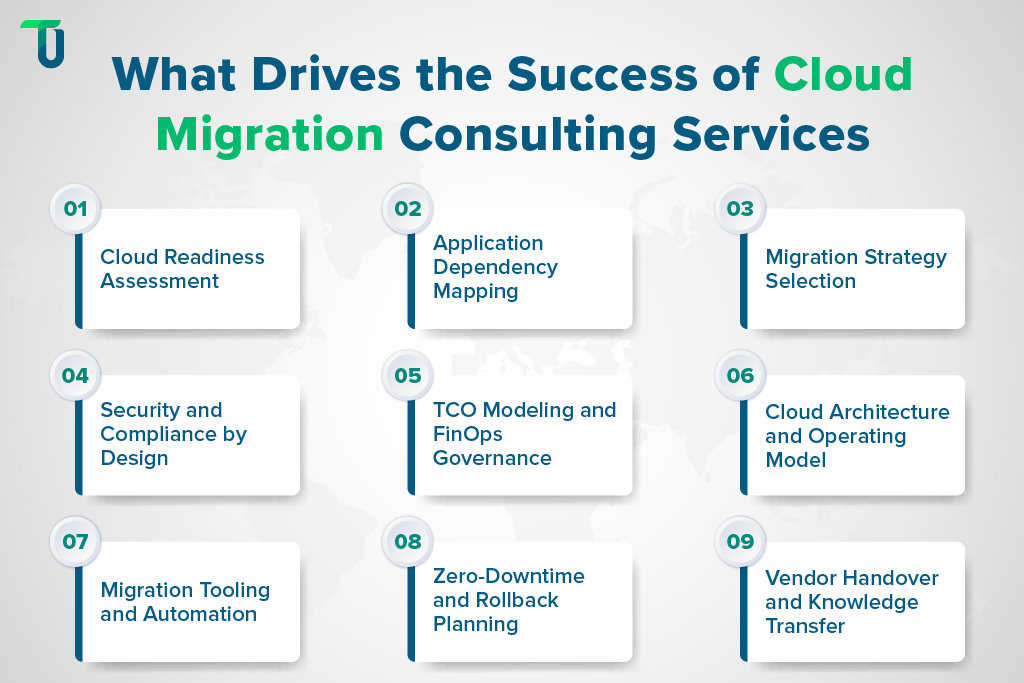
Factor 2: Application Dependency Mapping and Portfolio Rationalization
Risk eliminated: Cascading downtime caused by migrating systems whose hidden connections break silently in the new environment.
Enterprise environments are ecosystems, not collections of independent applications. A CRM may depend on middleware that relies on a legacy database no one has documented in years. Migrating one component without understanding these relationships creates an operational crisis that surfaces after go-live, in front of customers.
Dependency mapping traces connections across APIs, shared databases, authentication flows, third-party integrations, and data pipelines, producing a sequencing map that determines what must move together and what can move independently. See how an ETL solution for banking data integration simplifies secure enterprise data movement across financial systems. Portfolio rationalization delivers its most underappreciated return here.
Most enterprises conducting an honest portfolio audit discover that 20 to 30 percent of applications are redundant, end-of-life, or no longer serving a business function. A 2023 McKinsey analysis found organizations conducting formal application rationalization before migration reduced total migration costs by an average of 20 to 30 percent compared to those that migrated without triage. The governing principle: migrate less, not more.
Once the migration portfolio is rationalized, the next risk is choosing the wrong approach for what remains.
Factor 3: Migration Strategy Selection and the CTO Decision Framework
Risk eliminated: Architectural and financial consequences of choosing the wrong migration approach for the wrong workload.
Faster upfront decisions can create long-term cost and performance constraints. Choosing the right Cloud migration implementation strategies for each workload requires a structured framework rather than assumptions, ensuring long-term performance, scalability, and cost efficiency.
Primary strategies:
| Strategy | Meaning | When to Choose | Risk Profile |
|---|---|---|---|
| Rehost (Lift & Shift) | Move as-is to cloud | Legacy apps retiring soon; time-critical data center exits | Low upfront cost, high long-term cost |
| Replatform | Targeted optimizations (managed DB, containerization) | Operationally healthy apps benefiting from cloud services without full rebuild | Moderate effort, strong ROI |
| Refactor / Re-architect | Redesign for cloud-native features (microservices, serverless, auto-scaling) | Customer-facing, revenue-critical, high-growth apps | High upfront investment, highest long-term value |
| Retire | Decommission the app | Redundant, low-usage, or end-of-life apps | Immediate cost savings |
Decision signals:
- Rehost: app scheduled for replacement, stable usage, tight timeline
- Replatform: healthy app benefiting from managed services
- Refactor: variable traffic, high availability, long-term platform investment
- Retire: identified as redundant or end-of-life
Strategy selection sets long-term cloud economics. After that, the next risk is the shared responsibility boundary: what the provider secures versus what the organization must secure.
Factor 4: Security and Compliance by Design
Risk eliminated: The shared responsibility gap, where enterprises assume the cloud provider secures what they are contractually responsible for.
AWS, Azure, and Google Cloud secure the infrastructure: data centers, hypervisors, and networks. Everything above that: data, applications, identity, access, and configurations is the customer’s responsibility. This boundary is clear in provider documentation but often missing from migration plans.
Security gaps are preventable when designed into architecture from the start. Compliance mapping for healthcare, financial services, or government-adjacent markets must happen during design, not retrofitted post-deployment. Retrofitting is costly and can require full re-architecture.
Security by design includes:
- Zero-trust architecture: Continuous verification of every access request, no implicit trust
- IAM governance: Least-privilege role-based access, privileged access management from day one
- Encryption standards: TLS 1.2+ in transit, encrypted at rest with customer-managed keys
- Compliance mapping: HIPAA, PCI-DSS, SOC 2, GDPR, CCPA considered during architecture
- DevSecOps integration: Security tests embedded into CI/CD pipelines
- CSPM tooling: Tools like AWS Security Hub, Microsoft Defender for Cloud, and Prisma Cloud detect misconfigurations in real time
Because security governance must be organizational, not project-level, certified frameworks like ISO 27001 ensure consistent rigor across engagements.
What this looks like when caught late: Overly permissive IAM roles left undetected because security tooling was configured post-deployment. The issue surfaced during audit preparation, delaying certification and forcing unplanned remediation. The technology was not the problem, the sequence was.
Once security is embedded, the next risk shifts to financial: actual migration costs versus projected budgets.
Factor 5: TCO Modeling, Hidden Costs and FinOps Governance
Risk eliminated: Post-migration cost shock from the gap between projected savings and actual spend.
Cloud cost projections often fail once workloads hit production. According to the Flexera 2026 State of the Cloud Report, organizations waste an average of 27–32% of cloud spend, mostly from pre-migration modeling gaps, not operational failures.
A rigorous TCO model must include:
- Compute and storage: Sized to workload requirements, not over-provisioned on-prem allocations
- Data egress fees: Frequently underestimated per-GB charges
- Licensing: Bring-your-own versus cloud-native alternatives
- Third-party tooling: Monitoring, security, observability, FinOps platforms
- Support SLAs: Post-migration optimization, incident response, and managed services
- Migration execution: Professional services, tooling, parallel-run testing
Additional costs emerge during migration: idle test environments, over-provisioned instances, or premature reserved commitments. FinOps governance: tagging policies, budget alerts, and shared visibility must be in place before the first invoice arrives.
Fully loaded TCO models covering egress, licensing, tooling, and ongoing support should be established before any budget approval. If a consulting partner cannot produce one, it is a red flag.
Once the financial model is set, the next risk is architectural: whether platform and operating model decisions preserve long-term flexibility.
Planning a cloud migration but unsure where hidden risks may surface?
Evaluate your migration readiness across architecture, security, cost modeling, and operational ownership before execution begins.
Factor 6: Cloud Architecture Decisions and Operating Model Alignment
Risk eliminated: Vendor lock-in and architectural rigidity that limit strategic options three to five years post-migration.
The cloud platform, workload coupling to provider services, and governance model shape strategic flexibility for years. Consequences rarely appear immediately, surfacing only when the organization tries to change course.
Architecture patterns and when to use them:
- Public cloud (single provider): Simplifies governance but creates dependency. AWS for serverless and ML, Azure for Microsoft-centric workloads, Google Cloud for data-intensive analytics.
- Hybrid cloud: Common for enterprises with legacy systems or compliance-driven data residency. Cloud and on-premise systems operate as a unified environment.
- Multi-cloud: Optimizes cost, capability, and risk, but adds governance complexity that must be designed proactively.
Architecture shapes not only where workloads run but how they are operated. Refactoring customer-facing applications into cloud-native microservices without aligning the operating model creates six to twelve months of operational friction, high costs, and reduced reliability.
The operating model must be designed alongside architecture. This also determines the engagement model, consulting, managed services, or migration-as-a-service, based on internal capabilities, not vendor preference.
Once architecture and operating model are aligned, the next risk is execution: ensuring the migration process preserves the benefits the design intended.
Factor 7: Migration Tooling, Automation and AI-Assisted Migration
Risk eliminated: Human error at scale — the configuration drift, sequencing mistakes, and manual process failures that create security gaps and downtime during execution.
The case for automation in enterprise cloud migration is not efficiency. It is governance. Manual infrastructure provisioning creates environment inconsistencies that are invisible during testing and catastrophic at cutover. Automation is the mechanism through which governance commitments made during planning are enforced during execution.
The core automation stack — Infrastructure as Code via Terraform or Pulumi, CI/CD pipelines, migration hub tooling through AWS Migration Hub or Azure Migrate, data transfer automation via AWS DataSync or Azure Data Box, and configuration management through Ansible — is not a technology inventory. It is a governance framework. Each tool exists to eliminate a specific class of human error that, left unaddressed, surfaces as a security misconfiguration, a data integrity failure, or an audit gap.
AI-assisted migration: opportunity and governance guardrails
AI-assisted migration tooling accelerates dependency discovery, automates refactoring assessments, and surfaces cost optimization recommendations that manual analysis would miss. The governance principle that applies: AI tools can be recommended, but humans must approve. Infrastructure configurations generated by AI require review before deployment. Refactoring suggestions require validation against security policies before implementation. Governance frameworks defining that boundary are a prerequisite, not an afterthought.
Once execution risk is governed through automation, the highest-stakes moment remains: cutover, where everything built during the migration either holds or does not.
Factor 8: Zero-Downtime Planning, Data Integrity and Rollback Readiness
Risk eliminated: Business continuity failures at cutover, the moment of highest risk in any enterprise migration.
For mission-critical systems in financial services, healthcare, logistics, and e-commerce, downtime tolerance during cutover ranges from minutes to zero. The cutover plan must reflect that reality.
Zero-downtime cutover approaches:
- Blue-green deployment: Two identical environments run in parallel. Traffic switches from current production to the new cloud environment at cutover. Rollback is measured in seconds.
- Canary deployment: Traffic shifts incrementally at 5%, 25%, 50%, then 100%, with validation at each threshold. Issues affect a fraction of users rather than the full base.
- Staged rollout: Workloads migrate in planned waves, with non-critical systems moving first to validate tools and governance before higher-criticality systems follow.
Data integrity assurance requires:
- Pre-migration full backup with verified restore capability
- Checksum and cryptographic hash validation at source
- Real-time synchronization during the parallel-run period
- Post-migration reconciliation across records and business logic
- Documented recovery procedures for every modeled failure scenario
Rollback planning is a business continuity commitment, not a technical contingency. Every cutover plan must be defined: trigger conditions, maximum rollback window, decision authority, and stakeholder communication plan. This framework belongs to business leadership, not the technical team alone.
The requirement was clear: even brief downtime would disrupt port operations. The solution — an active-standby architecture with Amazon Route 53 health checks, AWS Auto Scaling, and Monit-based self-healing — achieved 99.99% availability with transparent failover. The architecture prioritized resilience and transparent failover under failure conditions.
Case Study: Warehouse Migration
During migration, centralized and legacy systems operated in parallel, ensuring uninterrupted warehouse workflows across portfolio companies. The migration succeeded because parallel-run discipline and phased cutover were enforced throughout, delivering 100% portfolio migration with no disruption.
Once the migration goes live, the final risk is one technology cannot address: whether the organization that built the new environment will still be there to explain it.
Factor 9: Vendor Handover, Knowledge Transfer and SOW Requirements
Risk eliminated: Operational abandonment, where the migration completes, the consulting engagement ends, and the internal team inherits a cloud environment they do not fully understand.
Even flawless technical execution can leave a business at risk if internal teams never gain operational capability. Vendor handover failures follow a consistent pattern: runbooks are missing, architecture documentation exists only at a high level, teams know what was built but not why, and support SLAs in the SOW go unenforced.
The solution is contractual. Knowledge transfer must be a defined deliverable with explicit outputs, completion criteria, and acceptance conditions.
A vendor handover SOW must require:
- Architecture documentation: Operational-level system diagrams, network topology, security groups, IAM roles, and data flows
- Runbooks: Step-by-step procedures for routine and non-routine tasks, including failover, disaster recovery, and rollback
- Training sessions: Structured sessions for internal engineers and operations staff
- Acceptance criteria: Conditions agreed by both parties to define a complete handover
- Transition support period: Post-go-live availability for the internal team to operate independently
If handover requirements are not in the SOW from the start, they will not appear at the end. This is not bad faith; it is project economics. Define handover clearly, hold it to the same standards as other deliverables, and internal teams will emerge capable of operating, optimizing, and evolving the environment independently.
How to Choose the Right Cloud Migration Consulting Partner
The nine factors above define what a successful migration requires, and your partner determines whether those requirements are met. Choose a model: strategic advisory, execution, or full-lifecycle managed services, based on migration complexity, internal capability, and target operating model. If you're evaluating an offshore development partner, assess their experience with enterprise migrations, governance, and long-term operational support.
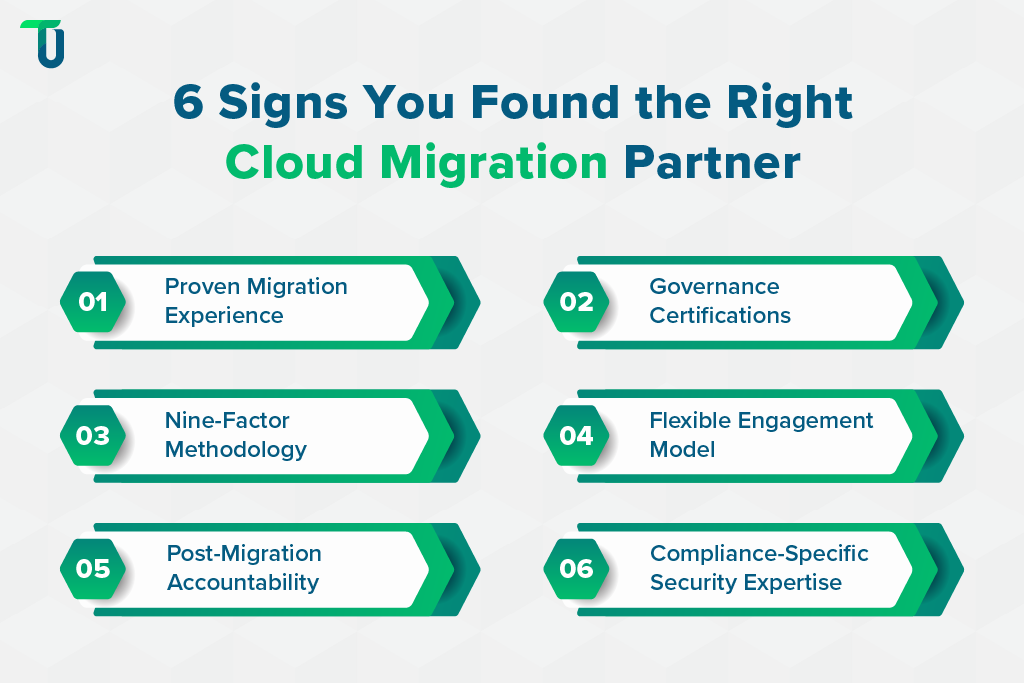
What to evaluate:
- Proven migration experience at your scale and industry: Ask for references with similar complexity, compliance, and timelines.
- Certifications signaling governance maturity: AWS Partner for cloud expertise, ISO 27001 for security management.
- Methodology that follows the nine factors: Assessment before architecture, security by design, TCO modeling, rollback planning, and SOW-defined handover. Skipping these steps increases risk.
- Engagement flexibility: Ability to operate as advisor, execution partner, or managed services provider, with smooth transitions as needs evolve.
- Post-migration accountability: Ongoing optimization, FinOps governance, and continuous improvement that compound cloud value.
- Security expertise specific to your compliance framework: Ask at what stage security review happens in their engagement model.
Disqualifying signal:
Ask a partner to walk you through the TCO model from a previous enterprise engagement. If they cannot demonstrate how egress fees, licensing, and post-migration support were modeled before budget approval or redirected to platform capabilities, they lack genuine consulting depth. That answer is the clearest risk signal.
What Separates Successful Enterprise Migrations from Costly Failures
Cloud migration consulting is a risk-management investment, not a procurement decision. The difference between a migration that delivers its projected ROI and one that becomes a remediation project is rarely the platform or tooling; it’s the rigor of decisions made before the first workload moves.
Experienced partners front-load the right decisions: assessing readiness before commitment, defining strategy before architecture, designing security by default, modeling TCO completely, confirming rollback readiness, and codifying handover contractually. These choices determine whether cloud value compounds or erodes over time.
At TenUp, we apply this framework to every enterprise migration. As an AWS Partner and ISO 27001 certified organization, we combine technical depth with governance rigor, ensuring operational continuity, compliance, and cost predictability across financial services, healthcare, logistics, and enterprise software.
When evaluating cloud migration services, the first conversation should focus on risk: known and unknown, and how a framework manages both.
Ready to plan your enterprise cloud migration with confidence?
Turn migration risk into a structured roadmap with governance, security, and cost clarity built in from day one with TenUp.
Frequently asked questions
What do cloud migration consulting services include?

Cloud migration consulting services typically cover readiness assessment, migration strategy selection (rehost, replatform, refactor, or retire), security and compliance planning, TCO modeling, and post‑migration optimization. These engagements focus on strategy, architecture, and planning, with hands‑on execution usually delivered via managed or implementation services, while managed services provide full operational ownership.
What is the difference between cloud migration consulting and cloud migration managed services?
Cloud migration consulting is project-based and focused on strategy, architecture, and migration planning, ending once the migration completes. Managed services are ongoing; transferring operational responsibility to the partner, including monitoring, optimization, and incident response. Cloud migration as a service goes further to combine strategy, execution, and managed‑service‑style operations for the migration lifecycle. The right model depends on your internal capability and target operating model.
How much do cloud migration consulting services cost for enterprises?
Costs vary by environment complexity, migration scope, compliance requirements, and engagement model. Ask any prospective partner for a fully loaded TCO model covering post-migration operational costs, not just a migration execution quote.
What is the most common reason enterprise cloud migrations fail or exceed budget?
Enterprise cloud migrations most commonly fail due to pre-migration planning failures, underestimated scope, inadequate dependency mapping, incomplete TCO modeling, and undefined shared responsibility boundaries. Defaulting to lift-and-shift without a workload-specific strategy compounds all four, creating technical debt and negating cloud cost benefits.
What should a cloud migration SOW include to protect the enterprise?
A cloud migration SOW must cover migration scope, security and compliance deliverables, data integrity and rollback plan, TCO and cost governance, architecture documentation and runbooks, and handover acceptance criteria with a post-go-live support period. Anything not defined in the SOW before the engagement begins will not reliably be delivered when it ends.
How to choose the best cloud migration consultant for my business?
Choose a cloud migration consultant by evaluating reference engagements at similar scale, certifications (AWS Partner, ISO 27001), methodology transparency across TCO modeling and security architecture, and post-migration support commitments. The clearest vetting signal: ask for a TCO model from a previous engagement. If they cannot produce one, they lack genuine consulting depth.
Which cloud migration consulting firms conduct a readiness assessment before starting?
Reputable cloud migration consulting firms, including Accenture, Deloitte, IBM, Capgemini, and TenUp, commonly treat readiness assessment as a prerequisite before any migration begins, covering dependency mapping, application readiness scoring, security review, and TCO modeling. Any firm that skips this step and moves directly to execution is a red flag.
Can cloud migration consulting services help with hybrid cloud setups?
Yes. Cloud migration consulting services help design and manage hybrid cloud setups, where certain workloads remain on-premise while others migrate to public cloud. Hybrid requires deliberate decisions around data residency, legacy dependencies, and compliance; without this expertise, hybrid becomes a costly migration halfway point rather than a deliberate long-term architecture.
Share the Article


