


The real cost of a bad offshore hire is not the contract. It is the rework nobody budgets for. Poor specification, weak SLAs, no IP clarity, and zero async discipline create failures that surface in month three. By then, the contract is signed, and the cost is yours.
The global IT outsourcing market is projected to reach approximately $634.18 billion in 2026, growing at a compound annual growth rate of about 6.20% to around $806.55 billion by 2030, according to Statista’s IT Outsourcing worldwide forecast. That scale reflects how deeply enterprises depend on offshore software development services, but market size does not indicate market success. Most offshore engagements fail not because of technical incompetence but because of governance gaps: no defined ownership, no accountability structure, no communication discipline.
This guide covers what "reputable" actually means when evaluating an offshore software development company in 2026, covering vendor assessment, true cost breakdown, red flags, distributed team governance, and when offshore is the wrong model entirely.
What Is an Offshore Software Development Company And What It Isn't
An offshore software development company is a technology firm in a different country delivering enterprise custom software development services, including architecture, custom application development, mobile and product engineering, QA, DevOps, and ongoing maintenance. Businesses looking for a Real Estate App Development Company should also evaluate domain expertise in property booking, CRM integration, and workflow automation.
What it is not: a labor pool you throw requirements at. The offshore model only works when treated as a delivery model with its own governance requirements: structured teams, defined SLAs, documented workflows, and clear IP ownership. Vendors who cannot demonstrate these are freelancers at scale, not engineering partners.
Which Countries Lead in Offshore Software Development: Why It Matters
Geography is a decision input, not a ranking. Each region's strengths map to specific project needs.
India: Largest English-speaking developer workforce globally. Deep AI and full-stack talent pipeline. First choice for scale and cost efficiency. Many globally trusted engineering partners offer AI-assisted development and enterprise-grade governance frameworks.
Eastern Europe (Poland, Ukraine, Romania): Technical depth in algorithms, systems engineering, and security. Time zones overlap with US East Coast mornings and EU business hours. Strong EU compliance alignment.
Latin America (Mexico, Colombia, Argentina): Near-full timezone alignment with US teams. Growing product engineering culture. Best choice when real-time collaboration at offshore rates is the priority.
Southeast Asia (Vietnam, Philippines): Cost efficiency with an expanding talent base. Vietnam's tech workforce grows at 14% annually. Best suited for web, mobile, and QA-intensive engagements.
The decision is not where your team sits. It is whether your engagement model is built to manage the distance.
Why Companies Choose Offshore Development: Where It Works and Where It Fails
Understanding why offshore engagements succeed or fail at the macro level is covered in TenUp's analysis of IT outsourcing trends shaping global IT services. The same structural shifts driving companies toward offshore models are also raising the bar for governance and vendor accountability.
Why offshore works:
Cost arbitrage: a senior developer in India costs a fraction of a US equivalent when you factor in salary, benefits, equity, and recruiting fees
Talent access: India alone produces roughly 1.5 million engineering graduates annually across all disciplines, creating a talent base far larger than any single domestic market.
Follow-the-sun delivery: code reviewed at the end of a US workday gets built, tested, and deployed overnight, compressing development cycles by up to 30-40% in well‑governed offshore setups, depending on workflow maturity.
Why it fails:
Scope ambiguity: requirements that feel clear internally become expensive guesswork across a 10-hour time difference
Weak SLAs: agreements that define deliverables without measurable uptime targets, response times, or escalation paths guarantee disputes
No async discipline: teams dependent on real-time meetings cannot sustain output across time zones, and bottlenecks surface as missed deadlines
The gap between offshore promise and offshore outcome is almost always a governance gap, not a technical one. Enterprises looking to understand how to prevent software project failure should prioritize governance frameworks before evaluating technical capabilities.
Systems holding back your ability to scale?
TenUp builds offshore-ready software with structured governance, ISO 27001-certified security, and transparent delivery.
Offshore vs Nearshore vs Onshore: Which Model Fits Your Project?
Most enterprises do not choose one model. They use a hybrid: onshore product leadership, nearshore project management, offshore engineering execution. The governance structure determines whether that hybrid delivers or fragments.
1. Choose Offshore When
Cost pressure is high, local talent is unavailable within your timeline, and your team can operate async-first. Offshore works well for organizations building on cloud-native architecture, where distributed engineering is already part of the delivery model. It also suits mobile development, product engineering, QA automation, and DevOps, covering engagements where output is measurable and async workflows are mature.
2. Choose Nearshore When
Real-time collaboration is a genuine requirement, not a preference. If product decisions happen in real-time, stakeholders expect same-day responses, or regulatory meetings require live attendance. Nearshore delivers the timezone alignment that offshore cannot. Latin America is the default nearshore choice for US companies in 2026.
3. Choose Onshore When
Compliance, IP sensitivity, or executive visibility demands it. Healthcare organizations under HIPAA, financial institutions under PCI-DSS, and government contractors with FedRAMP requirements often face data residency constraints that make offshore legally complicated. Onshore is not always the conservative choice. Sometimes it is the only viable one.
| Factor | Offshore | Nearshore | Onshore |
|---|---|---|---|
| Typical Rate (USD/hr) | $18–$80 | $40–$90 | $100–$200+ |
| Time Zone Overlap | Limited (5–12 hrs) | Partial (1–4 hrs) | Full |
| Talent Pool | Very large | Moderate | Limited, competitive |
| Cultural Fit | Requires planning | Low to moderate friction | Highest alignment |
| Control | Requires governance | Moderate | Highest |
| Best Suited For | Scale, specialization, cost efficiency | Companies needing US overlap | Compliance-heavy, real-time collaboration |
The True Cost of an Offshore Software Development Company (Beyond the Hourly Rate)
The invoice from your offshore partner is not your total cost.
Offshore Developer Hourly Rates by Region (2026)
Approximate 2026 ranges compiled from freelance‑platform data and agency‑rate benchmarks; treated as directional planning inputs, not an exact published index. Upwork’s developer‑rate guidance and Arc.dev’s developer‑rate lens can be used as reference starting points.
| Region | Rate (USD/hr) | Key Countries | Strengths |
|---|---|---|---|
| South Asia | $20–$50 | India, Pakistan | Scale, full-stack, AI/ML, enterprise systems |
| Southeast Asia | $18–$45 | Vietnam, Philippines | Web, mobile, QA, data engineering |
| Eastern Europe | $40–$80 | Poland, Ukraine, Romania | Systems, security, legacy migration |
| Latin America | $30–$70 | Mexico, Colombia, Argentina | US timezone alignment, modern web stack |
These are budget planning inputs. The rate does not determine your total cost. Your governance model does.
Compare Offshore Pricing Models Before You Sign
1. Dedicated Team
Full control over team composition and priorities. Higher baseline cost. Best for long-term engagements where requirements evolve. The team builds institutional knowledge that compounds over time and cannot be replicated by rotating contractors.
2. Fixed-Price
Predictable budget, but only works when scope is fully defined before development starts. Every requirement change becomes a renegotiation. Rework risk escalates sharply when scope shifts mid-engagement, which it almost always does.
3. Time-and-Material
Maximum flexibility for evolving scope. Requires active internal oversight. Without a defined governance cadence and sprint discipline on your side, costs drift in ways that are difficult to reverse mid-engagement.
Hidden Cost Categories That Inflate the Final Bill
1. Rework from Poor Specification
Requirements that feel complete internally rarely survive contact with a distributed team. Ambiguity becomes rework, and rework offshore costs more than getting the spec right before development starts.
2. Management Overhead Your Team Absorbs
Offshore teams require an internal owner who manages the backlog, reviews deliverables, and makes product decisions. That overhead is rarely budgeted. For five offshore engineers, expect approximately 15-25% of a senior technical leader's time consumed in coordination.
3. Communication Friction and Decision Delays
Every decision that cannot be made asynchronously costs a full business day in an offshore engagement. Multiply by unresolved decisions per sprint and the delivery impact becomes measurable.
4. Security and Compliance Retrofitting
Security requirements discovered after development begins are retrofit projects, not feature additions. Adding compliant access controls, encryption, and audit trails to a system not designed for them always costs more than building them in from the start.
5. Knowledge Transfer at Engagement End
Offshore teams that have not documented continuously trigger a knowledge transfer sprint when the engagement closes, delaying your next phase. Undocumented systems become internal liabilities.
Budget these before signing. They are not edge cases. They are the norm in under-governed offshore engagements.
Red Flags Checklist: How to Spot an Overpromising Offshore Vendor
Every offshore vendor looks credible in a proposal deck. The red flags appear in due diligence.
- No verifiable portfolio with similar-scale projects. Case studies without measurable outcomes do not qualify
- References who speak to relationship quality but cannot describe specific delivery results
- Vague security claims with no named certifications: ISO 27001, SOC 2, or equivalent
- Fixed-price proposals on poorly defined scope
- No IP ownership or code escrow terms in the contract
- SLAs without measurable uptime or response time targets
- Team in the proposal is not the team assigned to your project
- No async communication framework, entirely dependent on real-time meetings
- No stated developer retention rate or documented handoff process for mid-engagement departures
These are not disqualifiers in isolation. A pattern of three or more is a signal to walk away.
How to Evaluate an Offshore Software Development Company: 7 Decision Criteria
"Reputable" means verifiable credentials and proven delivery, not search rankings.
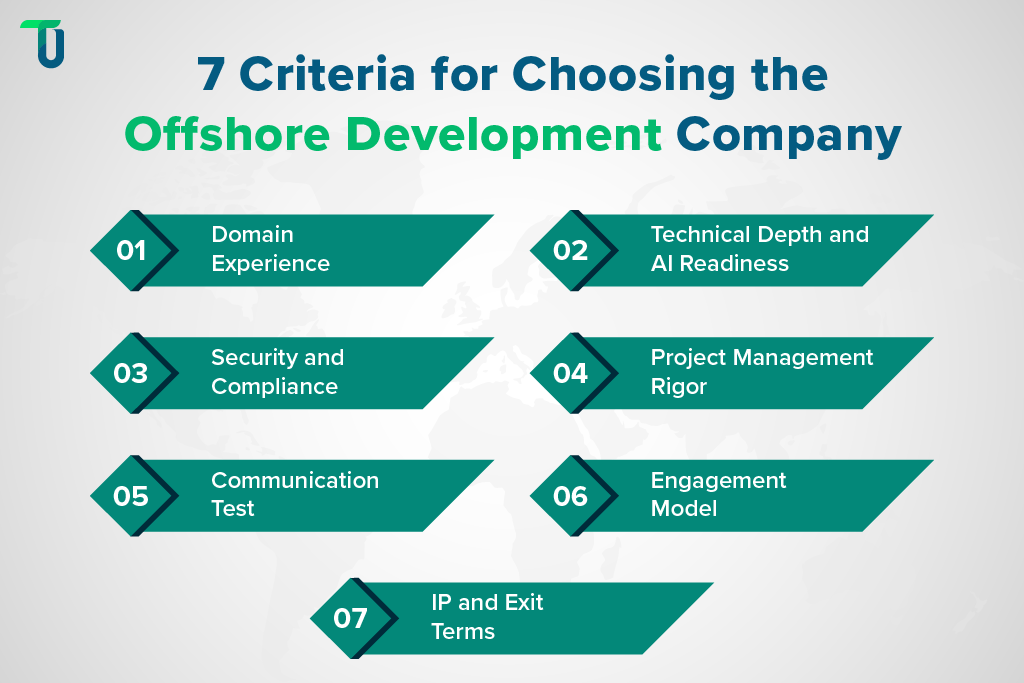
1. Verify Domain Experience With Evidence, Not Claims
Ask for case studies matching your industry, scale, and compliance environment. A portfolio of UIs is not delivery evidence. Ask: what was the outcome, how was it measured, and who is the client contact you can call? Review TenUp's case studies and Clutch profile as a reference for what outcome-based evidence looks like.
2. Assess Technical Depth and AI Readiness
Certifications, cloud partnerships, and stack alignment matter, but so does adaptability when requirements shift. In 2026, also ask whether the vendor uses AI-assisted development tools and whether they have a written policy governing how those tools interact with your code.
Vendors using GitHub Copilot or Cursor without client data protection policies introduce IP exposure you have not consented to. Your code could be processed by third-party AI systems under terms you never reviewed. TenUp's AI-assisted software development practice treats AI governance as a delivery requirement. Tools, validation process, and data protection boundaries are defined before the first sprint.
3. Confirm Security and Compliance Posture
Ask for named certifications: ISO 27001, SOC 2, GDPR, HIPAA, or PCI-DSS, depending on your domain. Then ask how those standards are maintained during active development. Compliance should be part of the vendor's operating model, not something figured out mid-project. Review NDA structure, data residency policies, and access controls before sharing technical details.
4. Evaluate Project Management Rigor
Ask for a sample sprint report from a recently completed project. A vendor with mature delivery processes shares one within 24 hours. If they cannot, that gap will appear in your engagement. Ask specifically how scope changes are handled mid-sprint, not just how work is planned. The answer reveals whether they have a process or just a habit.
5. Test Communication Before You Sign
Run a paid 2-4 week discovery sprint before committing to a full engagement. Scope it around a real module or integration, not a sample exercise. Evaluate async communication habits, documentation quality, how blockers are surfaced, and whether the team you worked with is the team that continues. A vendor who resists a paid pilot does not want to be evaluated before you are locked in.
6. Understand the Engagement Model and What It Controls
The engagement model distributes risk, not just cost. A fixed-price model with undefined scope transfers every change into a negotiation. A dedicated team model gives you control but demands active internal governance. Choose based on how clearly requirements are defined, the level of Enterprise software consulting you require, and how much oversight your team can absorb—not on headline rate.
7. Clarify IP Ownership, Code Access, and Exit Terms
Full source code ownership must be assigned upon payment, in the master service agreement, not mentioned verbally. For long-term engagements, add a code escrow clause. Define the transition plan before signing: what happens to documentation, repositories, and institutional knowledge if the engagement ends. A vendor who resists these terms is planning for the relationship to be harder to exit than it should be.
Evaluation reduces the probability of a governance failure after signing. It does not eliminate it. Governing from sprint one matters as much as the vendor you select. governing from sprint one matters as much as the vendor you select.
Where to Find Offshore Vendors Worth Evaluating
- Clutch: verified client reviews with outcome data
- Toptal: pre-vetted developer network
- AWS Partner Directory: credentialed vendors with cloud delivery capability
- Direct referrals: from founders or CTOs who have run offshore engagements
How to Govern an Offshore Development Team After You've Hired Them
Most offshore failures do not happen at the hiring stage. They happen in month three, when initial energy fades, communication norms were never documented, and accountability is undefined.
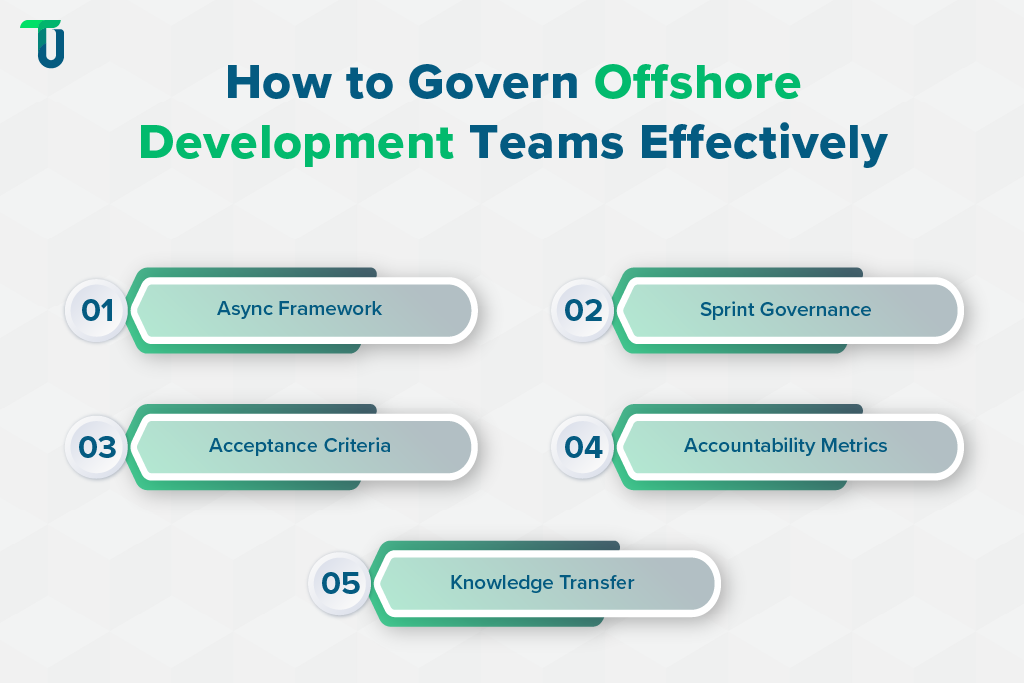
1. Build an Async-First Communication Framework
Async is not a workaround for time zones. It is a more disciplined communication model. Written standups in Slack, Loom walkthroughs for complex features, decisions documented in Notion, and Linear for task tracking create a searchable record that real-time meetings cannot. It also reduces time zone fatigue: your offshore team is not on 10 PM calls, and your internal team is not waiting each morning to be unblocked.
2. Establish Governance From Sprint One
Define the ownership matrix before development begins: who approves architecture decisions, who escalates delivery risks, who signs off on acceptance criteria. Weekly check-ins, bi-weekly sprint reviews, and monthly retrospectives are not overhead. They are how distributed teams stay aligned. Skip them and misalignment accumulates silently until it surfaces as a missed deadline.
3. Protect Quality With Defined Acceptance Criteria
Every deliverable needs measurable acceptance criteria before development starts. "The feature works" is not a criteria. "The API returns under 200ms for 95% of requests at 500 concurrent users" is. QA is not an end-of-sprint phase. It is continuous. Automated test coverage, code review protocols, and defect rate tracking belong in the engagement agreement, not left to the vendor's judgment.
4. Track Accountability With Visible Metrics
Velocity, defect rate, SLA compliance, and on-time delivery ratio tell you whether an offshore engagement is healthy before problems escalate. If you cannot measure it, you cannot manage it remotely. Share these metrics with the vendor in every sprint review. Transparency in both directions builds accountability faster than any contract clause.
5. Plan Knowledge Transfer Before You Need It
Documentation standards apply from day one, not when the engagement winds down. No single offshore team member should hold undocumented knowledge about architecture decisions, integration logic, or deployment processes. Treat documentation as a deliverable with acceptance criteria, not a courtesy.
TenUp's Take: The most common governance failure is treating offshore teams like internal hires and assuming norms develop naturally. They do not. Async discipline, ownership matrices, and documentation standards must be defined before sprint one. Retrofitting governance onto a team already operating without it costs more time than building it correctly from the start.
The companies that struggle with offshore teams rarely fail at hiring. They failed at governing.
Is Offshore Software Development the Right Model for Startups?
Offshore works differently for startups than enterprises. The risk profile is not the same.
What startups get right:
- Speed to hire: offshore teams are assembled and productive in 2-4 weeks, faster than any domestic hiring process
- Cost efficiency: a fraction of the fully-loaded domestic cost during early stages, extending runway meaningfully between funding rounds
What startups get wrong:
- Treating offshore as a substitute for internal technical leadership. An offshore team builds what you define; it cannot define what to build
- Expecting the vendor to own product direction. Roadmap decisions, trade-off calls, and backlog prioritization require an internal owner
- Underestimating how drift compounds. Without a technical co-founder or CTO writing acceptance criteria and reviewing deliverables, quality erosion is gradual and expensive to reverse
The decision signal: offshore works for startups with internal technical governance. It fails for those who expect the vendor to provide it. The same principle holds at enterprise scale. Strong enterprise application lifecycle management requires internal ownership of architecture decisions regardless of where engineering execution happens.
Without internal technical governance, offshore is not a cost-saving strategy. It is a risk multiplier.
Choosing the Right Offshore Software Development Partner in 2026
Offshore development works when three conditions are met: the engagement model matches your scope and compliance requirements, the vendor has verifiable credentials and outcome-based references, and you choose a Clutch-recognized software development company backed by independent client reviews and strong governance practices.
The failures that dominate post-mortems are preventable: rework cycles, IP disputes, quality drops in month four, and knowledge loss at engagement end. They require deliberate planning before signing, not crisis response after problems surface.
TenUp is an ISO 27001 certified AWS Partner with experience across enterprise and product-stage engagements. Our delivery model integrates AI-assisted software developmentwith structured governance: async-first communication, defined SLAs, continuous QA, and full IP ownership at every payment milestone. The engagement model is defined before the first line of code is written, because the companies that succeed offshore are the ones that governed well from sprint one.
Whether you are evaluating offshore vendors for the first time or an existing engagement is underperforming, explore how TenUp's enterprise application lifecycle management supports end-to-end delivery, from engagement design through production.
Ready to build an offshore engagement that ships?
TenUp combines ISO 27001-certified security, AI-assisted development, and governance-first delivery.
Frequently asked questions
What is the difference between offshore, nearshore, and onshore software development?

Offshore uses distant teams in India, Eastern Europe, and Southeast Asia, at the lowest rates with the largest time zone gaps. Nearshore uses nearby teams with partial overlap, such as Latin America for US companies. Onshore keeps clients and vendors in the same country, with cost increasing as time zone gap narrows.
How much does it cost to hire an offshore software development company in 2026?
Approximate 2026 ranges: South Asia and Southeast Asia $18–$50/hr, Latin America $30-$70/hr, Eastern Europe $40–$80/hr. The hourly rate is not your total cost. Rework, internal management overhead, and knowledge transfer at engagement end are real costs no rate table shows.
What should a contract with an offshore software development company include?
At minimum: IP ownership assigned upon payment, measurable SLAs, scope change protocols, NDA covering all project data, data residency policies, developer handoff obligations, and a structured exit plan with full repository access. Have a lawyer review IP clauses. Verbal assurances have no legal standing.
How do you maintain quality when working with an offshore development team?
Define measurable acceptance criteria before development starts. Require automated test coverage, not manual testing alone. Run QA continuously within each sprint. Track defect rate, velocity, and SLA compliance every sprint review. Run a paid 2-4 week discovery sprint first to validate quality standards before full commitment.
What are the biggest risks of offshore software development and how do you mitigate them?
The five most consistent risks:
- Poor specification leading to rework
- Time zone gaps creating decision delays
- Developer turnover destroying institutional knowledge
- IP ownership ambiguity in contracts
- Price-based vendor selection without delivery evaluation
All are preventable with detailed specs, async discipline, clear IP terms, and a paid discovery sprint.
How do you protect IP and code ownership with an offshore vendor?
Require an IP assignment clause in the master service agreement, not just the NDA, assigning all code to you upon payment. Add code escrow for long-term engagements. If the vendor uses AI tools, require a written policy on how client code is handled. Your NDA likely does not cover AI data exposure.
What should enterprises look for when choosing a long-term offshore software development partner?
Three things: a governance model they can articulate before signing: async framework, sprint cadence, escalation paths; a demonstrated developer retention rate. High turnover destroys institutional knowledge; and transparent exit terms covering full code access, documentation standards, and structured knowledge transfer.
Share the Article


