



The Growing Need for Secure Federated Identity Management
As businesses increasingly rely on a growing array of digital services and platforms, the complexity of federated identity management and federation across applications has become a major challenge. Traditional identity management systems struggle to support secure federated access at scale. As data security becomes essential, organizations need solutions that ensure secure, seamless access while preventing unauthorized entry.
Key factors driving this challenge include:
- The rapid rise of remote work, cloud computing, and mobile applications
- An increasing number of user touchpoints across platforms and services
- The difficulty of managing multiple identities for users across systems
Traditional methods of password management no longer suffice. Users are overwhelmed with numerous credentials, while organizations face:
- Higher risk of data breaches
- Increased likelihood of compliance failures
- Greater exposure due to weak password hygiene
Federated Identity Management (FIM) addresses these challenges by allowing users to:
- Authenticate once and access multiple systems
- Securely access services within and outside the organization
- Rely on centrally managed authentication handled by trusted identity providers
By securely linking identities across different platforms, FIM provides organizations with:
- Greater control over access
- Improved flexibility in managing users
- Increased operational efficiency at scale
What is Single Sign-On (SSO) and How Does It Work?
Our online identities are a maze of user names and credentials. Each time we use a website or service, we need to create an online identity. For organizations, this means creating multiple credentials for employees and customers each time a new application is deployed. Ultimately, users and employees have too many identities and passwords to remember. This leads to security issues like weak password hygiene that compromises businesses and individuals alike.
As a result, organizations need to enable users with simplified access for all their applications using SSO and FIM. This is typically done with the help of an Identity Provider (IdP)—a trusted provider that enables access to SSO and other identity management technologies. While SSO and FIM are related, they serve different use cases, which makes understanding Federated Identity Management vs SSO important when designing secure access across modern digital platforms.
Single Sign-On helps users access various web applications with a single set of credentials and is one of the most common SSO options used by enterprises today. These SSO federation models:
- Reduce password fatigue
- Improve user productivity
- Highlight the core benefits of single sign on for internal users
For enterprises that rely on multiple applications—such as HR, payroll, communications, and project management—SSO allows employees to access these services using one set of credentials.
This approach enables users to work efficiently by:
- Eliminating the need to remember multiple passwords
- Reducing login errors and the use of compromised credentials
- Lowering IT effort and costs related to password resets and support
Beyond internal access, businesses can also leverage SSO for customer-facing experiences. For example:
- Retail networks with multiple brands use SSO to let customers access accounts across stores through a single dashboard
- As users move between stores, the system re-authenticates them using the same credentials, ensuring a seamless experience
Understanding Federated Identity Management (FIM)
In enterprise environments, SSO is often implemented as a capability of FIM, but the two are architecturally distinct. FIM is a framework that allows organizations to securely share and validate user identities across systems and organizational boundaries using trusted identity providers and federated authentication protocols.
This model extends beyond a single company, enabling users to access multiple applications across different organizations with the same credentials. A common example is signing in to Spotify using Facebook login, where identity trust is shared between platforms.
But how does authentication actually work in a federated model?
In a federated authentication model:
- The responsibility of verifying and authenticating user credentials lies with a federated identity provider (IdP)
- Applications do not manage credentials directly and instead rely on a trusted federated identity service
- When users attempt to log into a specific application or service provider, the application communicates with the IdP to authenticate the user
The process of user identity authentication in federated systems is executed using established protocols such as:
- Security Assertion Markup Language (SAML)
- OpenID Connect
- OAuth 2.0
How Identity Federation Works: A Step-by-Step Process
How does Identity Federation work in practice? Let’s say a user wants to access a secured application that needs user authentication. This is what happens:
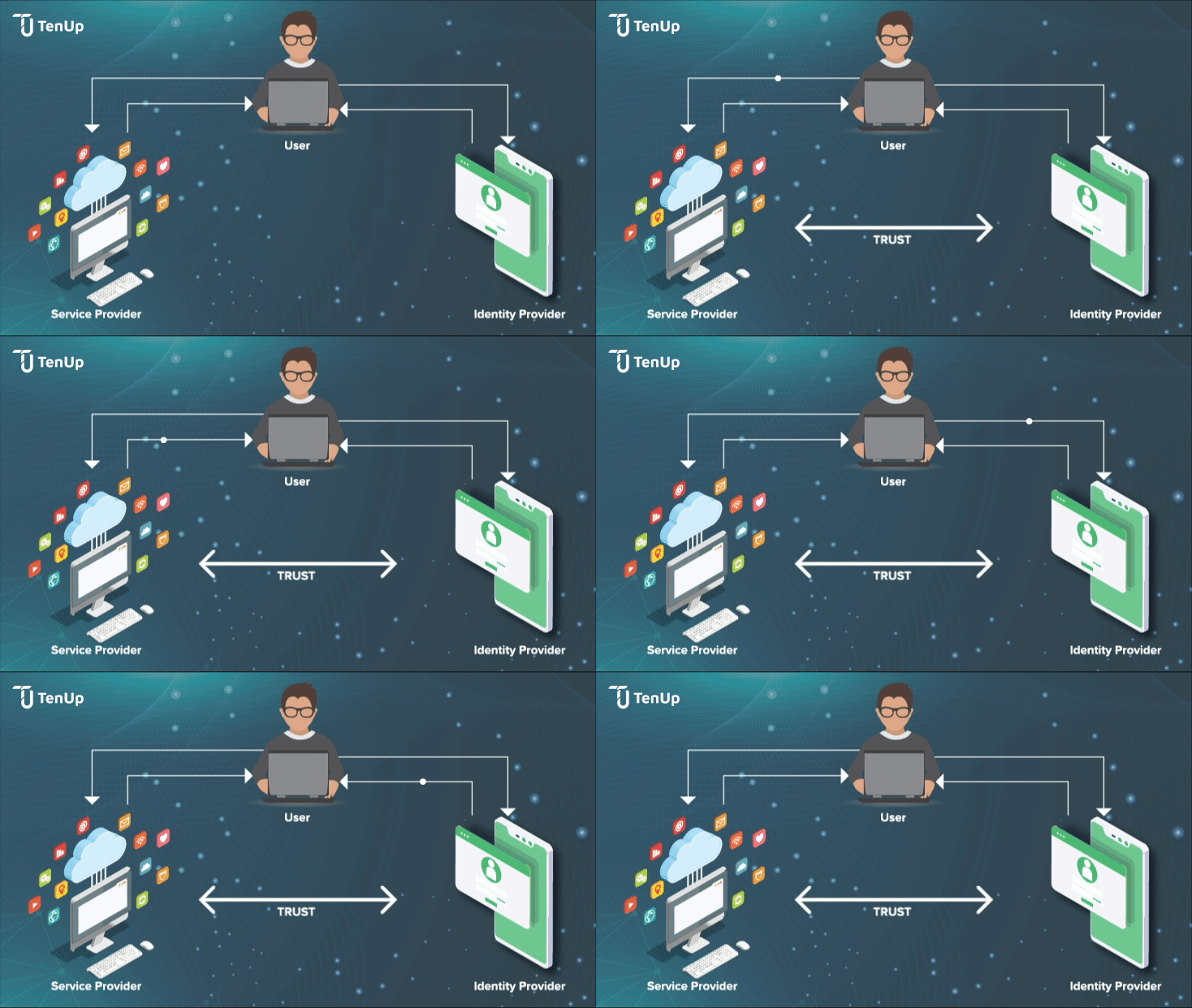
- Users will navigate to the service provider (SP) application
- SP needs the user to be authenticated at the IdP(SP uses various mechanisms to check whether the user is authenticated). Unauthenticated users are redirected to the login page at the IdP
- Users authenticate with IdP. If user details are validated correctly, the user is authenticated and offered an authentication claim.
- The user is directed back to the app with the authentication claim and the app allows the user access.
At TenUp, we’ve applied FIM across our own product suite, streamlining authentication and user access. To see how we put these principles into action, check out our case study.
Identity Providers (IdPs): The Backbone of Federated Identity
Identity Providers (IdPs) are trusted third-party vendors that act as federated identity providers, forming the backbone of federated identity management solutions. These solutions enable secure federated security and federated SSO by managing authentication across multiple service providers.
One of the main advantages of IdPs is their ability to authenticate users for third-party service providers—such as websites and applications—by federating user identities and authenticating end users without requiring the sharing of actual login details.
This approach is commonly known as Bring Your Own Identity (BYOI), or simply called “social login” or using external identity providers. IdPs help manage identities of varying degrees of strength and identity attributes, including identities issued by:
- Social networks
- Banks and financial institutions
- Mobile network operators
- Government authorities
- Digital identity providers
There are multiple open-source and proprietary Identity Providers that enterprises can leverage to manage and secure user authentication and build identity controls, including:
- Open-source IdPs such as OpenAM and Keycloak
- Proprietary IdPs such as Okta, Auth0, OneLogin, and Red Hat / IBM Identity and Access Management
Key Protocols for Federated Identity: SAML, OAuth, and OpenID Connect
Some of the leading websites and services use OpenID, SAML, and OAuth as core technologies for identity federation protocols, enabling secure authentication and authorization across systems.
OAuth
OAuth is an open-standard protocol for authorization that enables applications to request secure, delegated access to protected resources. While SAML uses XML, OAuth uses JSON, which provides a simpler and more flexible experience.
OAuth is particularly well suited for:
- Mobile applications
- Modern web applications
- Gaming platforms
- Internet of Things (IoT) devices
Because of this, OAuth often delivers a better user experience than SAML in mobile and API-driven environments. OAuth 2.0 is the framework that controls authorization to a protected resource by enabling secure, delegated access. OAuth 2.0 alone doesn't handle authentication, it only manages authorization. That's where OpenID Connect and SAML come in. OpenID Connect extends OAuth 2.0 to add an identity layer, while SAML is a completely separate, older standard that works independently of OAuth entirely.
OpenID Connect
OpenID Connect is an open standard managed by the OpenID Foundation and built on the OAuth 2.0 protocol. It enables users to be authenticated by third-party identity providers, with major contributors including Google, Microsoft, and Ping Identity.
With OpenID Connect:
- Users can select their own OpenID providers
- Websites relying on OpenID authentication can validate identities without managing credentials directly
SAML
SAML federated identity is one of the most widely adopted identity federation solutions. It enables federated SAML authentication by securely passing authentication assertions between Identity Providers (IdPs) and service providers using XML.
SAML is:
- Designed to work independently of OAuth but capable of integration in hybrid environments
- Based on XML rather than JWT
- Designed to securely exchange authentication and authorization data across web domains
SAML remains one of the most popular open standards due to its efficiency and speed in enabling access to multiple applications through assertions.
| Protocol | Use Case | Format | Auth Focus |
|---|---|---|---|
| SAML | Enterprise SSO | XML | Assertions |
| OAuth 2.0 | API Authorization | JSON | Tokens |
| OIDC | Web/Mobile Auth | JSON / JWT | ID Tokens |
Why Businesses Should Adopt Federated Identity Management
Identity federation management can be a key differentiator for application vendors, particularly when comparing SSO vs federated identity management or federated SSO vs SSO in enterprise environments with strict compliance, scalability, and partner access requirements. Potential customers increasingly expect a secure authentication system, and identity federation consistently earns strong support from CTOs and CISOs.
Beyond differentiation, FIM automates manual processes within secure frameworks, enabling efficient revenue-boosting services while companies focus on core priorities.
FIM delivers key business advantages:
- Seamless partner access: Safely extend operations externally without security breaches
- Operational efficiency: Automate authentication across cloud platforms and services
- Compliance alignment: Meets NIST 800-63 (federated identity verification), FedRAMP (cloud federation), and GDPR (consent/audit trails) requirements
- Innovation enablement: Supports Zero Trust and digital transformation at a global scale
While powerful, FIM requires addressing the following security considerations:
- IdP single point of failure: Mitigate with redundant providers
- Token replay attacks: Use short expiry + device binding
- Attribute leakage: Limit data sharing between domains
These controls make FIM resilient for hyper-connected enterprises.
In today’s globally connected landscape, there is immense value in establishing and managing identities:
- Within organizations
- Across enterprises
- For individuals on a global scale
As organizations adopt Zero Trust models, cloud-native architectures, and partner-driven ecosystems, federated identity is increasingly becoming the foundation for scalable access control. Instead of managing authentication per application, enterprises rely on centralized identity trust models that adapt as systems evolve—without disrupting user experience.
Conclusion: Strengthening Security and Access Control with FIM
Managing user access and security through federated identity management systems is becoming critical as businesses adopt more cloud services, partners, and platforms, reinforcing the need to understand how federated authentication works across modern application architectures. Federation authentication and access management enable secure digital transformation without compromising user experience.
Throughout this blog, we’ve discussed in detail:
- The concepts of Single Sign-On (SSO) and Federated Identity Management (FIM)
- The role of Identity Providers (IdPs)
- The key protocols that support federated authentication
- Why modern businesses increasingly rely on federated identity solutions
At TenUp, we’ve worked with many businesses to implement secure, scalable identity management solutions using FIM. Our experience includes applying military-grade security using splitkey cryptography to protect enterprise-grade software products.
Our team can help organizations:
- Integrate Identity Providers (IdPs)
- Manage user access across multiple platforms
- Simplify and strengthen overall IT security
If you’re ready to take your identity management to the next level , we’d be happy to help you find the right solution.
Frequently asked questions
What problem does federated identity management solve that SSO alone cannot?

Federated identity management enables secure access across multiple organizations, not just within one company. While SSO works inside a single domain, it cannot establish trust between separate enterprises. Federation allows a trusted identity provider to authenticate users once and securely extend that trust across partners and platforms—without creating duplicate accounts.
How does FIM handle multi-factor authentication (MFA)?
FIM protocols like SAML 2.0 and OpenID Connect support MFA through authentication context, which the IdP enforces during login. The resulting tokens and assertions are then trusted by service providers, so each app doesn't need to handle MFA separately. OAuth 2.0, as an authorization framework, delegates authentication entirely to the IdP.
When should an organization move from SSO to federated identity management?
An organization should move to federated identity management when user access needs extend beyond its own domain—such as working with partners, customers, or cloud services across multiple organizations. While SSO works well internally, federation becomes essential when secure, scalable access is required across different systems without managing separate credentials.
What role do identity providers play in federated identity management?
Identity providers act as the trusted authority in federated identity management. They authenticate users, validate their identities, and issue secure authentication claims that applications rely on. This allows multiple systems to trust a single identity source, eliminating the need for each application to manage user credentials.
How to integrate an existing directory service with a federated identity solution?
Connect your directory to an Identity Provider (IdP) like Okta, Azure AD, or Ping Identity using their built-in AD/LDAP connectors. The IdP acts as a bridge, reading identities from your directory and issuing SAML or OIDC assertions to federated applications, no directory restructuring needed.
How can I integrate federated identity management with existing single sign-on systems?
Configure your existing SSO's Identity Provider to support SAML or OIDC; most enterprise IdPs like Okta or Azure AD do this natively. This extends your internal SSO trust to external applications and partner systems without replacing your current setup or forcing users to re-authenticate.
What is the primary function of a claim in a federated identity system?
The primary function of a claim is to securely convey trusted user information from an identity provider to an application so access decisions can be made without sharing credentials. Claims tell service providers who the user is and what they’re allowed to access across systems.
How do federated identity management services handle user privacy and data protection?
FIM protects privacy by ensuring applications never access actual credentials; only assertions confirming identity. IdPs limit what user attributes are shared with each service provider, supporting data minimization. This directly aligns with GDPR requirements around consent, audit trails, and controlled data sharing across organizational boundaries.
Share the Article


