


Struggling with rising IT costs and clunky legacy systems? You're not alone. A 2025 Gartner report found that 85% of businesses now take a cloud-first approach, yet without the right cloud computing consulting services, that shift gets costly and chaotic fast. Cloud consulting services help businesses cut resource waste, tighten security, and modernize IT infrastructure without the trial and error of going solo. This guide breaks down what IT cloud consulting services actually deliver, the different types available, and how to evaluate the right partner for your company's size and industry, whether you run an SMB or an enterprise IT function.
How Cloud Consulting Services Benefit Businesses
Cloud consulting helps businesses move their data, apps, and systems to cloud platforms like AWS, Azure, or Google Cloud. It starts with a planning phase, often called cloud strategy consulting, where experts review the current setup, define goals, and map out which workloads move first before any technical work begins. From there, experts suggest the best cloud solutions that match business needs, a key part of cloud infrastructure consulting, the technical layer of networking, compute, and storage decisions that support everything built on top. They also guide through each step, from choosing the platform to shifting data safely.
Simply put, cloud consulting makes sure systems stay secure, follow rules, and run smoothly — supporting cloud compliance and performance. It also helps lower costs by using only what is needed. With the right support, cloud consulting makes cloud adoption easier and more reliable.
Cloud consulting services offer a range of benefits to companies by helping them improve operations, reduce costs, and scale efficiently. Here are some major ones that make it essential for modern businesses.
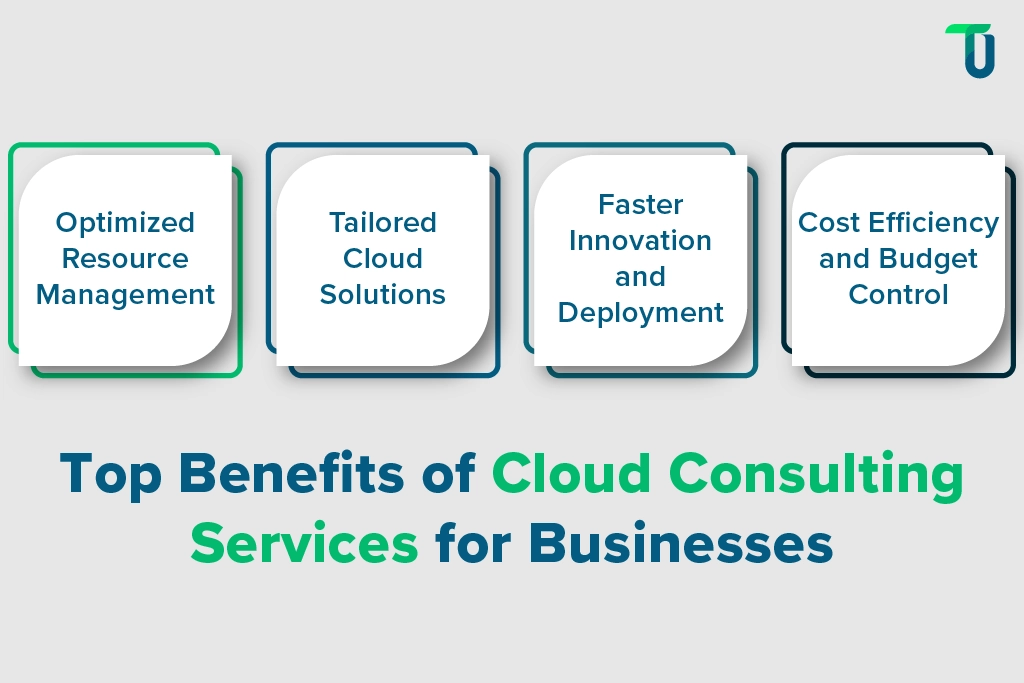
1. Optimized Resource Management
Cloud consulting helps businesses manage their resources efficiently. Consultants assess current IT infrastructure and design systems that allocate resources based on actual needs. This approach ensures that companies use only what they require, eventually reducing notable waste and expenses. Did you know, according to the Flexera 2022 State of the Cloud Report, organizations estimate that 32% of their cloud spend is wasted? The benefits of availing cloud consulting services include:
- Dynamic resource allocation
- Reduced operational waste
- Improved system efficiency
To summarize, by aligning resource usage with demand, businesses can scale operations up or down seamlessly. This flexibility is crucial for responding to market changes and maintaining optimal performance without overprovisioning.
2. Tailored Cloud Solutions
Every business has unique requirements, and cloud consulting offers customized solutions to meet these specific needs. Consultants evaluate business goals, compliance standards, and existing systems to develop a cloud strategy that fits perfectly.
- Customized cloud architecture
- Compliance with industry standards
- Integration with existing systems
This personalized approach ensures that the cloud infrastructure supports business objectives effectively. In addition, it also facilitates smoother transitions and better alignment with long-term goals.
Also Read: 7 Rs of Cloud Migration: Strategies for Moving Apps to the Cloud
3. Faster Innovation and Deployment
Cloud consulting accelerates the development and deployment of new applications and services. Consultants implement agile methodologies and DevOps practices, enabling rapid testing and iteration.
- Quick application development and deployment [Download free case study]
- Agile development processes
- Continuous integration and delivery
This speed allows companies to respond swiftly to market demands and customer feedback — a major benefit for businesses seeking SaaS scalability. Access to advanced tools and technologies through the cloud further supports ongoing innovation and competitiveness.
4. Cost Efficiency and Budget Control
Transitioning to cloud services with expert guidance helps businesses shift from capital-intensive investments to operational expenditures. The pay-as-you-go model ensures that companies only pay for the resources they use, providing greater budget flexibility.
- Optimized cloud spending
- Predictable budgeting
- Reduced capital expenses
Moreover, cloud consultants also implement cost management tools and cloud cost reduction strategies to monitor spending, identify savings opportunities, and prevent unexpected expenses. This financial oversight contributes to more predictable budgeting and improved financial health.
Related Read: Proactive Measures to Prevent Overbilling in Cloud Services
Optimize Your Cloud Strategy with Expert Consulting
Start your cloud transformation journey with TenUp. Let our experts help you scale and secure your cloud setup.
Types of Cloud Consulting Services
Cloud consulting services, often delivered as part of broader managed cloud services, can be further divided into several key sub-services, such as migration, optimization, security, integration, and disaster recovery. Let's take a closer look at each of these:
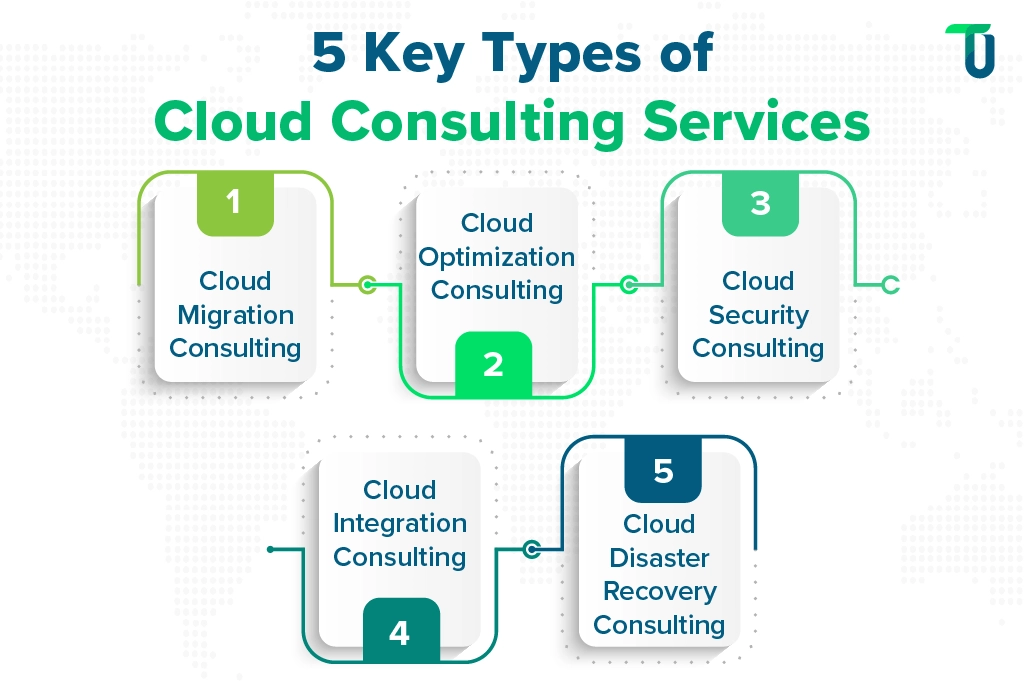
1. Cloud Migration Consulting Services
Cloud migration consulting helps businesses move applications, data, and systems from local servers to the cloud, whether the end state is fully public, hybrid, or a mix of both. Experts in this field review your current setup and choose the right cloud platform for your needs. They then create a detailed implementation plan, covering data transfer, testing, and cutover, to shift everything safely. With this type of cloud consulting, your transition becomes smooth, secure, and cost-effective.
Related Read: Why Cloud Migration Services are Key to a Secure and Agile Business
2. Cloud Optimization Consulting
After moving to the cloud, many businesses realize they are not using it efficiently. That is where cloud optimization consulting steps in, covering both one-time tuning and the ongoing cloud operations consulting work of tracking usage and adjusting resources over time. These experts check how resources are used and make changes to avoid waste. They help reduce costs, boost speed, and improve overall system performance, including guidance on how to optimize AWS/Azure spending and explore how cloud consulting can facilitate Supercloud adoption. Pricing for this work commonly follows a percentage-of-savings model or a fixed monthly retainer rather than a one-time project fee, since the value compounds over time. This form of cloud consulting ensures you get the most value from your cloud setup.
Related Read: A Complete Guide to Cloud Cost Optimization
3. Cloud Security Consulting
Security must stay a top priority in any cloud system. Cloud security consulting offers a clear view of your current risks and helps build a strong protection plan. Experts put tools in place like encryption, firewalls, and access controls. They also help follow rules like GDPR and HIPAA. This type of cloud consulting gives you the confidence to store and manage data safely.
Access Case Study: How TenUp applied military grade security to a SaaS product using Split Key Cryptography.
4. Cloud Integration Consulting
Many companies rely on different software tools, and increasingly different cloud providers, to handle daily tasks. Cloud integration consulting connects these tools and platforms so they work well together, including for businesses running multi-cloud environments across AWS, Azure, and Google Cloud at once. Experts create links between systems, help data move easily, and improve workflows. This type of cloud consulting reduces errors, saves time, and helps teams make faster decisions.
5. Cloud Disaster Recovery Consulting
Unexpected issues like cyberattacks or hardware failures can stop a business in its tracks. Cloud disaster recovery consulting helps set up a backup plan before problems happen. Consultants prepare systems that store copies of your data in safe places and make sure recovery happens quickly. This form of cloud consulting keeps your business running, no matter what comes your way.
To encapsulate, by selecting the right cloud consulting support, companies can reduce costs, enhance security, and minimize downtime.
TenUp’s Take: When choosing a cloud consulting company, ensure they have expertise in your specific needs– whether it’s migration, optimization, security, integration, or disaster recovery. They should be able to create solutions that make your cloud experience smoother, more secure, and cost-effective.
Enterprise Cloud Consulting: What Changes at Scale
Enterprise cloud consulting covers the same core disciplines as SMB engagements, migration, optimization, security, integration, and disaster recovery, but adds a layer of complexity that smaller engagements rarely face: multiple business units, legacy systems that can't move all at once, and compliance requirements that shift by region. Here's what typically changes once an engagement moves from SMB to enterprise scale.
1. Multi-Region and Hybrid Architecture Become the Default
Enterprises rarely run on a single cloud region or a single deployment model. Most maintain a hybrid setup, keeping some workloads on-premises for latency, compliance, or legacy reasons while shifting others to public cloud. Consultants working at this scale need to design for data consistency and failover across regions, not just within one. For a deeper breakdown of how public, private, hybrid, and multi-cloud models compare, see TenUp's guide to cloud deployment models.
2. Multi-Cloud Governance Adds a Coordination Layer
Large enterprises often run workloads across more than one provider to avoid vendor lock-in or meet procurement requirements. This means IAM policies, cost tracking, and security controls have to stay consistent across AWS, Azure, and Google Cloud at the same time, not just within one platform. Cloud consulting at the enterprise level includes building this cross-provider governance layer so no single team is left guessing which rules apply where.
3. Vendor and Compliance Complexity Scales With Business Units
An enterprise with multiple divisions, each running its own tools and vendor contracts, faces integration and compliance challenges an SMB never encounters. Consultants have to reconcile differing data residency rules, industry frameworks like HIPAA or PCI-DSS, and internal governance policies across every business unit involved. Getting this wrong doesn't just slow a project down, it can surface as an audit failure months after go-live.
TenUp's Take: enterprise engagements fail less often because of the technology and more often because no one mapped which business unit owns which compliance requirement before migration started. That mapping exercise belongs in week one, not after the first audit finding.
How to Choose the Right Cloud Consulting Company?
To have a productive and successful digital transformation, it is essential that you find the right cloud consulting company that is knowledgeable and can guide you through every development phase. You can also explore our step-by-step guide to cloud software development to understand what technical expertise and planning are needed before partnering with a consultant. Here is a step-by-step guide to choosing the right cloud consulting company:
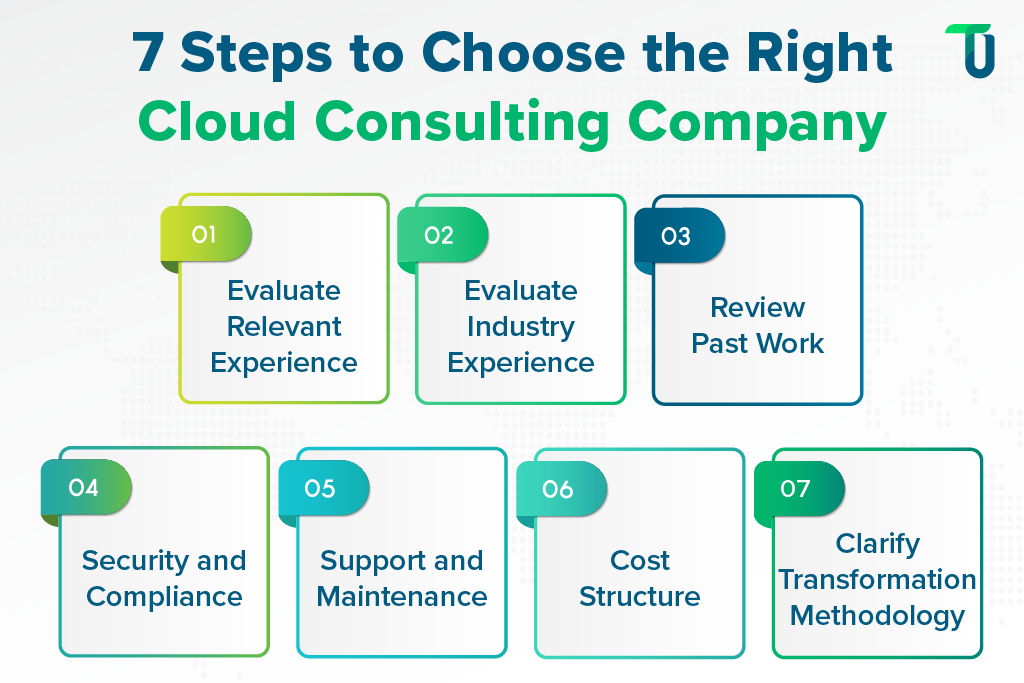
Step 1: Evaluate Relevant Experience
Start by checking the company's track record with the specific cloud platform you plan to deploy: AWS, Azure, or Google Cloud. Then verify certifications that back up that experience, such as AWS Certified Solutions Architect, Microsoft Certified: Azure Solutions Architect Expert, or Google Cloud Professional Cloud Architect.
Step 2: Evaluate Industry Experience
Find a company that also has industry experience and understands your industry context, healthcare, finance, retail, or SaaS, for example. A SaaS company should look for experience with multi-tenant architecture and usage-based billing, just as a healthcare company should look for HIPAA experience. Industry context puts a consultant in the best position to resolve the problems specific to your business.
Step 3: Review Past Work
Explore the company's past projects and successes to determine the likelihood that they will be effective at completing a similar project. Client testimonials, along with a case study, will help you determine if you and your anticipated outcomes will be accomplished.
Step 4: Security and Compliance
Security is always a top priority when leveraging cloud services. Make sure that your vendor has security measures in place that are strictly followed and are compliant with industry standards like GDPR or HIPAA.
Step 5: Support and Maintenance
When you have your cloud environment established, you will need support and maintenance. A provider that supports you will also be able to provide maintenance should concerns arise. A provider that offers support will ensure that your environment is operating properly with the least amount of downtime.
Step 6: Cost Structure
Before you make a final decision, it is important to understand the Cloud consulting company's pricing structure. Make sure that there are no hidden costs in their pricing, and most importantly, that it fits into your budget. Knowing the price structure from the vendor gives you the peace of mind that you will not have any surprises.
Step 7: Clarify Their Transformation Methodology
Ask how the firm structures a transformation engagement, not just a migration. Some providers run a phased, waterfall-style rollout with fixed milestones and formal sign-off at each stage. Others run agile sprints with continuous testing and incremental releases. The right fit depends on how much change your organization can absorb at once, and in regulated industries, how much formal sign-off each stage requires. Ask for a sample project timeline before you sign so you know what to expect at each stage, not just the end date.
By following these steps, you can confidently go about choosing the right cloud partner that aligns with your business goals and industry needs.
Key Questions to Ask Your Cloud Consulting Partner
Choosing the right cloud consulting partner begins with asking the right questions. The right questions help you understand their expertise, reliability, and how well they align with your business needs. Here are the top 15 questions to ask your cloud consulting partner:
1. What experience do you have with businesses like mine?
2. Which cloud platforms do you specialize in?
3. How do you approach cloud migration?
4. What security measures are in place to protect our data?
5. How do you handle data backup and disaster recovery?
6. What support and maintenance services do you offer after setup?
7. What certifications does your company have?
8. How do you make sure we follow all required regulations?
9. What are your service level agreements (SLAs)?
10. Can we scale resources easily with your services?
11. What is your pricing structure?
12. How do you monitor system performance?
13. What happens if there is a security breach or system issue?
14. Where is our data stored, and how?
15. Can you share references from past clients?
Asking these questions gives you clarity before committing. In other words, these questions help you find a cloud consulting company that offers the right skills, support, and security to match your goals.
Achieve Successful Transformation with TenUp’s Cloud Consulting Services
Cloud consulting is crucial for businesses looking to move, improve, and scale their systems efficiently — particularly in sectors where cloud development is becoming critical to digital payments and secure transactions. With expert support, companies can boost performance, protect data, and save costs– all while achieving their goals.
Join forces with TenUp Software Services – a leading provider of expert cloud consulting services, committed to delivering innovative solutions that drive efficiency, security, and business growth. Our expertise in AWS, DevOps, and serverless computing helps deliver tailored cloud solutions that drive efficiency, security, and growth.
Achieve Cloud Excellence with TenUp’s Expertise
Ready to grow your business with a personalized cloud strategy? Let our experts craft the perfect cloud solution for you!
Frequently asked questions
What is the average cost of hiring a cloud consulting firm?

Cloud consulting fees typically range from $5,000 to $50,000+ per project, depending on complexity. Hourly rates can vary from $50 to $250, with some firms offering monthly retainers for ongoing support.
Costs depend on the scope, tech stack (AWS, Azure, etc.), and expertise required. Always request a tailored quote for accurate pricing.
How much do cloud modernization consulting services typically cost for mid-size companies?
Mid-size companies typically spend $50,000 to $500,000+ on cloud modernization consulting. Costs vary mainly by application count, migration complexity, refactoring effort, security work, and compliance requirements. Simple lift-and-shift projects sit at the low end; multi-application modernization with dependency mapping and re-architecture sits at the high end.
How long does it take to complete a full cloud migration?
Most cloud migrations take 4 weeks to 6+ months, depending on data size, app complexity, and team readiness. Smaller projects move faster, while enterprise migrations with integrations and compliance needs take longer.
Strong planning and testing can significantly reduce delays.
What are the best cloud cost reduction strategies for small businesses?
Small businesses can cut cloud costs by rightsizing compute resources, automating scale-down of idle workloads, and using reserved or spot instances. Optimizing storage tiers, reducing cross-region data transfer, and adopting serverless where possible can also boost savings. A cloud consultant helps align cost-efficiency with scalability and digital transformation goals.
How does cloud infrastructure consulting help with digital transformation?
Cloud infrastructure consulting accelerates digital transformation by modernizing IT systems, designing scalable architectures, and optimizing cloud resources. Consultants guide seamless cloud migration, improve agility, ensure compliance, and unlock data-driven innovation—helping businesses move faster, scale smarter, and stay competitive.
What’s the most effective way to optimize AWS or Azure spending?
Maximize AWS or Azure savings by combining cost monitoring tools, rightsizing, reserved instances, and automated scaling. Cloud consultants can audit your usage and build a tailored cost optimization plan—ensuring performance, compliance, and long-term efficiency.
Why should SMBs hire cloud consultants instead of going solo?
SMBs benefit from cloud consultants by avoiding misconfigurations, reducing costs, and ensuring secure, compliant cloud adoption—without building a full tech team. Consultants deliver tailored, scalable solutions that improve performance and accelerate digital transformation.
How do I choose the right cloud consulting partner for long-term growth?
Choose a partner with industry-specific expertise, certified cloud engineers, and a strong security track record. The right consulting firm should support SaaS scalability, continuous optimization, and seamless integration—ensuring your cloud strategy evolves with your business.
How does cloud consulting fit into an overall IT infrastructure strategy?
Cloud consulting modernizes your IT infrastructure by integrating cloud-native and hybrid environments, replacing outdated systems, and architecting scalable, secure solutions. It ensures your tech stack is agile, cost-efficient, and aligned with business growth.
Share the Article


