



Here's the hard truth: most cloud transformations don't fail because of technology — they fail because of chaos. Misaligned goals, missing governance, poor observability, weak IAM setups, and a lack of structured cloud engineering services create gaps long before workloads ever reach production. In fact, recent industry data shows that about 94% of enterprises worldwide already use cloud computing services — yet many still struggle to translate that adoption into real business value. Ask any CTO or CEO who has survived a large-scale deployment, and you'll hear the same list: spiraling costs, compliance surprises, multi-cloud complexity, and teams firefighting issues that should have been engineered upfront. The outcome? Delays, downtime, cost overruns, and diluted ROI. Cloud platforms promise agility and scalability, but without a disciplined engineering ecosystem — IaC, CI/CD pipelines, FinOps governance, observability, and multi-cloud readiness — that promise quickly becomes an expensive experiment. The enterprises that succeed treat cloud adoption as an ongoing engineering lifecycle, not a one-time migration. This blog is your cloud engineering playbook: a before, during, and after deployment checklist with automation, security, and cost control built in from day one. Because in 2026, cloud success isn't just about getting there — it's about staying there.
Understanding Cloud Engineering Services
Cloud engineering isn’t just about spinning up servers or migrating workloads. It’s about creating an intelligent, automated, secure, and cost-efficient foundation that converts cloud investments into measurable business results. Modern cloud engineering services for enterprises combine architecture, automation, FinOps, security, CI/CD, and observability into one unified engineering framework.
For CTOs and CEOs, this is where the distinction matters. Cloud engineering services for enterprises go far beyond migration or cloud consulting—they integrate strategy with hands-on execution through Infrastructure as Code (IaC), DevOps automation, Kubernetes orchestration, multi-cloud architecture design, identity governance, and continuous monitoring. In simple terms, it’s how enterprises engineer the cloud to work for them, not the other way around.
So, why does having a services checklist matter? Because today’s environment involves distributed systems, fast-changing compliance rules, escalating cloud costs, and multi-cloud complexity. A well-defined checklist ensures no stage is left vulnerable—covering readiness assessments, architecture design, CI/CD readiness, IAM, observability setup, and post-deployment optimization. This reduces misconfigurations, avoids vendor lock-in, and ensures cost predictability.
Think of it as your operational guardrail. It aligns business goals with technical outcomes, helps manage risks early, and creates accountability across teams. With the right cloud engineering partner, this checklist becomes more than documentation; it becomes your blueprint for innovation, resilience, and long-term scalability.
Pre-Deployment Checklist: Setting the Foundation Right
Every successful cloud journey begins long before the first workload is deployed. The pre-deployment phase is where your Enterprise cloud migration strategy connects with engineering discipline. It’s where you define why you’re moving to the cloud, what success looks like, and how you’ll get there without compromising on cost, compliance, or control.
For CTOs and CEOs, this is the stage that determines whether cloud becomes a sustainable growth engine—or a recurring cost burden filled with surprises, misconfigurations, and inefficiencies. Here’s what your pre-deployment checklist should include:
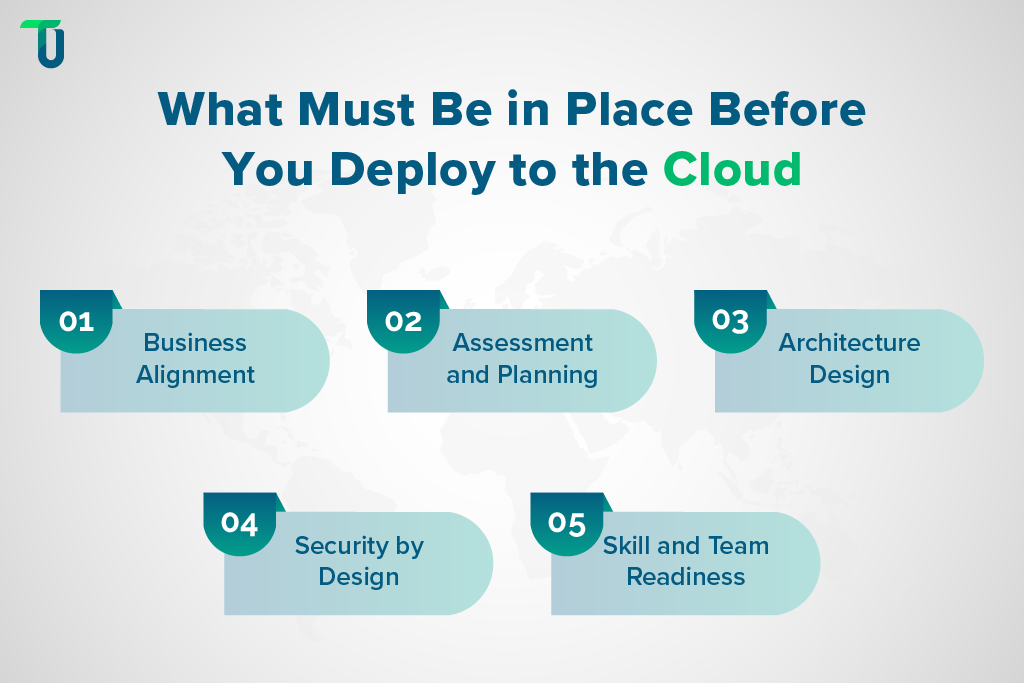
1. Business Alignment
Before any technical work begins, align your cloud strategy with business goals. Define measurable KPIs—agility, scalability, operational efficiency, cost optimization, deployment velocity—and map them to engineering outcomes. Include:
- FinOps KPIs
- Availability SLAs
- Security requirements
- Multi-cloud needs
- Future modernization goals
This alignment ensures every engineering decision directly contributes to business value and eliminates misdirection later.
2. Assessment and Planning
Start with a comprehensive cloud readiness assessment that reviews legacy systems, technical debt, compliance rules, data residency needs, workload dependencies, and multi-cloud suitability — see legacy modernization and migration best practices — for a structured approach to assessment and migration planning for:
- IaC readiness (Terraform/Pulumi)
- CI/CD pipeline setup
- FinOps model and cost visibility
- Baseline IAM structure
- Monitoring & observability stack (APM + logs + metrics)
- Security posture and governance
This prevents mid-deployment surprises and ensures cloud adoption begins on a stable, fully engineered foundation.
3. Architecture Design
The right architecture is the backbone of cloud success. Beyond selecting public, private, hybrid, or multi-cloud, define the architecture around:
- Portability (containers, Kubernetes, API-first design)
- Zero-trust security
- Network reliability & multi-region strategy
- Scalability patterns (auto-scaling, serverless, microservices)
- Vendor lock-in mitigation
- Data governance & sovereign-cloud considerations
Thinking about portability and long-term flexibility early prevents costly rework and ensures future scalability.
4. Security by Design
Security should never be an afterthought; it must be engineered into the foundation. Build:
- Zero-trust framework
- IAM roles, policies, and privileged-access cont
- Encryption standards for data in transit & at rest
- Compliance baselines (ISO, SOC2, HIPAA, PCI)
- CSPM scanning for misconfigurations
- Sovereign cloud & data residency policies (if multi-region)
Embedding security during design prevents breaches, ensures audit readiness, and eliminates late-stage compliance blockers.
5. Skill and Team Readiness
Even the best strategy fails without the right skills. Assess engineering readiness for:
- Infrastructure as Code (Terraform/GitOps)
- CI/CD pipelines
- DevOps & automation tooling
- FinOps cost governance
- Monitoring & observability
- Cloud security frameworks
- Container orchestration (Kubernetes/EKS/GKE/AKS)
If internal gaps exist, hire cloud engineering experts to accelerate delivery without compromising quality or security.
A strong foundation is not about over-preparation; it is about precision. When every checklist item is accounted for, deployment becomes predictable, efficient, and built for scale.
Before cloud deployment, pressure-test your foundation.
Surface gaps early and set up cloud environments that won’t unravel later. TenUp Soft’s cloud engineering experts can guide that process.
Deployment Checklist: Executing with Precision
This is where plans turn into action. The deployment stage defines how smoothly your cloud journey transitions from blueprint to business value. It is the point where precision matters most because every configuration, migration, and automation step directly impacts scalability, performance, and cost efficiency.
For enterprise leaders, this is the make-or-break phase. Deployment must follow a repeatable, automation-first, version-controlled process, backed by continuous testing, observability, and security validation to ensure a smooth, predictable rollout.
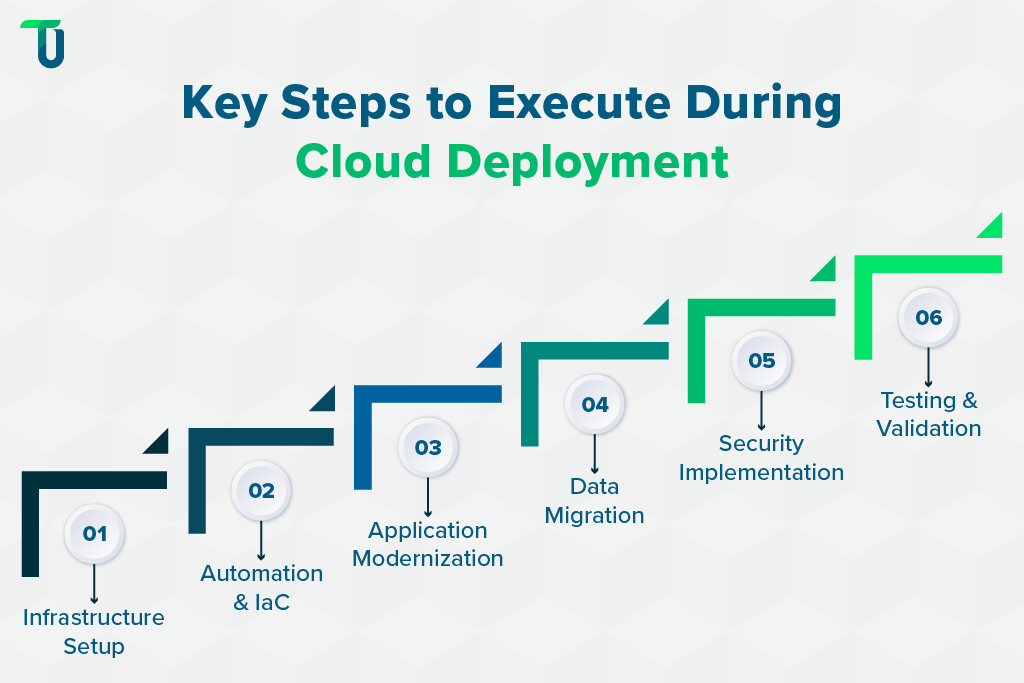
1. Infrastructure Setup
Lay the groundwork with a reliable, automated infrastructure setup using Infrastructure as Code (Terraform, Pulumi) — consider engaging professional IaC implementation services. Configure:
- Networking (VPCs, subnets, routing, firewalls)
- Compute & storage aligned to workload patterns
- High availability, multi-AZ, and failover
- Load balancers & auto-scaling groups
- Observability agents and baseline monitoring
- IAM roles and least-privilege access
Designing availability, resiliency, and visibility upfront prevents outages and ensures predictable scaling.
2. Automation and Infrastructure as Code (IaC)
Manual configurations cause drift, downtime, and inconsistent environments. Use Terraform, Pulumi, Ansible, GitOps workflows (ArgoCD, Flux) to fully automate provisioning and configuration management.
Add:
- Version-controlled IaC repositories
- Policy-as-code (OPA, Sentinel)
- Automated security checks before deployment
- Automated rollback for failed deployments
IaC ensures repeatability, governance, and compliance across all environments, eliminating manual errors.
3. Application Modernization
Cloud migration is no longer about simple lift-and-shift. Evaluate which applications should be:
- Rehosted
- Refactored
- Re-architected (microservices)
- Rebuilt cloud-native
Modernization includes adoption of containers & Kubernetes, serverless functions, API-driven architecture, event-driven workflows, and re-architecting applications through cloud application development with microservices.
This improves scalability, resilience, cost efficiency, and reduces vendor lock-in—all essential for long-term growth.
4. Data Migration
Migrate data securely using lossless, encrypted, compliance-ready workflows. Include:
- Pre-migration backups
- Automated validation & checksum verification
- Zero-downtime or minimal-downtime strategies
- Encryption in transit & at rest
- Masking or tokenization for sensitive datasets
- Data residency & sovereignty compliance checks
- Multi-region replication if needed
Following a structured data migration process ensures accuracy, security, and compliance.
5. Security Implementation
Security doesn’t stop at design—it must be actively enforced during deployment. Strengthen your environment with:
- Strict IAM roles & least-privilege access
- Key rotations & encryption policies
- CSPM tools (Prisma, Wiz, AWS Security Hub)
- Real-time threat detection (SIEM + SOAR)
- Secret management (Vault, AWS Secrets Manager)
- Automated security scanning in CI/CD
This ensures all resources remain compliant, monitored, and protected from day one.
6. Testing and Validation
Never assume deployment is complete until it has passed full, automated validation. Conduct:
- Load testing & stress testing
- Performance benchmarking
- Failover & disaster recovery testing
- Automated security scans
- Blue-Green or Canary deployments for safe rollouts
- Cost anomaly tests
- Monitoring & observability validation (logs, traces, metrics)
Testing ensures your cloud environment is resilient, scalable, optimized, and ready for production workloads.
A well-executed deployment phase minimizes risk and accelerates time to value. With automation, validation, and continuous monitoring in place, you create a cloud environment that is not just operational but optimized from day one.
Post-Deployment Checklist: Ensuring Long-Term Success
Going live isn’t the finish line—it’s the start of continuous engineering. Once cloud workloads are active, the focus shifts to performance, observability, security hardening, cost governance (FinOps), and operational resilience. This stage determines whether your cloud environment simply “runs” or continuously delivers business value at scale.
Post-deployment success is about stability and scalability in motion - how well your systems adapt, evolve, and sustain performance without draining resources or exposing vulnerabilities. Here’s what should be on your post-deployment checklist:
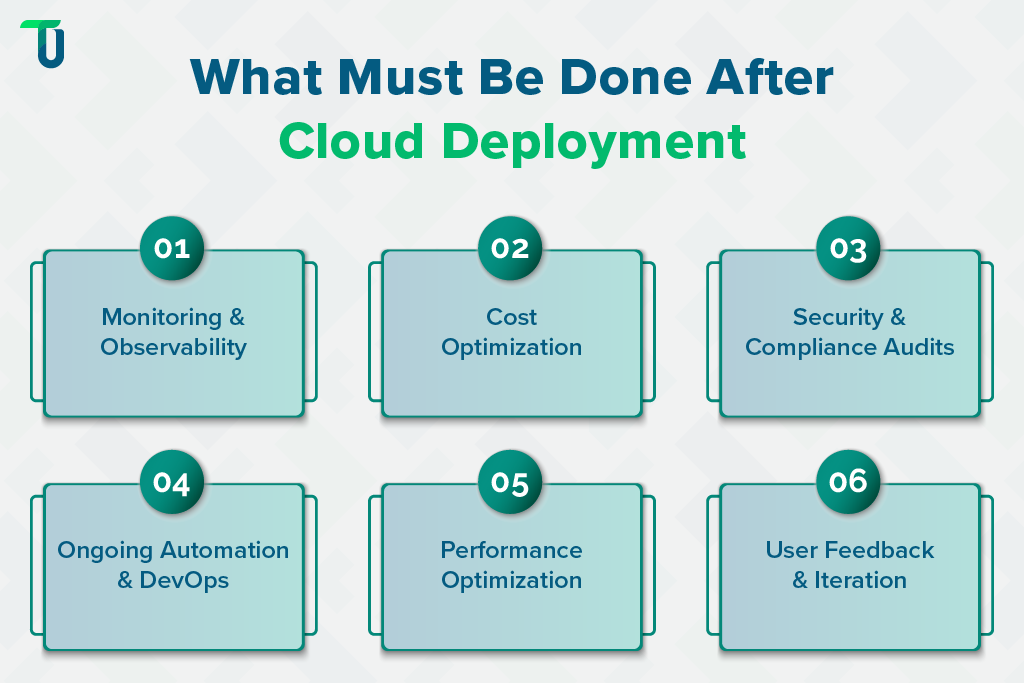
1. Monitoring and Observability
Visibility drives control. Implement a complete observability stack using Datadog, Prometheus, Grafana, OpenTelemetry, or cloud-native APM tools to monitor:
- Uptime & latency
- Application performance
- Real-time logs, traces & metrics
- Usage spikes & anomaly behavior
Add AIOps for automated root-cause detection and predictive alerts. Build dashboards that provide visibility for engineering, DevOps, FinOps, and leadership teams. This ensures bottlenecks are detected early—before users or costs are impacted.
2. Cost Optimization (FinOps)
Cost discipline doesn’t end after migration—it becomes a daily practice. Adopt a FinOps operating model to ensure complete cost visibility, including:
- Rightsizing compute & storage
- Automatic shutdown of idle resources
- Reserved instance vs on-demand evaluations
- Tagging policies for accountability
- Cross-team cost governance
- Cost anomaly alerts & dashboards
- Chargeback/showback for transparency
FinOps ensures cloud spending directly aligns with performance, usage, and business outcomes—eliminating waste and improving predictability.
3. Security and Compliance Audits
Continuous compliance is non-negotiable. Strengthen your post-deployment security posture with:
- Regular IAM audits & least-privilege reviews
- CSPM scans (Prisma, Wiz, AWS Security Hub)
- SIEM + SOAR integrations for real-time threats
- Encryption & key rotation audits
- Compliance frameworks (ISO, SOC 2, HIPAA, PCI-DSS)
- Data residency & sovereignty checks for multi-region workloads
- Automated drift detection
This ensures that as workloads evolve, your security and compliance posture stays strong, consistent, and audit-ready.
4. Ongoing Automation and DevOps
Automation doesn’t stop at deployment—it becomes the backbone of long-term cloud operations. Maintain:
- CI/CD pipelines for continuous delivery
- Automated patching & dependency updates
- GitOps workflows for configuration changes
- Auto-scaling & self-healing mechanisms
- Automated compliance checks
- Infrastructure drift detection
Continuous automation improves reliability, accelerates releases, and ensures operational consistency across all environments.
5. Performance Optimization
Cloud environments require continuous performance tuning. Optimize workloads for:
- Latency & throughput
- Auto-scaling efficiency
- Load balancing strategies
- Storage & caching behavior
- Container & Kubernetes resource limits
- API response performance
- Multi-region failover
Use analytics, AIOps, and feedback loops to predict usage, detect anomalies, and refine performance—without overspending or overprovisioning.
6. User Feedback and Iteration
Successful cloud systems evolve through continuous feedback. Gather insights from business teams, DevOps, support teams, and end users to identify:
- Performance gaps
- Feature requests
- Workflow friction
- Cost inefficiencies
- Security or compliance concerns
Feed this input into your engineering backlog, architecture roadmap, CI/CD pipelines, and FinOps reviews to drive meaningful, continuous improvements. Iteration keeps your cloud environment aligned with real-world needs and long-term adoption.
The post-deployment phase is where operational excellence meets business agility. It transforms a completed deployment into a living ecosystem that adapts, optimizes, and fuels innovation continuously.
Common Challenges Across the Cloud Engineering Lifecycle
Even the most well-planned cloud engineering initiatives face hurdles. The difference between success and struggle often lies in identifying these risks early—especially around cost, security, skills, and multi-cloud complexity. For CTOs and CEOs, understanding what typically goes wrong helps you build the right safeguards into your strategy.
Here are the most common challenges enterprises encounter across the cloud engineering lifecycle:
1. Cost Overruns Due to Poor Planning
Without a clear roadmap, cloud spending can spiral out of control. Unused resources, over-provisioned instances, and lack of visibility often lead to budget surprises. Adding FinOps consulting and cost optimization services and automated cost alerts can prevent overspending and keep cloud investments accountable.
2. Security Gaps in Hybrid and Multi-Cloud Setups
Managing consistent security policies across multiple environments—especially when evaluating hybrid vs multi-cloud vs supercloud strategies—is complex. Misconfigurations, weak IAM controls, and fragmented visibility expose organizations to risk. Adding Zero Trust, IAM audits, and CSPM tools helps maintain a unified and compliant security posture.
3. Talent and Skills Shortage
Cloud engineering demands specialized skills in automation, DevOps, and architecture. Many enterprises struggle to upskill teams fast enough. Including IaC, CI/CD, and cloud security training—or partnering with experienced providers—helps bridge the gap effectively.
4. Vendor Lock-In and Portability Issues
Relying too heavily on a single cloud provider can limit flexibility and inflate long-term costs. Building portable, API-first architectures and adopting containerization or Kubernetes ensures workloads can move seamlessly across platforms without disruption.
5. Managing Data Residency and Sovereignty Requirements
As global data regulations tighten, ensuring data compliance across regions is a growing challenge. Adding data residency rules and encryption policies helps meet local and international standards.
Use Cases of Cloud Engineering Services Across Industries
Cloud engineering is not one size fits all. Every industry has its own operational priorities, regulatory pressures, and scalability challenges. What remains constant is the requirement for security, automation, observability, and cost efficiency—outcomes delivered through structured cloud engineering.
Here’s how leading industries are leveraging cloud engineering to unlock measurable business value.
1. Financial Services: Meeting Compliance at Scale
The financial sector operates under constant regulatory pressure, where compliance and performance go hand in hand. Cloud engineering services enable secure infrastructure that aligns with frameworks like PCI-DSS, SOC 2, and ISO 27001.
Through automation, encryption, and access control, banks and fintechs can scale digital services without compromising on governance. Real-time monitoring and infrastructure as code (IaC) ensure compliance audits are faster, consistent, and verifiable across multiple regions.
Outcome: Improved audit readiness, stronger data protection, and faster rollout of new digital products without regulatory bottlenecks.
2. Healthcare: HIPAA-Compliant Data Migration and Security
Healthcare organizations face the dual challenge of managing sensitive patient data while modernizing legacy systems. Cloud engineering bridges this gap by designing HIPAA-compliant architectures that enable secure data migration, encrypted storage, automated backups, and role-based access control.
Automation in backup, data replication, and recovery ensures 24/7 availability, which is essential for mission-critical healthcare systems.
Outcome: Seamless interoperability, reduced compliance risks, and improved patient data access through secure cloud infrastructure.
3. Retail: Scaling for Peak Demand with Automation
Retail thrives on agility and customer experience. During high-demand seasons, scalability becomes a competitive advantage. Cloud engineering introduces auto-scaling, load balancing, Kubernetes orchestration, and CI/CD pipelines to ensure high performance, even under heavy traffic.
Continuous integration and deployment pipelines (CI/CD) help retailers push updates faster, while real-time observability tools minimize downtime during flash sales or campaign launches.
Outcome: Higher availability during peak traffic, faster innovation cycles, and optimized infrastructure costs through automation.
4. Manufacturing: IoT and Edge Integration with Cloud Services
Modern manufacturing depends on connected devices, predictive maintenance, and real-time insights. Cloud engineering enables seamless IoT integration through scalable data pipelines, event-driven architectures, and centralized analytics on the cloud.
Engineers can process sensor data at the edge while storing and analyzing large datasets in the cloud for predictive analytics. Security frameworks ensure device integrity and data consistency across the production line.
Outcome: Reduced downtime, optimized operations, and data-driven decision-making powered by IoT cloud synergy.
Future-Ready Cloud Engineering Services Checklist
Cloud engineering in 2026 is no longer about keeping systems online. It is about engineering for intelligence, sustainability, and speed. As technologies like AI, edge computing, and platform engineering reshape enterprise operations, organizations need a forward-looking checklist to stay competitive and resilient.
Here’s what future-ready cloud engineering looks like.

1. Incorporating AI and ML for Predictive Operations (AIOps)
Cloud operations are becoming proactive, not reactive. AIOps platforms use machine learning to predict system anomalies, automate root cause analysis, and optimize performance in real time. By integrating AIOps, enterprises can reduce downtime, improve incident response, and achieve operational excellence without manual intervention.
Checklist Tip: Integrate AI-driven insights into your monitoring stack to automate decision-making and reduce mean time to resolution (MTTR).
2. Sustainability and Green Cloud Practices
Sustainability is now a boardroom priority. Cloud engineering teams are focusing on energy-efficient architectures, carbon-aware workload placement, and optimized resource utilization. Providers like AWS, Azure, and Google Cloud now offer sustainability dashboards that measure and offset emissions across workloads.
Checklist Tip: Design workloads that auto-scale based on demand and leverage serverless or containerized environments to minimize energy waste.
3. Edge Computing Integration with Cloud Services
Enterprises are increasingly pushing data processing closer to where it happens. Integrating edge and cloud systems allows for low-latency decision-making in areas like manufacturing, retail, and healthcare. A unified edge-cloud strategy enables faster response times while maintaining centralized control and governance.
Checklist Tip: Build a hybrid architecture that balances on-prem edge processing with centralized cloud analytics for both agility and oversight.
4. Shift Toward Platform Engineering as the Backbone of Enterprise Cloud
Platform engineering is redefining how teams build, deploy, and scale applications. Internal developer platforms (IDPs) streamline DevOps workflows, standardize configurations, and accelerate delivery. This approach creates consistency and improves developer productivity across multi-cloud environments.
Checklist Tip: Invest in platform engineering capabilities that provide reusable templates, self-service environments, and built-in compliance.
5. Sovereign Cloud Strategy
As data sovereignty laws evolve, enterprises need greater control over where and how their data is stored. Sovereign cloud solutions offer local compliance, regulatory assurance, and secure data residency — essential for governments, finance, and healthcare sectors operating under strict jurisdictional boundaries.
Checklist Tip: Work with providers offering region-specific sovereign cloud options and verify compliance with local data protection frameworks.
6. Quantum-Ready Security
Quantum computing may still be emerging, but its future security implications are real. Future-ready organizations are exploring post-quantum cryptography and hybrid encryption models to protect sensitive data against next-generation threats.
Checklist Tip: Begin assessing cryptographic agility now so your systems can adapt to quantum-era security standards when they mature.
Why Choose TenUp Soft for Cloud Engineering Excellence?
The difference between a cloud that works and a cloud that wins lies in how it is engineered. At TenUp Soft, we don’t just deploy workloads; we build intelligent cloud ecosystems that scale, stay secure, and sustain business growth over time.
Our cloud architecture consulting services go beyond implementation. From architecture design, IaC (Terraform/Pulumi), DevOps and CI/CD automation, to AI-powered monitoring, observability, and FinOps optimization, we support the complete cloud lifecycle. Every cloud decision is aligned with your business goals to ensure agility without overspend, performance without trade-offs, and compliance without complexity.
Our experts bring deep experience across AWS, Azure, and Google Cloud, helping enterprises modernize applications, accelerate delivery pipelines, improve Kubernetes deployments, and achieve real-time observability across multi-cloud environments. Whether you are migrating legacy workloads, building cloud-native applications, or optimizing existing infrastructure, we design with one clear goal: to make your cloud deliver measurable business outcomes.
In a world where cloud success depends on precision, TenUp Software Services helps you move from adoption to acceleration. Because the right cloud engineering partner doesn’t just take you to the cloud—they help you stay optimized, future-ready, and ahead of the curve.
Ready to build your next-generation cloud ecosystem?
Transform your cloud vision into reality with TenUp Soft. Build, optimize, and scale your cloud infrastructure with precision, performance, and confidence.
Frequently asked questions
What are Service Level Objectives (SLOs) and why do they matter in cloud engineering services?

SLOs are measurable reliability targets, like uptime or latency, that define the performance your cloud service must meet. They matter because they keep reliability aligned with business goals, guide engineering decisions through error budgets, and help teams detect and fix issues before they impact users.
How does FinOps fit into cloud engineering, and when should it start?
FinOps brings financial accountability into cloud engineering by giving teams real-time visibility into cloud costs and helping them optimize spending without slowing delivery. It should start in the planning phase, before migration, and continue as an ongoing practice throughout the cloud lifecycle.
i. In simple terms: FinOps ensures every cloud decision is cost-aware, measurable, and aligned with business value.
How do you decide between lift-and-shift and application modernization?
Lift-and-shift works best when you need a quick, low-risk migration with minimal changes, ideal for urgent timelines, limited budgets, or legacy systems that are hard to modify. Modernization is the better choice when you want long-term performance, scalability, and access to cloud-native features, like auto-scaling, serverless, or microservices.
What are the essential disaster recovery (DR) metrics like RTO and RPO?
RTO (Recovery Time Objective) defines the maximum acceptable downtime, while RPO (Recovery Point Objective) defines how much data loss is tolerable. Lower RTO/RPO values mean stronger protection for critical workloads. Cloud engineering teams use these metrics to plan DR tiers, automate backups, enable cross-region replication, and test failover to ensure recovery meets the required limits.
How should enterprises approach multi-cloud without increasing risk?
Start with one primary cloud and add multi-cloud only when needed for compliance, latency, or specific services. Use containers, Kubernetes, IaC, and consistent IAM policies to keep workloads portable and avoid lock-in. This keeps the architecture simpler and reduces multi-cloud risk.
What observability practices are essential for cloud engineering success?
Essential observability practices include collecting logs, metrics, and traces with an OpenTelemetry-based stack, adding synthetic tests, and using clear, noise-free alert rules. Teams strengthen this with AIOps for anomaly detection, SLO-driven dashboards, and proper log retention to catch issues early and maintain reliable cloud operations.
What is the best way to secure secrets and keys in cloud environments?
The best way to secure secrets is to store them in a centralized secrets manager (like Vault, KMS, or Secrets Manager), enforce automatic key rotation, and ensure secrets never appear in code or IaC files. Pair this with least-privilege IAM, short-lived access tokens, encrypted storage, and CI/CD security scans to prevent credential leaks and unauthorized access.
What is a Golden Path in platform engineering and why is it important?
A Golden Path is a standardized, pre-approved workflow that gives developers a fast, guided way to build and deploy services using best practices by default. It bundles IaC modules, CI/CD templates, service blueprints, and security patterns so teams ship reliably without reinventing the process.
Why it matters: It reduces developer friction, ensures consistent quality and security, and boosts productivity across multi-team environments.
Share the Article


