


The mobile market is no longer about just “having an app.” It is about how deeply the app integrates into a user's life and business operations. Today, organizations are investing in custom mobile app development services that prioritize scalability, performance, and long-term growth. As AI becomes foundational, your mobile app development strategy must prioritize architecture, security, and scalability. An experienced mobile app development company ensures development and maintenance drive measurable results.
The importance of strong mobile strategy is reflected in market growth; the global mobile application market is projected to reach USD 864.5 billion by 2031, reinforcing how mobile solutions have become core revenue and engagement channels. This guide outlines the 11 best strategies for custom mobile application development, while also explaining what comprehensive custom mobile app development services include, from consulting and UI/UX design to development, testing, deployment, and long-term support. It also covers the cost of custom mobile app development in the USA, cross-platform approaches, personalization strategies, and selecting the right tech stack for scalable mobile apps.
Understanding Custom Mobile App Development in 2026
Custom mobile software development has evolved from simple feature delivery to full-scale product engineering. In 2026, businesses demand apps built around real workflows, measurable outcomes, and long-term scalability. Unlike template-based solutions, custom mobile app development services provide complete ownership, stronger security controls, and architecture designed for future growth across devices and platforms.
Below are the core factors that define modern custom mobile application development:
- A clear mobile app development strategy aligned with business objectives, user needs, and scalability goals.
- Cross-platform mobile app development using frameworks like Flutter and React Native, combined with native capabilities when required.
- Artificial intelligence and machine learning integration for personalization, automation, and smarter user flows.
- Strong focus on UX/UI design best practices, performance optimization, security, and data privacy.
In practical terms, comprehensive custom mobile app development services include consulting, architecture planning, UI/UX design, development, testing, deployment, and long-term mobile app maintenance.
Partnering with a reliable mobile application development company or experienced mobile app development firm ensures that architecture decisions, performance optimization, and security planning support sustainable business growth rather than short-term feature releases.
Custom Mobile App Development vs Off-the-Shelf App Solutions
When evaluating mobile solutions, businesses often compare custom mobile app development services with ready-made or template-based applications. While off-the-shelf apps may reduce initial setup time and cost, they typically limit scalability, integration flexibility, and long-term performance optimization.
For organizations building a core digital product or revenue channel, the decision directly impacts ownership, security, and competitive advantage.
| Factor | Custom Mobile App Development | Off-the-Shelf App Solutions |
|---|---|---|
| Ownership | Full code and IP ownership | Limited control, vendor dependent |
| Scalability | Built for long-term growth | Restricted by platform limitations |
| Performance Optimization | Fully optimized for use case | Generic performance tuning |
| Integration | Seamless API & system integration | Limited third-party integration |
| Security & Data Privacy | Custom security architecture | Shared infrastructure risks |
| Personalization | Deep user-level customization | Template-based features |
| Long-Term Cost | Higher upfront, lower long-term cost | Lower upfront, higher scaling cost |
| Competitive Advantage | Unique market differentiation | Similar features as competitors |
| Best For | Enterprises, startups building core products | Small businesses needing quick deployment |
Off-the-shelf solutions may suit short-term or low-complexity needs. However, businesses seeking scalability, ownership, and long-term ROI typically benefit from investing in structured custom mobile app development services delivered by an experienced mobile app development company.
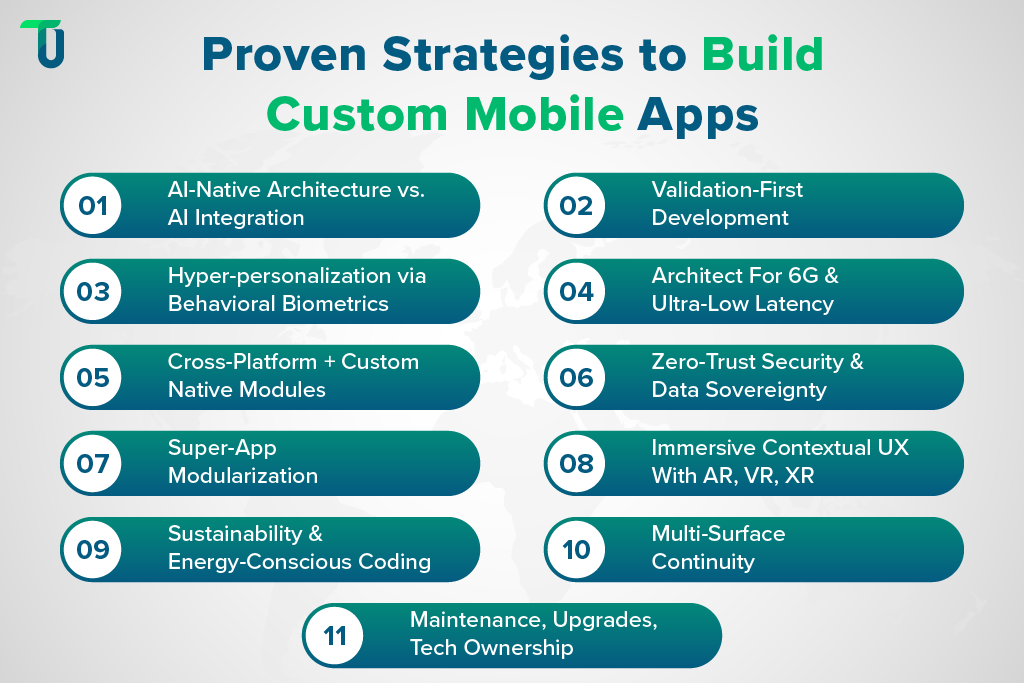
Top 11 Strategies for Custom Mobile App Development
The mobile market has moved beyond simple utility toward intelligent, adaptive, and context-aware experiences. To compete, your mobile app development strategy must embrace these eleven transformative shifts that redefine how users interact with their digital world.
Strategy 1: AI-Native Architecture vs. AI Integration
When teams talk about adding AI to a mobile app, they often mean two very different things. Some teams bolt AI onto an existing system as a feature. Others design the entire app with AI at its core. This early decision affects architecture, UX, data flow, and long-term cost more than most teams expect.
AI-native architecture treats intelligence as a foundational layer. AI integration, on the other hand, places intelligence on top of an already defined system.
Take a look at the table below that provides a quick glance at how these two approaches differ in design, performance, and long-term impact:
| AI-native architecture | AI integration | |
|---|---|---|
| System role | Intelligence is core to the app | Intelligence is an add-on feature |
| Data handling | Continuous, adaptive pipelines | Request-based or batch processing |
| User experience | Predictive, context-aware | Reactive, command-driven |
| Scalability | Designed for growth and complexity | Limited to specific use cases |
| Cost over time | Optimized for long-term efficiency | Can increase as features expand |
What makes an app truly AI-native?
- Data pipelines designed to support learning over time
- AI models embedded into core user workflows
- Real-time inference support at edge and cloud levels
- User journeys shaped by predictions, not manual input
AI-native systems enable smarter automation, dynamic personalization, and improved performance over time, especially in enterprise-grade mobile solutions.
When AI integration still Makes Sense
- Narrow use cases like search, chat, or tagging
- Legacy apps under phased modernization
- Strict budgets or regulatory limits
- Proof-of-concept or pilot products
This approach suits teams that want controlled scope without deep system changes.
For businesses investing in long-term products through comprehensive custom mobile app development services, AI-native architecture typically delivers stronger scalability, personalization, and return on investment. AI integration may suit short-term or limited-scope applications, but it rarely supports sustained product evolution.
Strategy 2: The "Validation-First" Development Cycle
One of the biggest reasons mobile apps fail is poor validation. Many teams build full-featured products before confirming real user demand, technical feasibility, or market fit. A validation-first approach, commonly embedded in structured custom mobile app development services, reduces this risk by testing assumptions before large-scale development begins.
Instead of investing heavily upfront, this model focuses on measurable learning and phased execution.
How Validation Protects Your Investment?
The enterprise mobile app development strategy 2026 prioritizes these early checks to gather real behavioral data. For businesses concerned about the cost of custom mobile app development in the USA, early validation directly improves ROI by eliminating non-essential features before full implementation.
- Evidence-Based Backlogs: Only build features that show high engagement during the prototyping phase.
- Modular MVPs: Launch small, focused components to test specific business hypotheses in real-market conditions.
- Reduced Risk: Identify technical hurdles during "spikes" rather than a week before launch.
Key Impact: For organizations investing in custom mobile app development services, a validation-first model creates a structured path from idea to scalable product. It keeps projects lean, lowers risk, and improves the likelihood of launching a market-ready solution.
Benefits of a Validation-First Approach
- Avoid high costs associated with features that provide no value.
- Get total clarity on the app development process from day one.
- Create a realistic budget and timeline based on proven needs.
- Gain a competitive edge by launching a product that fits the market perfectly.
To summarize, this approach aligns with the best practices of custom mobile app development 2026. It ensures your project stays lean, efficient, and relevant to the modern market.
Strategy 3: Hyper-personalization Through Behavioral Biometrics
Mobile app personalization has moved beyond static profiles and preferences. Today, behavioral biometrics read how users interact with devices such as how they type, swipe, hold their phone, or even walk. These subtle patterns allow apps to adapt and secure themselves without constant manual input from the user.
Benefits Of Behavioral Biometrics
- Continuous authentication: The app verifies a user's unique touch, swipe, and motion patterns, keeping accounts secure without repeated logins.
- Emotional UI adaptation: Interfaces adjust layout, color, and tone based on user stress levels or mood, creating a more intuitive experience.
- Anomaly detection: Sensitive features automatically lock if a pattern differs from the owner’s known behavior, adding an invisible security layer.
- Seamless personalization: Recommendations, notifications, and content adapt to individual habits without intrusive forms or settings.
Why It Matters For Custom Mobile Software Development
This approach aligns with mobile app personalization strategies and performance optimization. Apps that integrate behavioral biometrics can reduce fraud, increase engagement, and maintain high usability.
Pro tip: Start small with behavioral signals like swipe patterns or typing cadence before integrating more complex metrics like gait or touch pressure. This keeps implementation manageable while testing real-world value.
Strategy 4: Architecting For 6G And Ultra-Low Latency
6G is no longer a distant concept. It already influences how advanced mobile systems get designed today. Ultra-low latency changes how apps respond to user input, stream data, and sync across devices. Architecture must assume near-instant response, not best-effort delivery. Teams that ignore this shift risk early obsolescence, especially when building long-term products through structured custom mobile app development services.
Why This Strategy Matters
Traditional mobile architectures depend heavily on centralized cloud responses. That model struggles when users expect real-time feedback across networks, devices, and environments. With 6G-level latency, delays feel like failures. Apps must act before users notice the wait.
For custom mobile software development, this means rethinking where logic lives, how data moves, and how failures get handled. The goal is not speed alone, but predictable response under load.
Where Ultra-Low Latency Creates Real Impact
Not every app needs 6G-ready architecture. But for certain use cases, it becomes critical. Here are a few high-impact examples:
- Real-time collaboration tools with shared state
- Remote control and robotics interfaces
- Immersive AR and XR experiences that react instantly
In these scenarios, even small delays break trust and usability. Forward-thinking mobile app development companies increasingly plan infrastructure that can evolve with network improvements rather than rebuilding systems later.
Strategy 5: Cross-Platform + Custom Native Modules
Cross-platform mobile app development helps teams move faster by sharing a single codebase across platforms, making it suitable for specialized solutions such as Residential Move Management Software that need to support field operations across different devices. But speed alone is not enough. Pure abstraction limits access to device-level features. That is why modern custom mobile application development relies on a hybrid model that blends cross-platform foundations with custom native modules.
This approach allows teams to balance delivery speed with technical control. Many enterprise-grade apps now follow this structure because it scales well over time, improves maintainability, and reduces long-term rework.
Where Cross-Platform Fits Best
Cross-platform frameworks work well when consistency and speed are priorities. They simplify maintenance and reduce development effort without sacrificing usability for standard features. The following are its best use cases:
- Shared business logic across iOS and Android
- Common UI flows and design systems
- Faster release cycles with one source code
- Easier testing and updates
When Native Modules Become Essential
Some features demand deeper system access. Native modules solve this gap by giving full control over platform capabilities. Native modules are critical for:
- Camera, sensors, GPS, and Bluetooth access
- High-frame-rate animations and transitions
- Platform-specific security and encryption
- Performance-sensitive workflows
This hybrid model helps control the cost of Custom Mobile Software Development in the USA by avoiding fully separate native builds while still meeting performance, security, and scalability standards expected from professional mobile app development companies.
Build Your Mobile MVP With Expert Support
Launch your idea with the right product engineering team by your side. We help with MVP design, development, and early validation.
Strategy 6: Implementing Zero-Trust Security And Data Sovereignty
Mobile apps now operate in hostile environments. Users switch networks, devices, and locations daily. Zero-trust security assumes no request is safe by default, whether it comes from inside or outside the system.
Data sovereignty adds another layer by defining where data lives and who controls it. Together, they reshape how custom mobile software development teams design secure systems.
Why Zero-Trust And Data Sovereignty Matter
Traditional perimeter security no longer works for modern apps. Zero-trust focuses on strict identity checks, limited access, and continuous monitoring at every step. Data sovereignty addresses legal and regional rules that affect how user data is stored and processed. Key advantages it offers are:
- Reduced risk from compromised devices or accounts
- Clear control over user data across regions
- Stronger compliance with privacy regulations
- Better user trust through visible protection
For businesses investing in scalable mobile platforms, integrating security at the architectural level is more effective than layering it on after deployment.
To summarize, in custom mobile software development, zero-trust and data sovereignty must guide decisions across deployment, updates, and long-term maintenance. Within professional custom mobile app development services, protection is treated as a foundational system design principle, not a post-launch checklist item.
Strategy 7: Super-App Modularization
Super-apps often fail because everything is built into one large codebase. When a single feature breaks, the whole app feels unstable. Modularization solves this by breaking the app into independent feature blocks.
Each module behaves like a small product with its own roadmap, updates, and release cycle. This structure gives teams more control as the app grows and reduces long-term technical debt; an approach increasingly adopted in enterprise-grade custom mobile app development services.
Key Benefits Of Modular Super-Apps
A modular approach brings clarity and speed to custom mobile software development, especially for complex platforms.
- Faster feature releases since teams work on modules in parallel
- Isolated testing and QA without affecting the full app
- Easier third-party integration for payments, maps, or analytics
- Clear ownership of features across development teams
Common modules usually include payments and identity, messaging and notifications, analytics and reporting, and sometimes search or discovery. Each can evolve without forcing risky full-app updates.
TenUp's Take: Treat modular architecture as a business decision, not just a technical one, because ownership and risk control directly affect cost, timelines, and product trust. Design modules around real user capabilities like payments, identity, or communication, not internal team structures or short-term delivery pressure.
Strategy 8: Immersive Contextual UX With AR, VR, And XR
Immersive UX has moved beyond visual appeal. In modern custom mobile application development, AR, VR, and XR solve real problems by responding to user context such as location, task intent, and physical surroundings.
When designed with purpose, immersive experiences feel natural and helpful rather than complex or distracting.
Where Immersive UX Creates Real Value
Immersive features work best when they solve a clear problem, not when they exist for novelty. In custom mobile application development, high-impact use cases include:
- Guided maintenance and field training where visual cues replace manuals
- Retail product visualization that helps users assess size, fit, or placement
- Real-time spatial navigation for indoor maps, logistics, or large venues
These use cases shorten decision time and lower user error.
Design Rules That Matter
Immersive experiences can lose impact if they confuse users or overtax devices. Keep these tips in mind:
- Give users clear ways to exit back to standard screens
- Make interactions simple, predictable, and intuitive
- Optimize performance to prevent lag and reduce battery drain
To encapsulate, in custom mobile application development, AR and XR should act as tools, not showcases. Context, clarity, and restraint decide success.
Strategy 9: Sustainability and Energy-Conscious Coding
Mobile apps that drain battery quickly frustrate users. At the same time, regulators and enterprises increasingly track energy consumption. Energy-conscious coding is no longer optional. It is a core part of responsible software design.
Small technical choices in background tasks, network usage, or rendering can have a large impact when scaled across millions of users. Adopting these practices early helps the app perform efficiently without compromising user experience.
Techniques To Reduce Energy Usage
- Efficient Background Task Management: Limit unnecessary background activity and schedule updates strategically.
- Reduced Network Calls: Minimize data requests by batching calls and caching data where possible.
- Optimized Rendering Cycles: Render only what is visible on the screen, and avoid heavy animations that consume CPU and GPU resources.
- Battery-Aware Notifications: Adjust push notifications and real-time alerts to avoid constant wake-ups.
Benefits For Users And Business
- Better battery life leads to higher user retention and satisfaction.
- Lower server and network demand reduces infrastructure costs.
- A visible commitment to sustainability builds stronger brand trust and credibility.
Energy-conscious coding aligns with UX, performance, and operational goals. For any custom mobile application development project, this strategy delivers long-term benefits for users, developers, and businesses alike.
Numbers That Matter:
- Traditional mobile app projects run over budget or time in about 52.7% of cases. (Source: Adalo)
- Around 37.8% of mobile apps take 5–12 months to build; only 3% exceed two years. (Source: TechBehemoths)
Strategy 10: Multi-Surface Continuity
Users no longer stay on a single device. They switch between smartphones, tablets, smartwatches, cars, and desktops naturally. Apps that treat each device as isolated often break the flow.
Multi-surface continuity makes experiences seamless across platforms, so actions started on one device can continue on another without friction—an important capability for Appointment Scheduling for Real Estate Agents where users may need to manage schedules and bookings across devices. This approach turns mobile software into a connected ecosystem rather than a collection of screens.
Key Elements Of Multi-Surface Continuity
- Shared State Across Devices: Keep user data, preferences, and progress synchronized across platforms. Users should resume tasks from any device without friction.
- Context-Aware Session Handoff: Apps should detect when a user switches devices and adapt the session automatically. For example, a shopping cart, navigation, or media playback continues without restarting.
- Consistent Interaction Logic: Navigation, gestures, notifications, and feedback should feel familiar on all screens, preserving usability and reducing learning curves.
Platforms To Consider
- Mobile phones and tablets
- Wearables and automotive systems
- Web apps and desktop companions
Multi-surface continuity defines modern app experiences. Custom mobile software development now requires designing apps that feel like a single ecosystem. This strategy strengthens user retention and aligns with the enterprise mobile app development strategy 2026.
Strategy 11: Long-Term Maintenance, Upgrades, and Technical Ownership
Shipping a mobile app is not the final step; it is only the beginning of its lifecycle. Real value appears over months and years as the app faces OS updates, changing user expectations, and scaling demands.
Early decisions about ownership and maintenance shape stability, performance, and cost over time. Without a clear plan, even a well-built app can become expensive and hard to manage.
Key Practices for Sustainable App Management
- Clear Documentation and Coding Standards: Keep code organized with detailed documentation for smooth updates and faster onboarding of new developers.
- Automated Testing and Continuous Integration: Use automated test suites and CI pipelines to detect issues early and release upgrades with confidence.
- Performance Analytics and Monitoring: Implement continuous performance analytics to track crash rates, API latency, memory usage, battery consumption, and real-user experience metrics. This ensures proactive issue detection, data-driven optimization, and long-term scalability across devices and operating system updates.
- Upgrade Roadmap and Deprecation Plan: Define a structured schedule for feature updates and technical upgrades to prevent unexpected disruptions.
- Mobile App Maintenance: Continuous mobile app maintenance ensures compatibility with OS updates, performance improvements, evolving security standards, and user experience enhancements over time.
How to Select the Best Custom Mobile App Development Partner
Choosing the right mobile app development company or mobile app development consultancy can determine whether your app becomes a scalable digital asset or a costly technical burden. Focus on a company that offers:
- Clear and transparent pricing for development, maintenance, and upgrades
- Proven workflows for long-term support and smooth app updates
- Deep expertise across platforms, devices, and OS versions
Look for a team that offers strategic mobile app development consulting, not just coding services.
Partnering with the right team or the right custom mobile app development company ensures your app not only launches successfully but also evolves easily with your business.
Cost, Timeline, and Team Strategy for Custom Mobile App Development
When you start custom mobile application development, three factors shape the outcome: cost, timeline, and the team behind the project. Understanding these elements early helps you plan realistically and avoid delays or budget overruns.
How To Estimate Cost of a Custom Mobile App Development?
The cost of custom mobile app development depends on app complexity, features, and platforms. A simple app with basic features for a single platform costs less, while a multi-platform app with AI integration or AR/VR functionality costs more. Consider the following factors:
- List all core features, integrations, and UI requirements
- Decide on platform: iOS, Android, or cross-platform
- Include testing, deployment, and post-launch support
- Factor in potential revisions and updates
Key Timeline Factors That Affects Custom Mobile App Development
The development timeline varies based on scope, team size, and testing needs. Simple apps may launch in a few weeks, while enterprise-grade apps take months. Clear milestones prevent scope creep and keep the project on track.
- Break the project into phases: discovery, design, development, QA, deployment
- Assign realistic durations to each phase
- Include buffer time for unforeseen challenges
- Review dependencies between features to avoid delays
Custom Mobile App Development: How To Structure Teams
Successful custom mobile software development depends on how you organize your experts. A disjointed team leads to communication gaps, while a structured one accelerates your timeline. Here are a few core roles for your development squad:
- Product Owner
- Project Manager
- UI/UX Designers
- Frontend/Backend Developers
- QA Engineers
In addition to the core roles, supporting specialists like data analysts, DevOps engineers, security experts, and content strategists strengthen the team. To manage this team effectively, follow these practices:
- Clearly define goals, responsibilities, and ownership for each member.
- Use project management tools to track tasks, dependencies, and deadlines.
- Conduct regular check-ins to address challenges and align priorities.
- Foster open communication and collaboration across all roles.
All in all, a well-structured team ensures faster problem-solving and higher-quality outcomes. It allows your custom mobile app development company to adapt to changes, easily scale features, and maintain long-term app performance.
Best Tech Stack for Mobile Apps
Choosing the right tech stack is critical for custom mobile application development. The tech stack determines app performance, scalability, maintainability, and the ease of adding new features. It should match the app’s purpose, target platforms, and long-term goals.
Take a look at the table below that summarizes modern technologies for different layers of a mobile app:
| Layer | Popular Tech Options | Key Benefits |
|---|---|---|
| Frontend | React Native, Flutter, Swift, Kotlin, Jetpack Compose, SwiftUI |
|
| Backend | Node.js, Django, Java/Spring Boot, Go, Rust, Firebase, Supabase |
|
| Database | PostgreSQL, MySQL, MongoDB, DynamoDB, Firebase Realtime DB |
|
| Cloud/DevOps | AWS, Google Cloud, Azure, Docker, Kubernetes, Vercel, Netlify |
|
| AI/ML Layer | TensorFlow Lite, PyTorch Mobile, ML Kit, Core ML |
|
| Analytics & Monitoring | Firebase Analytics, Amplitude, Mixpanel, Sentry |
|
These are the most widely used technologies for building modern mobile apps. However, no single tech stack fits every project. Factors such as app complexity, target platforms, team expertise, and project goals influence the best choice.
To ensure you select the right combination for your custom mobile application development, consider elements like cross-platform versus native requirements, backend scalability, database type, AI or analytics needs, and cloud or serverless architecture.
Your Next Step Toward a Successful Mobile App
The right mobile app can become a digital asset for companies that grow with their business. However, achieving this in 2026 is not easy. Teams face challenges like integrating AI at the system level, maintaining strict security across devices, and delivering personalized experiences that feel seamless.
This is why you need a knowledgeable and committed partner. At TenUp Software Services, we tackle these challenges head-on, supporting custom mobile software development with AI-native architecture, zero-trust security, and hyper-personalized user experiences.
From validation-first MVPs for startups to complex multi-surface ecosystems for enterprises, our team delivers scalable digital products, including Real Estate CRM Development Services that optimize agent operations, customer engagement, and property booking workflows. As a forward-thinking mobile app development company, we deliver enterprise-grade mobile app development and consulting, building scalable architecture and providing long-term mobile app maintenance support.
Want an App That Stands Out?
TenUp builds custom mobile apps with the latest strategies, tech stacks, and AI-driven architecture, ready to scale.
Frequently asked questions
What are custom mobile app development services?

Custom mobile app development services are end-to-end solutions that design, build, and deploy mobile applications tailored to a specific business, covering strategy, UI/UX design, development, testing, and long-term maintenance. Unlike off-the-shelf apps, they offer full code ownership, stronger security, and architecture built to scale.
How long do custom mobile app development services typically take?
Custom mobile app development typically takes 3 to 12+ months, depending on complexity, features, and platform requirements. MVP or basic apps take 3–5 months, mid-level apps require 5–8 months, and enterprise platforms can take 8–12+ months. Key factors include platform choice, AI integrations, team size, and testing scope. Adopting a validation-first or MVP approach is the most effective way to reduce delivery time and avoid costly rework.
What factors influence the cost of custom mobile app development services?
The cost of custom mobile app development depends on app complexity, platform choice (iOS, Android, or cross-platform), UI/UX design, AI or advanced integrations, security and compliance needs, and post-launch maintenance scope. Cross-platform development and early validation can significantly reduce overall costs.
How do custom mobile app development services handle scalability?
Custom mobile app development services handle scalability at the architectural level by using modular or microservices architecture, cloud-native infrastructure (AWS, Azure, Google Cloud), database optimization, load balancing, and an API-first approach, ensuring the app grows with user demand without requiring a full system rebuild.
Can custom mobile app development services support AI and machine learning integration?
Yes. Custom mobile app development services support AI and machine learning integration either by embedding models directly into the core architecture (AI-native) or adding them as modular features. AI can power personalization, fraud detection, predictive analytics, and intelligent automation, running on-device via TensorFlow Lite or Core ML, or through cloud APIs for heavier processing.
How do I choose the right custom mobile app development company?
Look for a company that offers:
- Strong portfolio with relevant industry experience
- Verified expertise across native and cross-platform development
- Transparent pricing and clear project milestones
- Post-launch maintenance and long-term support plans
- Strategic consulting beyond just coding
How much do custom mobile app development services cost in the USA?
Custom mobile app development in the USA typically costs between $30,000 and $300,000+, depending on complexity, platform, and team expertise. Basic MVPs range from $30,000–$60,000, mid-level apps from $60,000–$120,000, and enterprise apps from $120,000–$300,000+. US-based developers charge $80–$150+ per hour, and budget an additional 15–20% annually for post-launch maintenance.
Share the Article


