


Estimating software development costs is one of the most difficult tasks for enterprise leaders. On average, large IT projects run 45% over budget and 7% over time, while delivering 56% less value than originally predicted, highlighting how frequently custom initiatives exceed expectations and incur hidden costs. Unlike off-the-shelf products with clear price tags, custom software is an investment in a unique asset. This is why enterprises increasingly rely on custom software development services delivered by experienced partners who understand scale, security, and long-term ownership costs.
Large organizations often face a paradox: they need precise budgets to secure internal funding, but software requirements often shift as the project moves forward.
This detailed guide provides a structured framework to navigate custom software development cost estimation, helping you move from rough guesses to precise financial projections that account for both build and ongoing costs.
Understanding Custom Software Development Cost
When enterprises ask, "how much does custom software development cost?"The answer is rarely a single number. For organisations evaluating enterprise software development services, cost is influenced by architecture depth, integration complexity, and compliance requirements. It is a range influenced by technical debt, scale, and organizational goals.
What Drives the Cost of Custom Software?
Custom software development costs are primarily shaped by technical and architectural requirements. In enterprise environments, key drivers include:
A. Scope and Workflow Complexity: The broader and more interconnected the workflows, the higher the development effort. Multi-step processes, approvals, and role-based actions increase design, implementation, and testing needs.
B. Business Logic and Data Architecture: Complex rules, real-time processing, and high data volumes require deeper engineering, including validation and performance optimization.
C. Integrations and External Dependencies: Connecting with ERPs, CRMs, payment gateways, or legacy systems adds effort for integration, error handling, and maintenance.
D. Non-Functional Requirements: Security, scalability, and availability are critical, particularly for regulated industries.
E. Deployment and Scalability Needs: Cloud-native or high-availability architectures require more upfront engineering to support growth and multi-region operations.
Average Software Development Cost Ranges
While every project differs, enterprise-grade software generally falls into these categories:
A. Simple Applications: $50,000 to $100,000. These are often internal tools or basic CRUD (Create, Read, Update, Delete) apps with limited integrations.
B. Medium Complexity Systems: $100,000 to $300,000. This includes multi-tenant SaaS platforms, custom E-commerce engines, or logistics management systems with several third-party integrations.
C. Complex Enterprise Platforms: $300,000 to $1,000,000+. These involve legacy system migrations, high-security requirements (finance/healthcare), and massive data processing needs.
Why Estimates Differ 3x–5x Across Vendors
This gap is common in enterprise software development. The reason is not only price per hour. Vendors build software with different strategies. Some use reusable components. Others write from scratch. Some bake security and scalability into their process. Others do not. Here are the major factors that influence the enterprise software development costs:
A. Seniority of Talent: A team of junior developers is cheaper but may take twice as long or create technical debt.
B. Scope Assumptions: One vendor might assume a basic UI, while another includes a fully custom, high-fidelity UX design.
C. Infrastructure Rigor: Some quotes include DevOps, automated testing, and security hardening, while others only cover the code itself.
Custom Software Development Cost vs Total Cost of Ownership
Software development cost represents the initial build effort, while Total Cost of Ownership (TCO) reflects the full lifecycle cost of an enterprise application. Understanding this distinction is critical before committing to long-term platform investments.
A. Software Development Cost (Build Cost): This includes requirements analysis, design, development, testing, and deployment. It covers the effort required to deliver a working system but excludes ongoing operational expenses.
B. Total Cost of Ownership (TCO): TCO extends beyond the build phase and includes hosting and infrastructure, monitoring, Mobile App Maintenance, enhancements, licensing fees, ongoing support, and defect fixes over the software’s lifetime.
C. Why the Difference Matters: Many organisations focus only on build cost when budgeting. In practice, operational and maintenance expenses often exceed initial development. For example, a platform that costs USD 200,000 to build may incur a three-year TCO of USD 500,000 once lifecycle costs are considered.
Do You Know What Your Enterprise Software Will Actually Cost Over Time?
Enterprise software costs depend on scope, architecture, and long-term ownership. A short discussion can help clarify scope and cost.
Key Factors Affecting Custom Software Development Cost
To understand how much software development costs, you must look at the specific variables that inflate or deflate the budget.
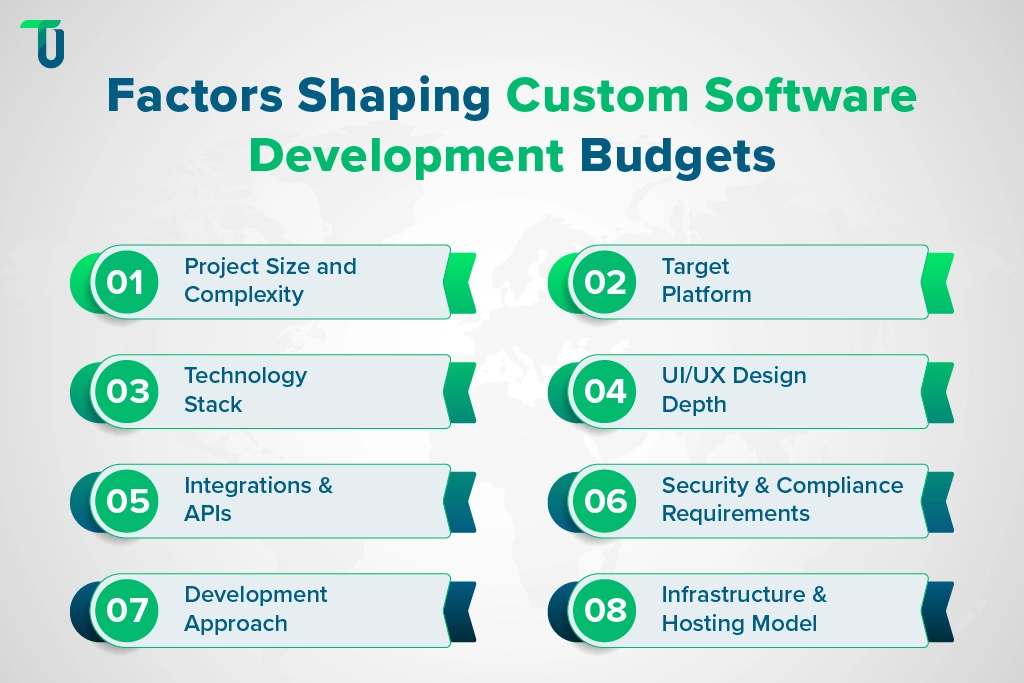
1. Project Size and Complexity
This refers to the number of user roles, the intricacy of the business logic, and the volume of data. A tool that manages a 50-person team is fundamentally different from a platform that handles millions of transactions for a global finance firm.
2. Target Platform
Building for a single web platform is more affordable than a multi-platform approach. If you need a web app, a native iOS app, and a native Android app, the cost increases. Using cross-platform frameworks like Flutter or React Native can reduce this cost by sharing a single codebase.
3. Technology Stack
The choice of language and framework impacts the hourly rate of developers. Common stacks like JavaScript (Node/React) or Python have a large talent pool and competitive rates. Specialized stacks like Rust or legacy systems like COBOL command a premium.
4. UI/UX Design Depth
A basic interface using standard components is cost-effective. However, enterprises often require a custom design system that reflects their brand and ensures high user adoption. High-fidelity prototypes and multiple rounds of user testing add to the custom software development pricing.
5. Integrations & APIs
Connecting to modern APIs (like Stripe or Twilio) is straightforward. Integrating with legacy ERPs or proprietary internal databases is complex and often requires significant custom middleware, which increases the cost estimation for a software project.
6. Software Quality, Security & Compliance Requirements
Healthcare (HIPAA) or finance (PCI-DSS) projects require extra layers of encryption, audit trails, and third-party security audits. These compliance measures can add 20% to 50% to the total budget.
7. Development Approach
Agile development allows for flexibility but makes the total end-cost harder to pin down initially. Waterfall provides a clear price up front but often leads to expensive "change orders" when requirements inevitably shift.
8. Infrastructure & Hosting Model
Cloud-native builds on AWS or Azure involve costs for serverless functions, database storage, and CDN usage. The way the software is architected determines your monthly operational bill.
In addition, internal coordination effort, testing depth, data migration needs, and post-launch support expectations also shape overall software development cost.
Custom Software Development Cost Breakdown by SDLC Phase
The Software Development Life Cycle (SDLC) provides a roadmap for where the money goes. The table below briefly outlines how cost is distributed across each project phase and what drives spending at every step.
| Phase | % of Budget | Primary Activities |
|---|---|---|
| Discovery & Scoping | 10% - 15% | Requirements gathering, user stories, technical architecture. |
| UI/UX Design | 10% - 20% | Wireframes, prototypes, user testing, style guides. |
| Development & Engineering | 40% - 60% | Frontend/Backend coding, API integration, database setup. |
| QA & Testing | 15% - 20% | Bug fixes, automated tests, security audits, UAT. |
| Deployment | 5% | CI/CD pipeline setup, cloud environment configuration. |
| Maintenance | 15% - 25% (Annual) | Updates, hosting, monitoring, small feature tweaks. |
Note that cost allocation changes based on project goals, team structure, and technical decisions. No two software initiatives share the same distribution.
Software Development Pricing Models for Enterprises
Selecting the right financial structure is as critical as the technical architecture itself, especially when enterprises rely on accurate enterprise software development cost estimation to balance flexibility, risk, and long-term value in complex builds like AI-driven systems. Enterprises evaluating enterprise application development services must choose pricing models that balance flexibility, risk, and long-term value.
Custom software development pricing is not one-size-fits-all; the software development cost and pricing model you choose dictates how risk is shared between the enterprise and the vendor.
A. Fixed Price Model
This model involves a pre-determined budget and timeline based on a concrete set of requirements. It is best suited for small to medium projects where the scope is unlikely to change.
- Best for: MVPs, internal tools with clear specs, and projects with a strict "hard" budget.
- The Trade-off: While it offers price certainty, it lacks flexibility. Any change in direction requires a formal "change order" process, which can stall momentum and increase the average cost of software development through administrative overhead.
B. Time & Material (T&M) Model
In a T&M engagement, you pay for the actual hours worked by the development team. This is the standard for modern, Agile enterprise projects where requirements evolve based on user feedback.
- Pros: Extreme flexibility and faster project kickoff since you don’t need to define every single button before work starts.
- Cons: Budget predictability is lower. Without strict management, "scope creep" can cause software development costs to climb beyond initial projections.
C. Dedicated Team Model
For long-term digital transformation, enterprises often "rent" a full-stack team. This team acts as an extension of your company, focusing exclusively on your product roadmap.
- Structure: You pay a fixed monthly fee per team member (e.g., Lead Dev, QA, Designer).
- Why it works: It provides the highest level of continuity and deep product knowledge. It eliminates the friction of constant re-estimation for new features, making enterprise software development cost estimation more about monthly burn rates rather than per-feature quotes.
D. Value-Based Pricing
This is a sophisticated model where the vendor’s compensation is tied to specific business outcomes rather than hours spent.
- Examples: A percentage of new revenue generated by a custom E-commerce engine or a fee based on the reduction of operational costs.
- Alignment: This creates the strongest incentive for the vendor to deliver high-quality, high-impact software, though it requires complex legal and data-tracking frameworks.
E. Hybrid Pricing Models
Many enterprises now use a "Fixed-Price Discovery" followed by "T&M Development." You pay a set fee to define the blueprint and then switch to a flexible model for the actual build. This reduces the risk of software development cost overruns by ensuring the foundation is solid before the expensive engineering starts.
Step-By-Step Framework: Cost Estimation for Software Development Projects
To get the most realistic answer to how much does it costs to make a software, enterprises cannot rely on guesswork. Instead, you need a repeatable framework that accounts for the complexity of modern engineering and clearly explains how much custom software development really costs across discovery, development, and long-term ownership.
The following are the 8 steps that remove uncertainty and connect cost to actual work.
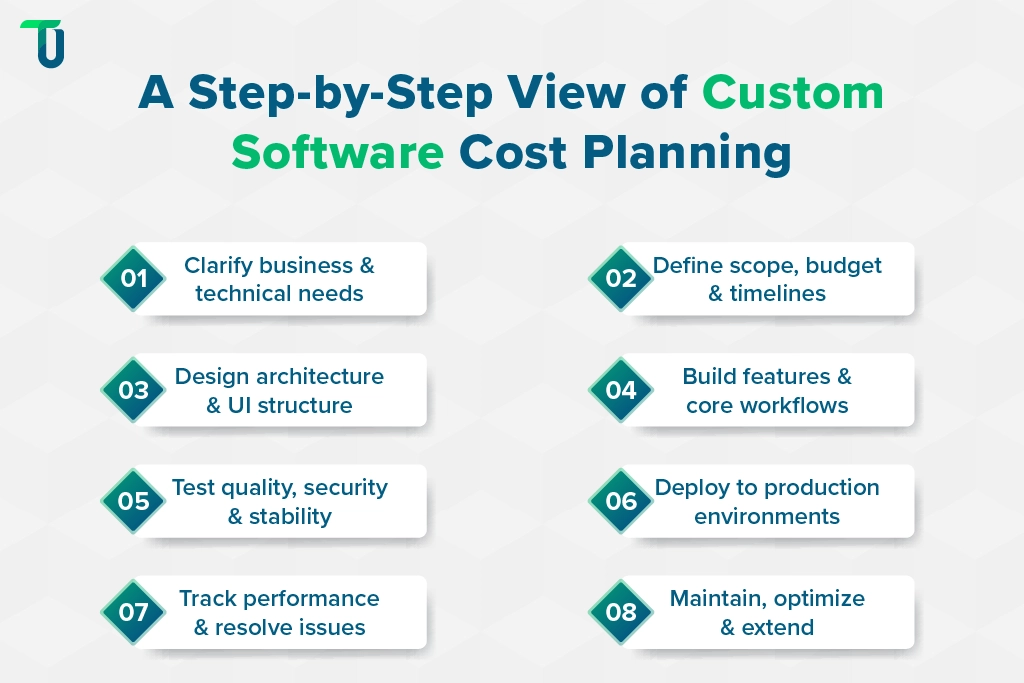
Step 1: Understand Project Requirements
Before looking at code, you must define the boundaries of the project. Scope creep is the primary reason software development costs spiral out of control. Enterprises must separate core business value from aesthetic preferences.
- The MoSCoW Method: Categorize every feature into Must-have, Should-have, Could-have, and Won't-have (for now). This ensures the budget focuses on mission-critical logic first.
- User Persona Mapping: Identify every type of user who will touch the system. An admin portal, a customer-facing mobile app, and a field-agent dashboard all require different development efforts.
- User Story Creation: Write out requirements in plain English.
Step 2: Plan Scope, Budget, and Timeline
Technical discovery is the bridge between a business idea and a functional system. This step determines the complexity of the "unseen" parts of the software, which often account for the bulk of the software development cost.
- Legacy Integration Audit: Will the new software need to pull data from a 20-year-old mainframe? If so, the cost for custom middleware will be high.
- Data Volume & Scalability: A system handling 100 users costs significantly less than one built for 100,000 concurrent sessions. Architecture for high availability (multi-region failovers) adds to the engineering hours.
- Security Posture: Determine if the software needs SOC2 compliance, biometric authentication, or advanced data masking. These "non-functional requirements" often take more time to build than the visible buttons and forms.
Step 3: Design System Structure and UI
The cost estimation for a software project is only as accurate as its smallest parts. A Work Breakdown Structure takes high-level features and shreds them into manageable tasks.
For Example: Breaking down "Payment Integration"
- Integrating Stripe API: 16 hours
- Setting up recurring billing logic: 24 hours
- Handling failed payment webhooks: 12 hours
- Developing an invoice generation engine: 20 hours
- Building a customer billing dashboard: 30 hours
By breaking one large "Payment" bucket into 100+ hours of specific tasks, you eliminate the risk of missing hidden complexities like "Edge Case Handling" or "Tax Calculation."
Step 4: Develop and Build the Software
Once the WBS is complete, you must apply real-world labor rates. Not all hours are billed at the same rate. An enterprise-grade project requires a mix of expertise:
| Role | Responsibility | Impact on Cost |
|---|---|---|
| Solutions Architect | Designs the system structure and database schema. | High hourly rate; involved heavily in Phase 1 & 2. |
| Senior Backend Dev | Builds the core logic, security, and integrations. | The engine of the project; accounts for 40% of hours. |
| Frontend Engineer | Creates the user-facing interface and interactions. | Drives the look and feel; 20-30% of hours. |
| QA Engineer | Writes automated tests and performs manual audits. | Essential for stability; 15-20% of hours. |
| Project Manager | Ensures timelines and budgets stay on track. | 10-15% overhead of total hours. |
Custom software development pricing is calculated by multiplying the hours per role by their respective rates.
Step 5: Test for Quality and Security
In software, the "unknown unknowns" are a guarantee. An estimate that ignores hidden costs in enterprise software development and claims 100% accuracy is likely hiding future invoices.
- Contingency Buffer: Standard enterprise practice is to add a 15% to 25% buffer. This is not "profit"—it is the fund used when a third-party API changes its documentation mid-build or a library update breaks a dependency.
- Defining Assumptions: Your quote should include a list of assumptions. For example: "This estimate assumes the client provides clean, mapped CSV data for migration." If the data is messy, the client knows why the price might change later.
- Risk Multipliers: If the project uses bleeding-edge technology (like custom AI model training), the risk multiplier should be higher than a standard web app build.
Step 6: Deploy the Final Application
A single "Total" price tag is hard to sell to a board of directors, which is why enterprises increasingly rely on a detailed enterprise software development cost breakdown that explains where budgets are allocated and how risks are managed. You must present the software development cost breakdown in a way that shows logical progression.
- Phased Budgeting: Show the cost for a Pilot, then Version 1.0, then Version 2.0. This allows the enterprise to release funds based on hitting specific milestones.
- Feature-Level Pricing: If the budget is too high, stakeholders can look at the breakdown and decide to move the "Advanced Analytics Dashboard" to next year’s budget without derailing the entire project launch.
Step 7: Monitor Performance and Issues
If you are using an internal team or a Software Development Partner, validate your estimates against the broader market before making long-term investment decisions. This is where you see the average cost of software development for your specific niche.
- The "Too Good to be True" Quote: If a vendor quotes 50% less than others, they usually lack an understanding of enterprise security requirements or plan to use offshore talent with no project management layer.
- Technical Interviewing: Ask vendors how they arrived at their WBS. A vendor who can explain the specific hours assigned to "Database Indexing" is more reliable than one who gives a round number for "Development."
Step 8: Maintain and Improve Over Time
The final step is moving the conversation from "How much does it cost to build?" to "How much does it cost to own and what do we gain?" This shift is central to successful enterprise digital transformation services, where software is treated as a long-term business asset — and it begins with knowing how to build custom enterprise software with the right scope and architecture from day one.
Here’s the TCO Formula:
TCO = Acquisition Costs + Operating Costs + Maintenance Costs + End-of-Life Costs - Residual Value
Compare the TCO against the projected gains over 3 years. These gains include:
- Efficiency Gains: Reducing manual data entry by 40 hours per week across the team.
- Revenue Generation: Attracting new customers through a better mobile experience.
- Risk Mitigation: Replacing a legacy system that is at risk of a security breach or total failure.
By following these steps, you gain a transparent, predictable roadmap that aligns your budget with long-term enterprise growth and value.
TenUp’s Take: Avoid the trap of the lowest bid. In enterprise software, cheap code often leads to massive technical debt and integration failures. To win, invest heavily in the Discovery Phase to lock your scope and use CI/CD automation to slash long-term maintenance costs.
Cost Optimization Strategies Without Sacrificing Quality
To manage your custom software development cost effectively, focus on precision rather than cutting corners. Here are some strategic methods to reduce expenses while maintaining high performance.
1. Build a Minimum Viable Product (MVP): Launch only core features first. This allows you to gather real user data before you commit a budget to complex features that people might not actually use.
2. Use Open Source Libraries: Don’t pay for custom code where stable, secure open-source solutions already exist. Use proven frameworks for standard tasks like user authentication or data visualization to reduce manual labor hours.
3. Implement Automated Testing Early: Manual testing is slow and prone to error. While automated scripts require an initial investment, they catch bugs before they become expensive structural problems in the later stages.
4. Optimize the Talent Mix: Use a blend of senior architects and mid-level developers. Architects set the right direction to avoid rework, while mid-level engineers handle the bulk of the execution at a lower hourly rate.
5. Prioritize Cloud Governance: Monitor your cloud resource usage from day one. Over-provisioned servers are a common source of waste. Right-size your infrastructure to match your actual traffic.
6. Adopt DevOps Practices: Automation in deployment reduces human error and downtime. A streamlined pipeline means your team spends time on new features rather than fixing broken releases.
7. Fixed-Scope Sprints: Work in short, defined cycles. This prevents the project from drifting into "gold-plating," where developers add unnecessary polish that doesn't contribute to the business goal.
These strategies help you control your budget while building a stable, enterprise-grade product that delivers long-term value and reliability.
Custom Enterprise Software Development: Hidden Costs to Avoid
Unexpected expenses often arise when the initial project plan lacks technical depth. These hidden triggers can inflate your custom software development cost by 30% to 50% if you do not account for them during the budget phase. The following are some of the most common factors that drive budgets beyond their initial estimates.
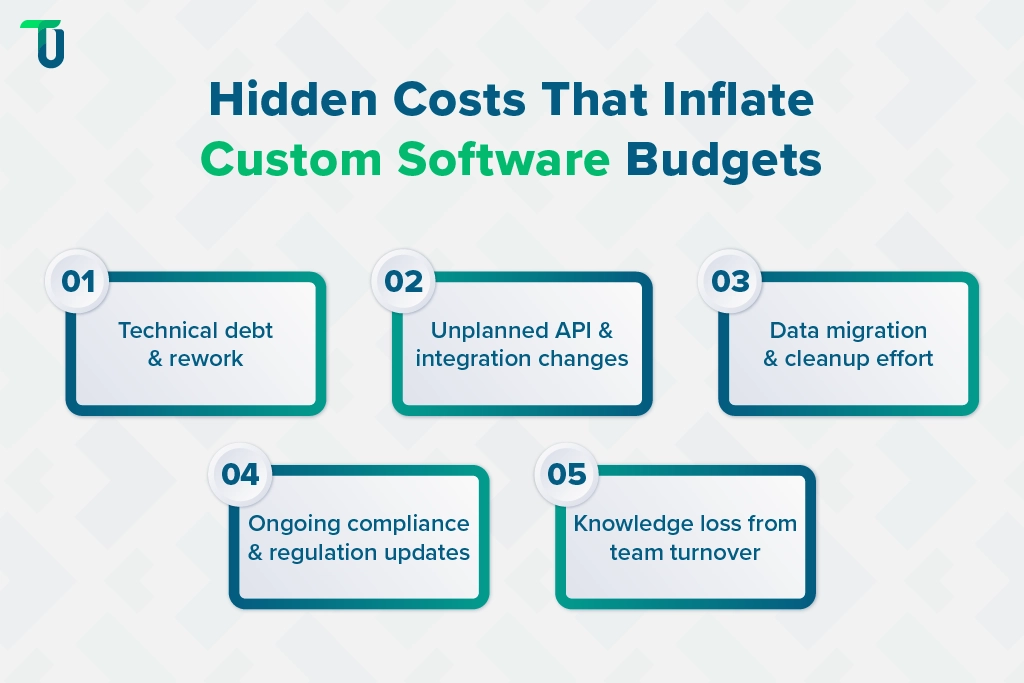
1. Technical Debt and Refactoring
If a team writes code too fast to meet a deadline, they often skip best practices. This creates "technical debt." Eventually, you must pay to rewrite that code so the system can scale or stay secure. This rework is a silent budget killer that appears months after the launch.
2. Third-Party Integration Changes
Most enterprise software relies on external APIs for payments, maps, or data. If those providers change their terms, pricing, or technical structure, your team must drop everything to update your code. These maintenance tasks are rarely in the original estimate but require constant attention.
3. Data Migration and Cleanup
Moving data from an old system to a new one is never simple, and underestimating this effort is one of the most common hidden costs in custom software development during legacy modernization initiatives. Old databases often have "dirty data" with missing fields or inconsistent formats. The process to map, clean, and verify this data involves hundreds of manual hours that many stakeholders overlook.
4. Regulatory and Compliance Updates
Laws like GDPR or industry-specific rules change frequently. A software build that is compliant today might need a total overhaul next year due to a new privacy law. The cost to audit and update security protocols is a recurring expense for any serious enterprise tool.
5. Knowledge Loss and Turnover
If a key developer leaves the project, the new hire needs time to learn the codebase. You are effectively paying for their "learning curve" without seeing new features. Poor documentation makes this transition even more expensive.
In addition to these triggers, proactive monitoring and clear documentation help you maintain control over your budget and prevent minor technical issues from becoming major expenses.
Build Your Next High-Scale Software Solution with TenUp
Precise estimation is the difference between a successful digital transformation and a costly project failure, and effective custom software product developmentcustom software product development begins with structured discovery, realistic planning, and disciplined execution. By viewing custom software development cost through the lens of long-term value and total ownership, enterprises can make smarter investment choices.
A structured framework ensures that every dollar spent aligns with a specific business goal, while proactive risk management prevents hidden costs from derailing your roadmap. At TenUp Software Services, we provide transparent, engineering-focused enterprise software development services for organisations of all sizes, helping leaders build scalable systems with predictable costs and measurable business impact. We focus on technical discovery and granular work breakdowns to eliminate budget surprises. Contact our experts today!
Are You Planning Enterprise Software with Cost Clarity?
Enterprise software decisions benefit from clear scope, realistic cost expectations, and disciplined engineering.
Frequently asked questions
How do enterprises accurately estimate custom software development costs before finalizing requirements?

Enterprises estimate custom software development costs by conducting early technical discovery, prioritizing core features, and breaking work into small, estimable units. They use relative sizing, historical project data, and MVP scoping to define realistic cost ranges, supported by documented assumptions and contingency buffers as requirements evolve.
Why do custom software development cost estimates change during Agile projects?
Cost estimates change during Agile projects because requirements, priorities, and technical understanding evolve with each sprint. As teams learn from user feedback, uncover integration or scalability challenges, and refine scope, estimates are continuously updated. Agile treats estimates as living forecasts, not fixed promises, to align cost with real progress and business value.
What hidden costs are most commonly overlooked in enterprise software development budgets?
The most commonly overlooked costs include long-term maintenance, cloud infrastructure scaling, technical debt refactoring, data migration cleanup, compliance updates, and third-party integration changes. These expenses usually appear after launch and can increase total cost of ownership by 30–50% if they are not planned during estimation.
How does Total Cost of Ownership (TCO) differ from initial software development cost?
Initial software development cost covers only the one-time build effort, such as design and engineering. Total Cost of Ownership (TCO) includes the full lifecycle cost—hosting, maintenance, security updates, scaling, support, upgrades, and eventual replacement. For enterprise systems, TCO is often two to three times higher than the initial build cost.
What pricing model is best for SME software projects with evolving scope?
For SME projects with evolving scope, a Time & Materials or hybrid pricing model works best. These models allow requirements to change as the product evolves, while hybrid approaches—such as fixed-price discovery followed by T&M development—offer early cost clarity without locking SMEs into rigid contracts that drive change-order overruns.
Why do software development cost estimates vary so widely between vendors?
Cost estimates vary because vendors make different assumptions about scope, architecture quality, security, testing depth, and scalability. Differences in team seniority and risk buffers also affect pricing. Lower quotes often exclude critical work, leading to higher costs later through rework or technical debt.
When should enterprises involve a software development partner in cost estimation?
Enterprises should involve a software development partner during the discovery or early planning phase, before budgets and scope are finalized. Early engagement helps uncover technical risks, integration complexity, and compliance requirements, resulting in more accurate cost estimates and fewer budget surprises later.
How much does custom software development cost?
Custom software development typically costs between $50,000 and $1,000,000+, depending on project complexity, scale, integrations, and compliance requirements. Simple internal tools may start around $50k–$100k, while enterprise platforms with advanced security, integrations, and scalability often exceed $300k. Final cost depends on scope, architecture, and long-term ownership needs.
Share the Article


