


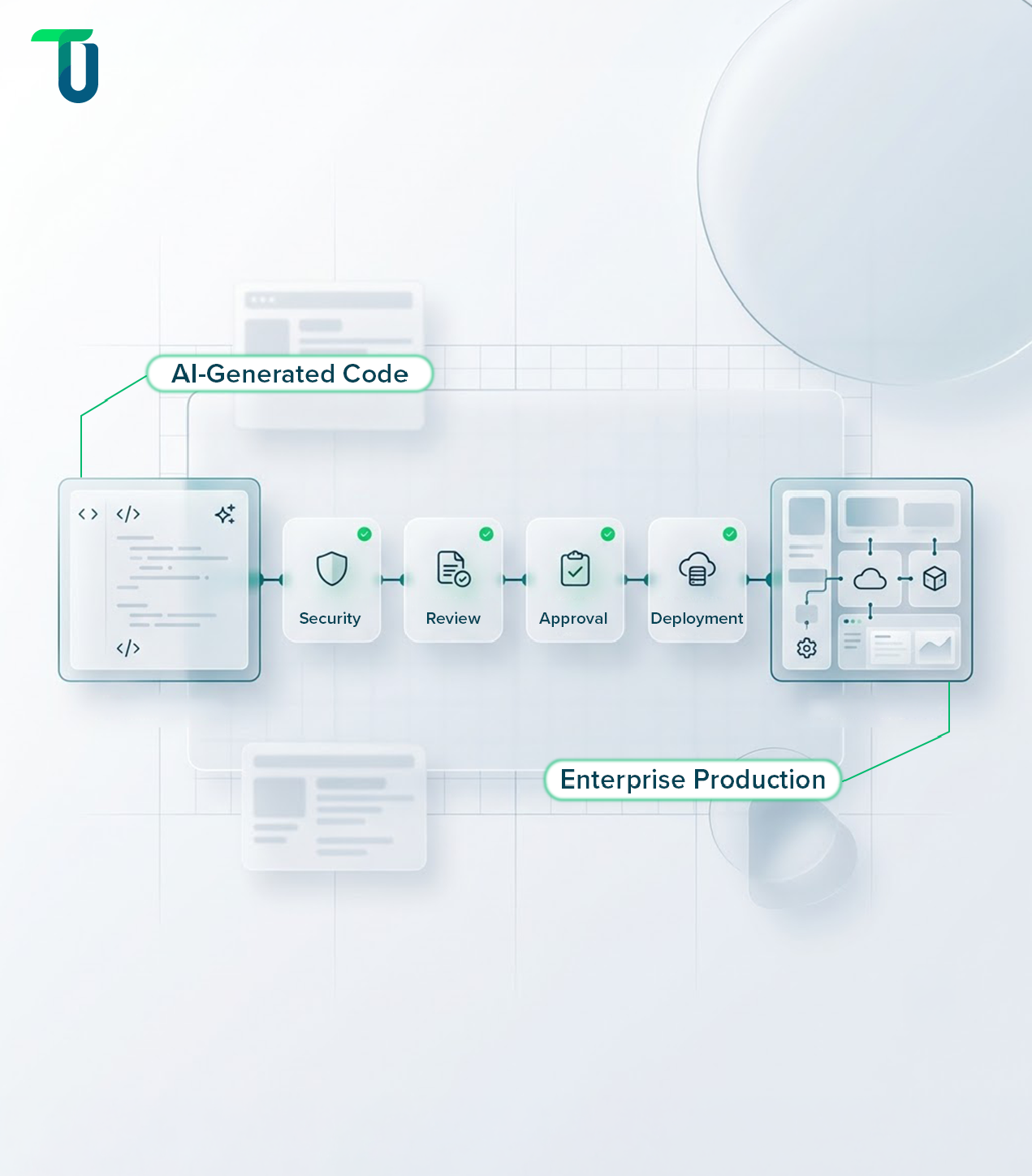
AI-assisted software development is creating as many problems as it solves. The enterprises absorbing the damage are the ones that never asked the right questions before signing a development engagement.
According to a Microsoft Research study on GitHub Copilot, developers using AI coding tools complete tasks 55.8% faster. But the speed of generation and the quality of delivery are not the same metric, and the gap is where enterprise projects fail.
This blog covers what AI-assisted software development changes in enterprise delivery, where it breaks down at scale, and what it means when your development partner uses AI to build software for you.
What AI-Assisted Software Development Actually Means for Enterprise Delivery in 2026
AI-assisted software development integrates AI models and ai programming tools, including GitHub Copilot, Cursor, Claude (Anthropic), and Gemini, across the software development lifecycle to generate, review, test, and document code, shifting engineering focus from writing syntax to governing output. Platforms like Replit and Bolt.new extend this into full ai-native development environments where entire stacks are scaffolded from natural language prompts.
AI-assisted development is not a faster version of traditional development. It is the foundation of ai-first software delivery, with direct implications for delivery timelines, team composition, code quality, and post-launch maintainability.
Futurumgroup research shows AI has reached 97% of software development organizations. The real question is whether the AI in your development partner's process is governed or ungoverned.
1. The Shift From Code Generation to Lifecycle Automation
AI in enterprise development has moved well past autocomplete. Driven by AI-assisted coding tools, agents now handle:
- Requirements parsing and architecture modeling
- Code scaffolding and generation
- Automated test generation and vulnerability scanning
- Deployment documentation across the full SDLC
One senior engineer with a structured AI-assisted workflow can deliver the throughput of a traditional three-to-four person team.
The delivery implication: timelines compress, but so does the window for catching architectural errors. What used to surface in a two-week sprint review now needs a same-day review gate.
2. The Augmented Engineering Operating Model
AI-assisted development does not replace senior engineers. It changes what they do. Engineers shift from writing implementation code to setting architectural constraints, reviewing AI output against business logic, and governing what gets merged.
A development partner's value is no longer measured by headcount. It is measured by the quality of engineering judgment above the AI layer, and whether that judgment is structured or ad hoc.
3. Why This Is a Procurement Decision, Not Just a Tooling Decision
When your development partner uses AI to generate your production code, it affects four things no standard contract addresses:
- What gets built
- Who owns it
- How it can be maintained after the engagement ends
- What your audit rights are over the process that produced it
It's essential to address what matters more to enterprise buyers: what happens when AI generates code on your behalf, with your IP at stake?
| SDLC Stage | AI Application | Enterprise Delivery Impact |
|---|---|---|
| Planning and Design | Requirements parsing, architecture modeling | Faster scoping, higher risk of misaligned assumptions if specs are weak |
| Coding and Refactoring | Context-aware code generation, pattern completion | Reduced routine effort, inconsistent output quality across complex modules |
| Testing and QA | Automated test generation, vulnerability scanning | Earlier defect detection, reviewer fatigue at AI-speed output volumes |
| Maintenance and Ops | Log analysis, auto-generated documentation | Lower onboarding time, hidden ownership gaps when documentation is auto-generated only |
The enterprises most exposed to AI-related delivery failures are not the ones resisting AI. They are the ones whose development partners adopted AI for speed without building the governance layer that makes speed sustainable.
Where AI-Assisted Development Delivers Measurable Enterprise Value
AI-assisted software development delivers real value, but only where infrastructure, architecture, and engineering governance are already strong. AI amplifies what exists. It does not compensate for what is missing.
The benefits below are conditional, not guaranteed.
1. Delivery Velocity on Well-Scoped, Modular Projects
McKinsey's research on developer productivity confirms software developers can complete tasks up to twice as fast with generative AI when working on clearly scoped, well-defined tasks.
The condition: well-defined specifications must exist before AI generates a single line of code. When AI operates against vague requirements, generation speed becomes a liability. A spec-first methodology is not a process preference. It is a delivery requirement.
2. Shift-Left Quality Control
AI agents in CI/CD pipelines catch bugs, flag vulnerabilities, and generate unit tests during coding rather than QA review. DORA's 2024 State of DevOps research confirms teams with automated quality gates in the coding phase resolve defects at significantly lower cost than teams catching them post-merge.
The condition: review infrastructure must be redesigned for AI-speed output volumes. Review processes built for human-speed commits eliminate most of the velocity benefit.
3. Legacy System Acceleration
AI tools explain complex legacy codebases, generate scaffolding aligned to existing patterns, and reduce developer ramp-up time. For enterprises with large legacy estates, this reduces the onboarding cost of bringing new engineers into established, complex systems.
The condition: AI context must be scoped to the actual legacy codebase, not general training data. Generic context produces suggestions that conflict with proprietary business logic.
4. Senior Engineering Capacity Reallocation
When AI handles boilerplate and routine implementation, senior engineers shift capacity to architecture decisions, system coherence, and risk evaluation, which determines long-term software quality.
The condition: without structured review gates and defined engineering standards, senior engineers spend their freed capacity correcting AI output rather than doing higher-value work.
| Benefit | Condition Required |
|---|---|
| Delivery velocity | Well-defined specifications before any code is generated |
| Shift-left quality control | Review infrastructure redesigned for AI-speed output volumes |
| Legacy system acceleration | AI context scoped to the actual codebase, not general training data |
| Senior capacity reallocation | Structured review gates and defined engineering standards in place |
Understanding where those conditions break down is the more important question for enterprise buyers evaluating what their development partner actually delivers.
Where AI-Assisted Development Breaks Down at Enterprise Scale
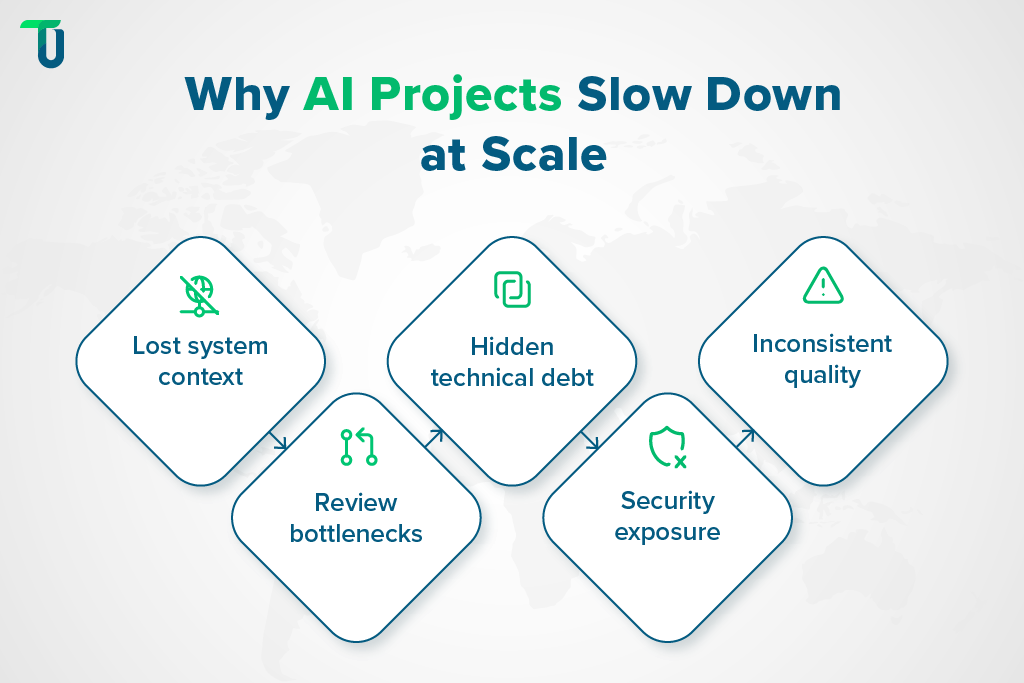
AI-assisted development breaks down at enterprise scale in predictable patterns. These failure modes are the default outcome when AI is integrated without a structured governance methodology.
1. Context Loss in Complex, Interdependent Codebases
AI tools perform well on isolated, well-scoped modules. They struggle with interdependent systems, proprietary business logic, and legacy architecture where behavioral rules are embedded in institutional knowledge rather than documented specifications.
MIT Sloan Management Review's analysis documents a consistent pattern: AI assistants trained on public data produce code that works in isolation but fails to mesh with proprietary systems' business rules. The enterprise risk is code that passes unit tests in development but creates integration failures in production.
The mitigation: specs as the source of truth. When architectural constraints, business logic, and system boundaries are documented before AI generates code, the AI operates within defined guardrails.
2. The Productivity Paradox: Generation Speed Outpacing Review Capacity
AI code generation outpaces what human teams can review, test, and validate. Without CI/CD pipelines and automated review gates redesigned for AI-speed output volumes, ai-assisted programming creates pull request backlogs, not delivery acceleration.
MIT Sloan research shows time spent reviewing and rewriting AI-generated logic can exceed the time generation saved. When debugging AI-generated code, engineers face an additional compounding cost: tracing failures in code they did not author takes significantly longer than debugging code they wrote.
3. Hidden Technical Debt From Dependency Conflicts
AI models introduce incompatible libraries, duplicate logic, and unoptimized patterns that pass tests at generation but compound maintenance costs over time. This debt surfaces 12 to 18 months post-launch, when teams discover they are maintaining code they did not fully author and cannot fully audit.
According to the Cloud Security Alliance (CSA), 62% of AI-generated code solutions contain design flaws or known security vulnerabilities, often from outdated library suggestions or insecure patterns in training data.
4. Security Exposure From Unreviewed AI-Generated Code
Enterprises are shipping untested AI-generated code under velocity pressure. IT Pro's reporting documents organizations knowingly bypassing QA pipelines to maximize AI-driven speed, with security teams flagging the downstream consequences as growing.
Governance frameworks built for human-speed commits do not scale to AI-speed output volumes. Baseline requirements when AI is generating production code:
- Static Application Security Testing (SAST) integrated into CI/CD pipelines
- Automated dependency scanning
- Defined merge standards enforced before any code reaches production
5. Output Quality Inconsistency
The same prompt can produce meaningfully different implementation quality depending on model, context window, and prompt construction. This inconsistency makes estimation, sprint forecasting, and QA scope structurally harder to predict.
A partner without clear answers to these five failure modes is absorbing risk on your behalf and passing the cost back post-launch.
Evaluating a development partner's AI practices?
Connect with TenUp's engineering team to explore a 60-minute Spec Session against your actual project requirements.
What AI-Assisted Development Changes About Enterprise Team Structure and Vendor Requirements
AI-assisted development changes what enterprise engineering teams need to be good at, and what they must demand from development partners. Most vendor evaluation frameworks have not been updated to reflect this.
1. The Skill Shift From Syntax to Architectural Reasoning
Prompt engineering, the ability to frame problems precisely for AI systems, is now a core engineering competency. Engineers who cannot evaluate AI output against architectural constraints cannot govern what gets merged.
The relevant question when evaluating a development partner is not whether their engineers use AI. It is whether senior engineers are architecturally focused and prompt-literate, or whether they are using AI to accelerate work without structured review of what it produces.
2. Junior Developer Capability Risk
Engineers relying on AI without understanding underlying architecture create long-term maintainability liabilities. MIT Sloan and industry research consistently documents junior developers accepting AI-generated code that passes tests without understanding its architectural implications.
A development partner's AI practices should include defined protocols ensuring every engineer understands what they are shipping, not just that it compiles.
3. Headcount Is No Longer a Reliable Capacity Signal
One engineer with a structured AI-assisted workflow can deliver the throughput of a traditional three-to-four person team.
Headcount is no longer a valid proxy for delivery capacity.
4. Shadow AI and Unsanctioned Tool Use
Industry analysis documents that only 11% of production AI agents pass the security bar for enterprise governance. The same applies inside vendor teams: engineers adopting AI tools individually, without standards governing how those tools interact with your codebase and data.
A development partner's AI governance policy is a material due diligence factor, not their tool selection:
- Tool selection tells you what AI they use
- Governance policy tells you how they control what it does with your code, your business logic, and your proprietary data
Once team structure implications are clear, the next question is governance: what frameworks should contractually govern an engagement where AI generates your production code.
What Governance Looks Like When AI Generates Your Production Code
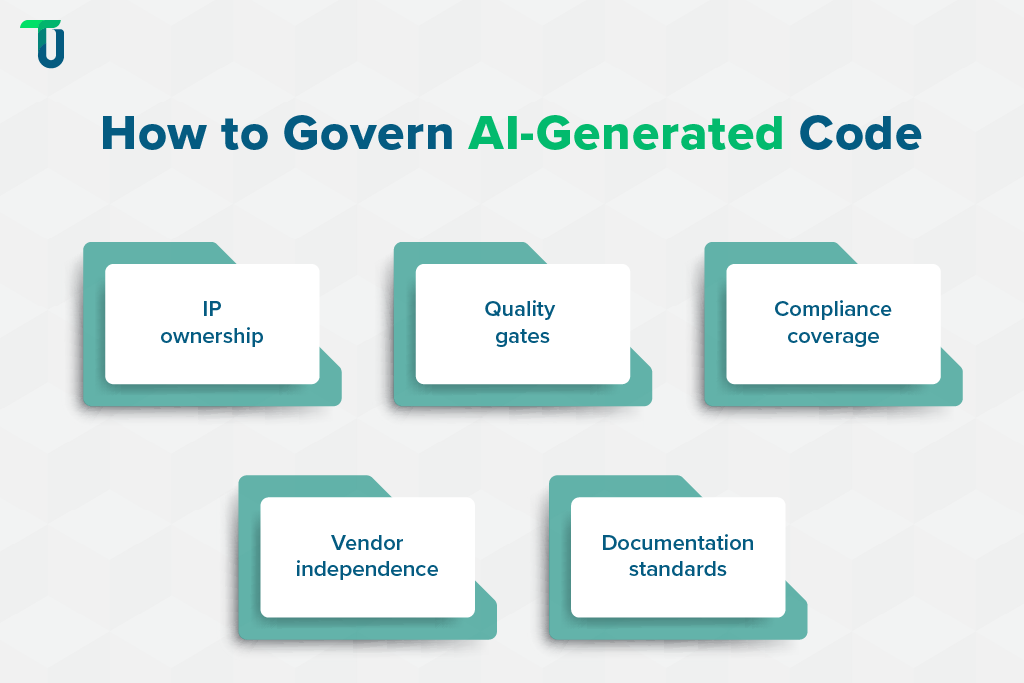
Governance for AI-generated code is not an internal IT policy question. For enterprise buyers, it is a contractual and audit rights question that belongs in vendor evaluation before a statement of work is signed. For a deeper look at how this governance integrates into CI/CD and DevSecOps pipelines, the implementation detail sits one level below the procurement decisions covered here.
1. Code Ownership and IP Rights in AI-Assisted Engagements
When a development partner uses AI to generate your production code, IP ownership is not automatically protected by standard contract boilerplate. AI-generated code may incorporate patterns from training data that introduce third-party license obligations, and the libraries AI selects may create licensing liabilities you inherit at delivery.
Contracts must explicitly address:
- Who owns AI-generated outputs
- What third-party dependencies were introduced and under what license terms
- What your audit rights are over the generation process
Standard IP clauses are insufficient.
2. Review Gate Architecture as the Non-Negotiable
AI-speed code generation requires AI-assisted review infrastructure. SAST integrated into CI/CD, automated dependency scanning, and defined merge standards are baseline requirements, not enhancements.
In practice: every feature is traced from a signed specification through a governance pipeline to production-ready code. Automated tests run per feature as it is built. No code merges without passing defined quality gates.
3. Compliance Certification Coverage of AI Workflows
Compliance certifications including SOC 2, HIPAA, and PCI-DSS do not adjust for AI authorship. A partner whose certifications have not been formally extended to cover AI workflows has a governance gap your auditors will find.
4. Reversibility and Vendor Lock-In Risk
AI toolchains increasingly operate on usage-based pricing rather than fixed per-seat licenses. Partners with deep dependencies on specific AI platforms introduce vendor lock-in risk you may not discover until you try to modify or transfer your system.
Require the following as contractual deliverables:
- Observability into AI tool usage throughout the engagement
- Rollback procedures for AI-generated changes
- Trace analytics on every AI decision affecting your codebase
- Full source code, specifications, infrastructure-as-code, and deployment runbooks transferred at engagement close
- Your codebase running independently of any vendor toolchain from day one
5. Documentation Standards for Long-Term Maintainability
Auto-generated documentation is not equivalent to intentional architectural documentation. Failing to address this gap can increase the hidden costs of AI-assisted software development for enterprises through additional onboarding, maintenance, and rework after handover. AI cannot produce the architectural decision records, data model rationale, and system boundary documentation your internal teams need after the engagement ends.
Define documentation standards as a delivery requirement with the same weight as code quality.
How to Evaluate a Custom Software Development Partner That Uses AI
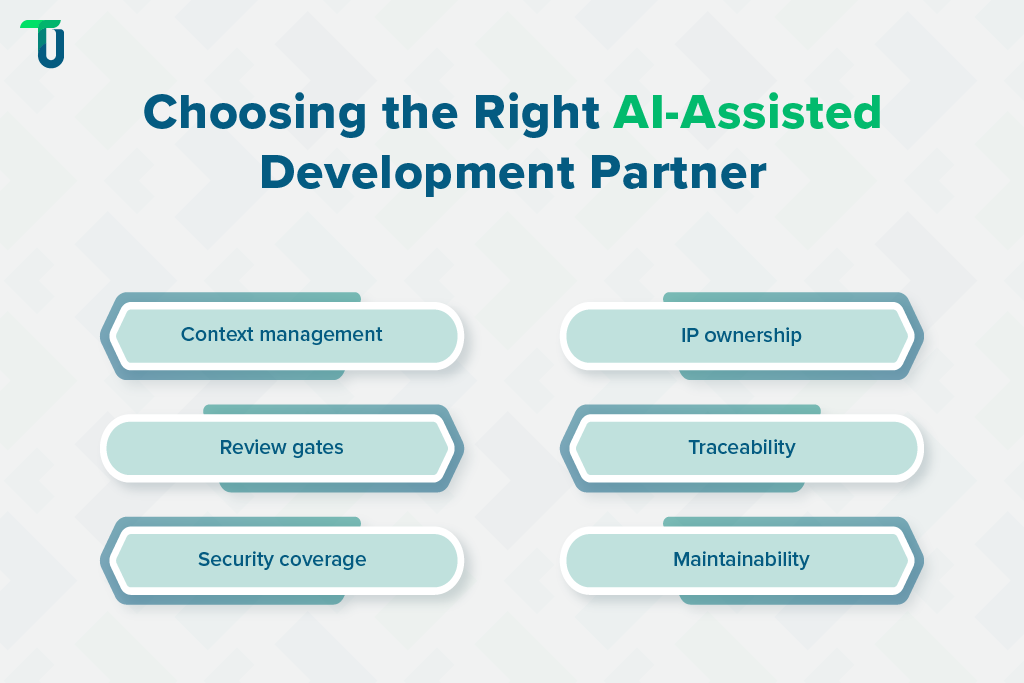
Evaluating a partner's AI-assisted software development practices requires a different checklist than evaluating general technical capability. The AI coding assistant tools a vendor uses matter far less than the methodology governing their output.
The most revealing question to ask any development partner is not "do you use AI?" It is "walk me through what happens to AI-generated code between generation and merge." Partners with a real answer have built a methodology. Partners without one are shipping on faith.
1. Context Management Protocols
How does the partner ensure AI tools have access to your full system context, including architectural constraints, business logic, proprietary dependencies, and edge cases, rather than isolated code snippets?
AI tools trained on public data produce code that conflicts with proprietary business rules unless operating within a defined context framework. A spec-first methodology, where zero-ambiguity specifications govern every engineering and AI decision, is the structural answer. Without it, context loss at enterprise scale is not a risk. It is a certainty.
What a strong answer looks like: The partner documents functional requirements, user stories, acceptance criteria, data models, and edge cases before any code is generated. Specifications are the source of truth.
Red flag: Any partner who cannot articulate a context management approach, or who describes AI generating code from developer judgment rather than documented specifications.
2. Review Gate Architecture
What automated and human review processes govern AI-generated code before it reaches production? How was that infrastructure designed for AI-speed output volumes?
Review processes built for human-speed commits create bottlenecks that eliminate AI's velocity advantage.
What a strong answer looks like: Automated tests run per feature as it is built. SAST is integrated into CI/CD. Defined merge standards require passing quality gates, not just peer review.
Red flag: Any partner whose review process has not been restructured since adopting AI, or that relies primarily on human judgment at AI output volumes.
3. Security and Compliance Coverage
Are the partner's AI-assisted development practices explicitly covered under their compliance certifications? When SOC 2, HIPAA, or industry-specific frameworks are claimed, do their audit scopes extend to AI-assisted workflows?
What a strong answer looks like: The partner can demonstrate that their compliance certifications explicitly cover AI-assisted workflows, including data handling, access controls, and audit trails for AI-generated outputs, not just traditional development practices.
Red flag: A partner whose certification predates their AI adoption and has not been formally extended.
4. Code Ownership and IP Documentation
What contractual provisions govern ownership of AI-generated outputs? What third-party license audit processes document every dependency AI introduced?
What a strong answer looks like: Full source code, specifications, infrastructure-as-code, CI/CD pipelines, and architectural decision records transfer to the client at engagement close. The codebase runs without the vendor from day one. Zero proprietary frameworks. Zero vendor lock-in.
Red flag: Partners who treat IP ownership as standard contract boilerplate rather than an AI-specific governance decision requiring active dependency auditing.
5. Reversibility and Observability
Can the partner provide trace analytics on AI tool usage, rollback procedures for AI-generated changes, and documentation of AI-introduced dependencies? If the engagement ended today, could your internal team maintain and extend what was built?
What a strong answer looks like: Documented rollback procedures, versioned infrastructure-as-code, full Git repository with commit-level traceability, and deployment runbooks your team can execute independently.
Red flag: Partners who cannot demonstrate observability into their AI toolchain at the engagement level, not the tool level.
6. Long-Term Maintainability Commitment
What documentation standards apply to AI-generated code? How does the partner ensure your teams can maintain what was built after handover?
What a strong answer looks like: Architectural decision records, data model documentation, API references, and system boundary documentation are defined delivery requirements with the same weight as code quality standards.
Red flag: Auto-generated documentation treated as equivalent to intentional architectural documentation.
The right development partner does not just use AI. They use it within a governance framework that protects your delivery timelines, your IP, and your long-term system health.
Building on the Right Foundation
AI-assisted software development delivers. The productivity gains are documented. So are the delivery failures, and they follow a predictable pattern when governance is absent.
The enterprises capturing sustainable value from AI-assisted software development chose partners who built governance methodology before building velocity on top of it:
- Specs as the source of truth
- Review gates designed for AI-speed output
- Compliance coverage that explicitly includes AI workflows
- Full IP transfer at engagement close
- Documentation standards that serve post-engagement maintainability
Tools generate code. Partners own outcomes. TenUp's AI-assisted software development practice is built around that distinction. Our governance framework covers every stage of delivery: Engineering Charter, zero-ambiguity specifications, architecture validation, and high-velocity delivery governed by automated quality gates. Critically, that governance is AI-specific, not a general certification extended to cover AI as an afterthought. Every quality gate, review protocol, and IP transfer standard in our engagements is designed for AI-speed output, not adapted from a pre-AI delivery model. See how that translates into production outcomes across our AI-powered project case studies.
If you are evaluating development partners or auditing your current vendor's AI practices, the questions in this blog are the right starting point.
Need AI-assisted delivery for your next project?
TenUp's Spec Session puts our governance methodology to work on your actual requirements, with a written specification yours to keep.
Frequently asked questions
What is AI-assisted software development, and how does it differ from traditional development?

AI models generate code, automate tests, and scan for vulnerabilities while engineers govern output quality and compliance. The difference from traditional development is not speed. It is where judgment is applied: governing AI output rather than producing it directly.
What are the biggest risks of AI-generated code in enterprise software projects?
Five: context loss conflicting with proprietary business logic; review bottlenecks letting unvalidated code reach production; hidden technical debt from dependency conflicts; security vulnerabilities from training data; and IP gaps when contracts don't address AI-generated outputs. Each is preventable with the right methodology.
How does AI-assisted development affect software delivery timelines?
On well-scoped projects with strong specs, timelines compress. McKinsey documents 20 to 45% productivity gains; GitHub shows task completion up to 55% faster. On poorly scoped projects with ungoverned AI output, generation speed creates downstream congestion that extends timelines past what traditional development would have required.
Who owns the IP rights to AI-generated code in a custom software development engagement?
Standard contracts don't protect it automatically. Require explicit provisions covering AI-generated outputs, third-party dependency audits, license compliance, and full source code transfer at engagement close. Don't rely on IP boilerplate written before AI-assisted development existed.
What governance frameworks should enterprises require when working with AI-using development partners?
At minimum: spec-first methodology; SAST and dependency scanning in CI/CD; compliance certifications explicitly covering AI workflows; defined merge standards; and full IP transfer at engagement close. Compliance certifications including SOC 2, HIPAA, and PCI-DSS don't adjust for AI authorship. Partners must prove their certifications explicitly cover AI workflows in audit scope.
Where does AI-assisted development break down at enterprise scale?
In complex interdependent codebases where AI lacks proprietary context; in review pipelines built for human-speed commits; in systems where dependency conflicts accumulate silently; and post-engagement when auto-generated documentation substitutes for intentional architectural documentation.
What should enterprises ask a custom software development partner about their AI-assisted development practices?
Six questions: How do you manage full system context for AI? What review gates govern AI-generated code? Do your compliance certifications cover AI workflows? Who owns AI-generated outputs contractually? Can you provide trace analytics and rollback procedures? What documentation standards apply beyond auto-generation?
How does agentic AI development differ from standard AI-assisted coding, and what does it mean for enterprise buyers?
Agentic AI executes multi-step tasks autonomously without human intervention at each step. Standard AI-assisted coding generates suggestions engineers review and accept. Agentic development amplifies both velocity and governance risk. Without structured oversight, autonomous agents introduce security exposures and architectural conflicts faster than any review process catches them.
Share the Article


