


Vibe Coding: How It Impacts Custom Software Development Services
Vibe coding impacts the way software is built by combining human logic with machine-generated code. Here are the key ways it influences modern development:
- Speeds up MVP creation and rapid prototyping through AI-assisted workflows
- Reduces repetitive coding tasks, helping teams focus on architecture and logic
- Lowers early custom software development cost with faster delivery cycles
- Enhances collaboration between developers, testers, and business teams through shared prompts and greater automation and collaboration in DevOps.
Overall, Vibe Coding helps custom software development companies deliver faster, smarter, and more scalable solutions, reducing custom software development costs while facilitating high-quality and security through AI-assisted workflows.
According to GitHub’s 2024 Copilot Report, 92% of developers say AI tools help them complete repetitive tasks faster, while 70% believe AI will handle more than half of all code within five years.
Key Advantages of Vibe Coding in Custom Software Development Services
From agile development to cloud-native applications, Vibe coding offers clear advantages for custom software development services. Here are the major ones:
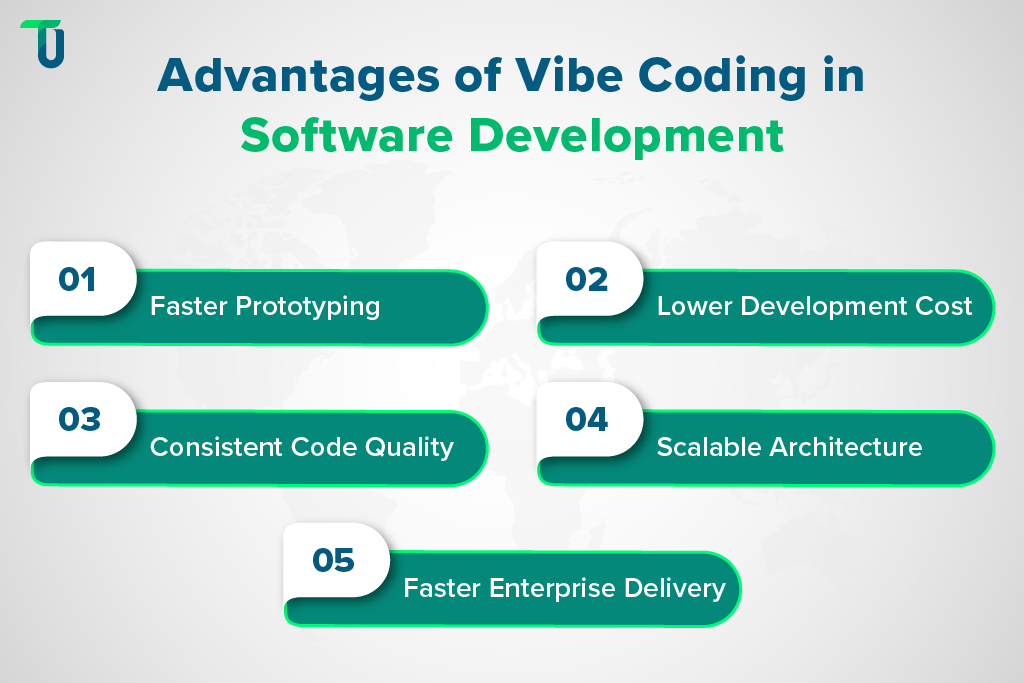
- Faster Prototyping: Teams can use Vibe Coding tools for startups — build MVP with AI — moving from idea to working model within days using AI-guided code generation, a core offering of our AI-assisted custom software development services for startups and MVPs.
- Lower Development Cost: AI-assisted workflows automate repetitive coding, reducing custom software development cost during design, prototyping, and MVP stages.
- Consistent Code Quality: By following AI-assisted custom software development best practices, teams can maintain uniform structure, naming, and logic across modules.
- Scalable Architecture: Vibe coding fits well with microservices architecture and API-first development, supporting scalability for custom web application development. Read TenUp’s guide on Microservices Design Patterns to learn more.
- Faster Enterprise Delivery: An LLM-driven workflow enables faster and more secure enterprise app deployment. In fact, a GitHub experiment with Copilot showed developers completing specific coding tasks up to 55% faster than those without AI assistance.
In addition to these major advantages, Vibe coding also helps software development companies accelerate delivery, maintain agility, and align technical output with real business goals across every stage of development.
Strategic and Business-Level Impact of Adopting AI-Assisted Custom Software Development with Vibe Coding
The impacts of Vibe coding extend beyond faster delivery. It reshapes how a custom software development company plans, builds, and scales projects. Here are the three major ways it influences business and strategy:
A. Operational Efficiency: Teams can deliver faster through LLM-driven workflows for enterprise applications, cutting manual effort and optimizing custom software development cost through automation.
B. Agility and Scalability: Vibe coding supports cloud-native applications, microservices architecture, API-first development, and even the systems covered in our custom enterprise software development guide, allowing projects to scale easily with market needs.
C. Governance and Quality: Integrating Vibe coding into CI/CD and DevSecOps pipelines helps maintain code security, consistency, and compliance while aligning with AI-assisted custom software development best practices.
Accelerate Software Delivery with TenUp’s AI Expertise
Partner with TenUp to leverage Vibe Coding and AI-assisted custom software development services for faster, scalable, and secure cloud-native software solutions.
Rapid Prototyping with Vibe Coding: From Concept to MVP
Vibe Coding has set a new pace for custom software development services by showing how to use rapid prototyping with AI and Vibe Coding for rapid prototyping in custom software effectively. Instead of spending weeks on setup and structure, teams now move from idea to prototype within days. Developers describe the product flow or logic, and Large Language Models (LLMs) generate the base code. The focus shifts from manual coding to quick validation and refinement.
For a custom software development company, this means faster MVP delivery, early feedback, and reduced custom software development cost through AI-assisted coding. It blends well with agile development, cloud-native applications, and API-first development. Teams can test features, collect user insights, and decide whether to scale or pivot much earlier.
Building MVPs through AI-Driven Workflows
A software development company can use Vibe coding for rapid prototyping by following a simple workflow:
- Define intent and scope: The team sets the business logic, data flow, and API structure in clear natural language.
- Prompt the model: The developer feeds this context to the LLM to generate code modules such as backend APIs, front-end components, or test scripts.
- Code review and refactor: Engineers inspect the output, validate security practices, and align it with company standards.
- Integrate with CI/CD: Code enters the pipeline for automated testing, dependency checks, and build validation.
- Deploy and monitor: The team deploys to staging or production within a DevOps or cloud-native setup.
- Refine continuously: The model output improves as teams refine prompts and feedback.
This approach works well for startups and enterprises that need fast validation without heavy investment. By combining AI-assisted development with human review, Vibe coding makes custom web application development faster, more practical, and closer to real-world business needs for cloud-native custom software solutions.
AI-Assisted Development and LLM-Driven Workflows
Large Language Models (LLMs) have changed how teams build and ship software by enabling LLM-driven workflows for enterprise applications that scale faster and perform reliably.Instead of hand-writing every function, developers now describe what they want the code to do, and the model generates the base structure. This shift allows faster prototyping, smarter debugging, and shorter development cycles.
For a custom software development company, LLM-driven workflows allow teams to handle more projects efficiently — focusing on architecture and design while AI handles repetitive coding tasks.
Related Read: Custom AI Software Development: A Guide to Building Intelligent Solutions
Best Practices for AI-Assisted Custom Software Development
Teams using AI-assisted custom software development best practices or Vibe Coding must balance speed with quality. Here are the key best practices to follow:
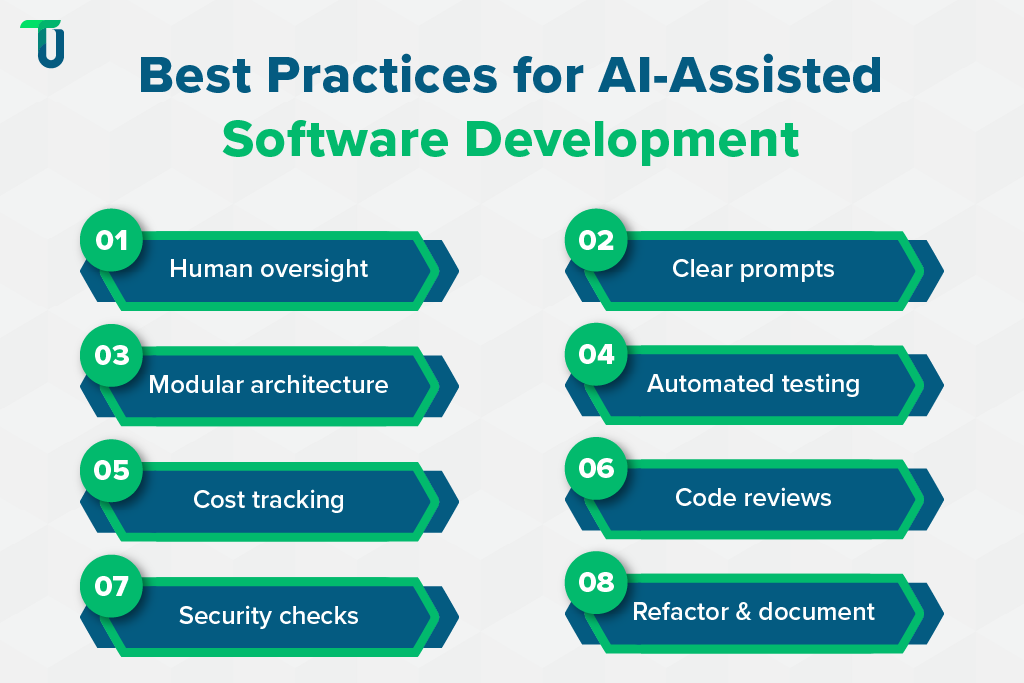
- Keep Human Oversight:Review all generated code before merging. Developers must verify logic, dependencies, and application security.
- Define Clear Prompts: Precise inputs lead to better outputs. Use clear instructions and context for LLMs in each task.
- Use Modular Architecture: Build with microservices and API-first development to make AI-generated parts easier to replace or update.
- Add Strong Testing: Automate unit and integration tests within your CI/CD setup to catch early errors in generated modules.
- Track Custom Software Development Cost: Account for prompt use, reviews, and LLM fees while budgeting for real ROI.
- Apply Code Reviews and Version Control: Keep version history and peer reviews active for quality assurance and long-term maintainability.
- Integrate Security Checks: Embed static analysis and vulnerability scans during the integration Vibe coding into CI/CD and DevSecOps pipelines.
- Refactor and Document: Clean up AI-generated code and document every change. This keeps custom web application development sustainable.
Following these best practices helps balance automation with control, allowing teams to build faster with Vibe coding while maintaining quality and accountability across every software project. Let’s now understand how to use Vibe coding for rapid prototyping in custom software.
Integrating Vibe Coding into CI/CD and DevSecOps Pipelines
Integrating Vibe Coding into CI/CD workflows changes how teams build, test, and secure software. It blends automation with AI-driven assistance, helping developers push reliable updates faster while maintaining control, visibility, and security across every stage of the delivery process.
Role of Vibe Coding in Modern CI/CD Environments
Vibe coding blends well with CI/CD pipelines because both aim for speed and consistency in software delivery.
In a standard setup, developers push changes that automatically trigger builds, tests, and deployments. With AI-assisted development, this process becomes faster and more frequent since Large Language Models (LLMs) can generate ready-to-use modules, API layers, or basic logic blocks.
How it fits:
- LLM-generated code can enter existing pipelines just like manual code — a practical example of this approach is Vibe Coding for rapid prototyping and enterprise apps.
- Each stage– build, test, and deploy- remains automated and repeatable.
- Development teams can shorten sprint cycles and deliver updates more often.
However, faster delivery does not mean less oversight. Every piece of generated code should still pass through testing, linting, and manual review before integration.
To summarize, for cloud-native applications or custom web application development, CI/CD pipelines ensure quality and stability — essential when embedding Vibe Coding into the CI/CD pipeline. The goal is not just speed, but also trust in what the system deploys.
Security and Compliance in AI-Generated Code Pipelines
Security is the biggest concern when integrating Vibe coding into DevSecOps pipelines. AI-generated code might include unsafe libraries, weak authentication, or overlooked data rules. That makes security validation a must at every stage of development.
Key practices for secure integration:
- Run static analysis and vulnerability scans on all AI-generated modules.
- Validate license terms, API usage, and third-party dependencies.
- Set up security gates that block builds with high-risk findings.
Even though automation helps, the final accountability remains with the development team. Maintaining proper documentation, clear approval workflows, and traceable audit logs helps teams stay compliant across environments. In other words, by treating AI-generated code like any other code in CI/CD, teams can keep their systems secure while still gaining the speed and efficiency that Vibe coding offers.
Steps to Embed Vibe Coding into DevSecOps Workflows
Integrating Vibe coding into DevSecOps requires structure and discipline. Below are key steps a custom software development company can follow:
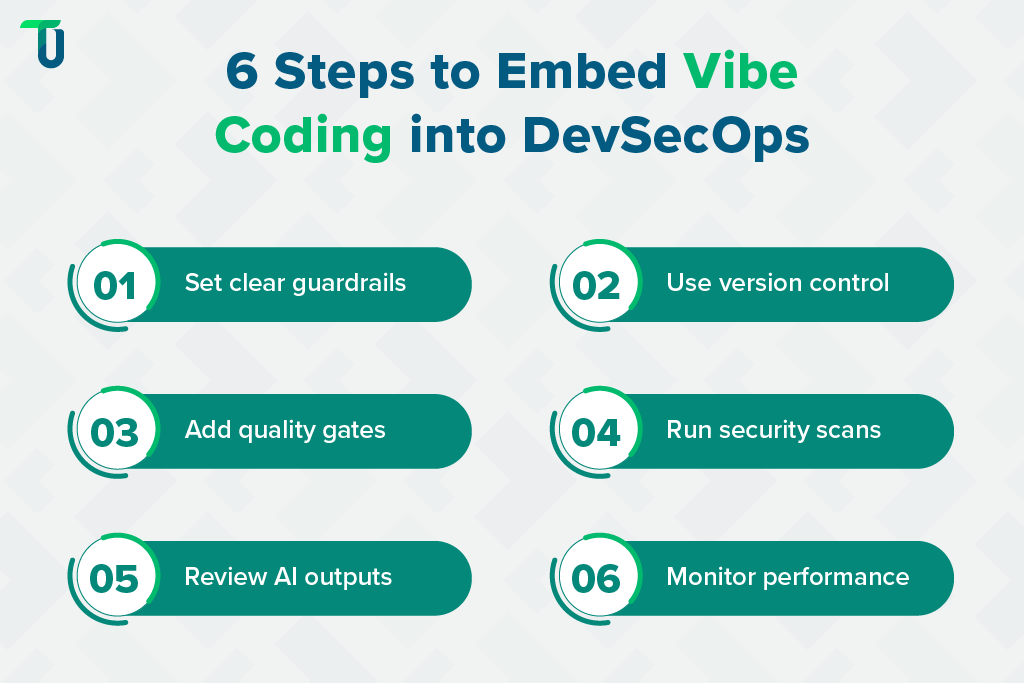
Step 1: Define clear guardrails: Identify which components can use LLMs for generation and which must remain manually coded. This sets the scope and reduces rework.
Step 2: Use version control for every AI output: All generated code should go through Git commits, pull requests, and peer review. This maintains transparency and accountability.
Step 3: Add automated quality gates: CI/CD pipelines must include tests, code linting, static analysis, and dependency checks. Each stage should automatically reject unstable or insecure builds.
Step 4: Run security scans continuously: Integrate open-source and third-party scanners for real-time risk detection. Monitor license and compliance flags before deployment.
Step 5: Review and refine outputs: Human engineers must inspect architecture and validate LLM-generated logic. Manual oversight keeps the balance between speed and reliability.
Step 6: Track performance and errors: Once deployed, monitor metrics like response time, resource usage, and security alerts.
By following these steps, a custom software development company can use Vibe coding effectively without sacrificing stability or security in modern software delivery.
How Do You Maintain Code Quality When Vibe Coding Fails?
Vibe coding can accelerate custom software development, but it does not guarantee flawless output. Sometimes AI-generated modules contain errors, incomplete logic, or hidden dependencies. Maintaining code quality requires a systematic approach that combines human review, structured testing, and careful refactoring.
Identifying Reliability Gaps in AI-Generated Code
Even when a software development company uses Vibe coding tools for startups — build MVP with AI, gaps appear in logic, security, or performance. Recognizing these early prevents bigger issues during deployment. Common reliability gaps include:
- Incomplete business logic: Features may work in test scenarios but fail under edge cases.
- Inconsistent architecture: AI-generated modules may not follow microservices architecture or API-first development standards.
- Security vulnerabilities: Missing validation, weak authentication, or poor handling of sensitive data affect application security.
- Dependency issues: Outdated libraries or conflicts in cloud-native applications can break builds.
- Scalability concerns: Generated code may not handle production loads efficiently, affecting custom web application development.
To sum up, a custom software development company should use a combination of static code analysis, automated testing, and peer review to detect these gaps.
Refactoring and Review Strategies to Restore Stability
Once gaps are identified, teams must take structured steps to restore stability. Best practices include:
- Code audits: Review AI-generated modules line by line to identify architectural or functional inconsistencies.
- Refactor for standards: Reorganize code to match cloud-native applications, microservices architecture, and API-first development principles.
- Unit and integration tests: Build test suites to cover edge cases and ensure proper functionality.
- Documentation: Maintain clear documentation for AI-assisted modules so future developers understand intent and flow.
- Continuous integration: Use integrating Vibe coding into CI/CD and DevSecOps pipelines to catch regressions early.
- Human oversight: Developers should validate outputs before moving to production to reduce risk.
By following these steps, a custom software development company can combine speed from Vibe coding with reliability and maintainability. This approach allows teams to leverage AI-assisted custom software development best practices without compromising long-term quality.
Build Secure, Scalable Systems with Vibe-Driven Pipelines
Let us help you integrate AI-assisted coding into CI/CD and DevSecOps pipelines for high-performance delivery.
Practical Challenges and Realities of AI-Powered Development
AI-powered development offers speed and flexibility, but it comes with practical challenges. Teams must balance rapid prototyping with long-term maintainability, control custom software development cost, and manage resources for production-ready deployment.
Understanding the trade-offs helps custom software development companies plan better.
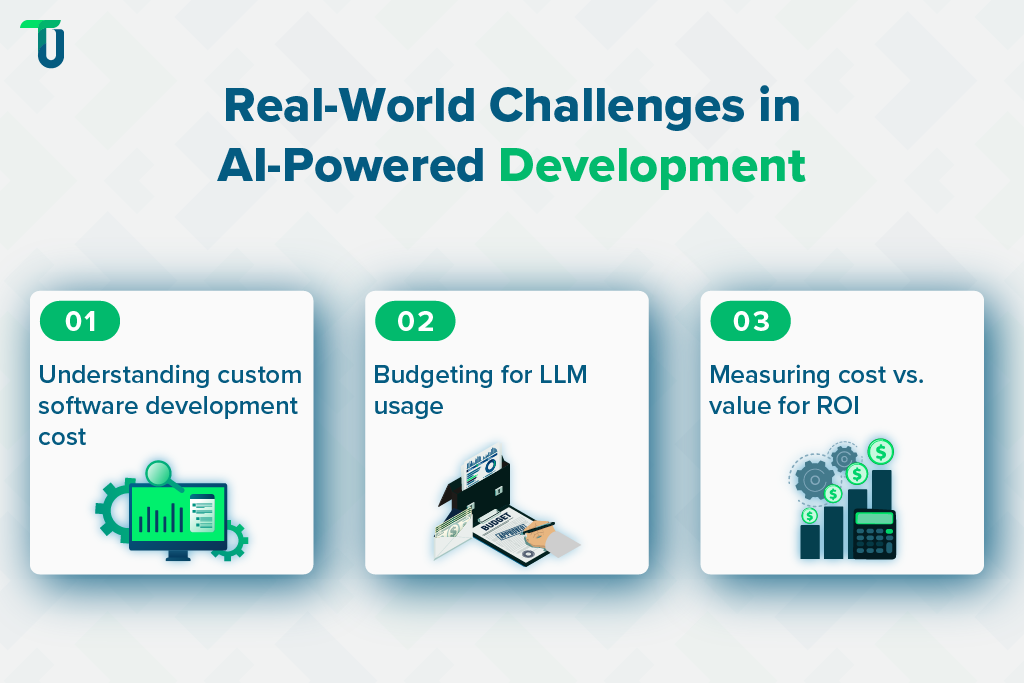
Understanding Custom Software Development Cost
The custom software development cost extends beyond human effort — especially when integrating AI-assisted workflows or Vibe Coding practices for faster builds. A comparison of vibe coding vs traditional software development cost can help enterprises understand the full financial trade-offs. When a custom software development company uses Vibe coding or LLM-driven workflows for building custom enterprise apps, several factors add up:
- Initial development: AI-generated code reduces manual effort but still requires review, testing, and integration.
- Tooling and platforms: Using Vibe coding tools for startups or cloud-based IDEs involves subscriptions and compute costs.
- Maintenance: Code refactoring, security updates, and scaling modules in custom web application development projects remain necessary.
- Team allocation: Even with AI, developers spend time on architecture, system design, and QA.
Understanding all components helps in estimating the custom software development cost realistically—refer to this custom software development cost guide to avoid underbudgeting.
Expert Tip: Always treat AI-generated code as a “junior developer’s draft.” Review, refactor, and annotate before integration.
Budgeting for LLM Usage
Large Language Models (LLMs) drive Vibe coding workflows for rapid prototyping in custom web application development, but they add variable costs. Here are a few costs to consider:
- Subscription or API costs for LLM services.
- Compute resources for running model-driven builds.
- Time spent refining prompts and reviewing outputs.
- Integration with existing DevOps/CI/CD pipelines and cloud infrastructure.
- Additional cost for testing, documentation, and refactoring.
It is recommended that you treat LLM usage as part of the overall project budget, not an optional add-on. Budgeting upfront avoids surprises.
Cost vs. Value: Measuring ROI
ROI for AI-assisted development depends on efficiency, speed, and business impact. Key points to measure include:
- Time saved: Faster MVP development and rapid prototyping reduce market entry time.
- Quality outcomes: Proper review ensures code aligns with API-first development, microservices, and agile practices.
- Flexibility: Teams can adapt quickly to client needs without drastically increasing the cost of custom software development.
- Strategic advantage: Clients benefit from faster delivery and scalable solutions built with cloud-native applications.
Balancing cost with these factors helps you decide when AI-assisted workflows add true value and when manual approaches remain necessary.
Team Composition and Governance in the Vibe Era
As Vibe coding becomes part of modern software development, team structures and governance models must evolve. Companies need hybrid roles, clear collaboration practices, and oversight mechanisms to maintain code quality, security, and project alignment.
Emerging Hybrid Roles in AI-Assisted Development
Vibe coding changes who does what in a custom software development company. Traditional developers work alongside specialists who guide LLM-driven workflows for building custom enterprise apps. Here are some notable hybrid roles:
- Prompt Engineers: Define clear instructions for LLMs to generate functional code.
- AI-Orchestration Leads: Manage AI-generated modules and coordinate with human developers.
- DevSecOps Engineers: Integrate outputs into CI/CD pipelines while monitoring application security.
- Traditional Developers: Refine, test, and stabilize modules, ensuring alignment with cloud-native applications and microservices architecture.
These hybrid roles help custom software development companies balance rapid prototyping, AI-assisted MVP development, and long-term maintainability. Teams can deliver custom web application development faster without losing control of architecture or compliance.
Building Collaborative Workflows Between Developers and Vibe Coders
Collaboration is key in Vibe-driven projects. Developers and AI specialists must share responsibility for outcomes while coordinating tasks effectively. Some of the best practices are:
A. Shared Context: Keep feature requirements, business logic, and rapid prototyping goals visible to all team members.
B. Task Division: Assign AI to repetitive code generation while humans handle architecture, integration, and critical modules.
C. Feedback Loops: Review AI output regularly for quality, performance, and compliance.
D. Documentation: Maintain clear records of Vibe coding tools for startup outputs and changes to avoid knowledge gaps.
This workflow supports both speed and stability, helping companies better manage software development costs efficiently while delivering value.
Governance, Oversight, and Quality Control in Vibe-Driven Projects
Proper governance ensures that the speed of AI-assisted custom software development through Vibe Coding does not compromise code quality or security. Key practices include:
- Code Review: Treat AI-generated modules like any other code for testing, security, and compliance.
- Standards and Guidelines: Set architecture, naming, and security rules for AI-generated outputs.
- Monitoring Pipelines: Integrate AI outputs into DevOps / CI/CD pipelines with automated checks.
- Accountability: Assign clear ownership for final production-ready code to maintain accountability.
Overall, with governance in place, a company can use Vibe coding safely.
Recommended Reads:
Why Cloud Native Applications Are the Future of Software Delivery
A Start-Up Founder’s Guide to Cloud Software Development
Cloud Application Development With Microservices: A Complete Guide
The Future of Custom Software Development Services: LLMs, Vibe Coding, and Beyond
The software development landscape is moving fast. Teams now combine agile practices, cloud-native applications, and modular design with tools that let them prototype, test, and deploy solutions more efficiently. The next wave will focus on contextual code, smarter workflows, and more integrated delivery models.
From Low-Code to Contextual Code
Low-code and no-code platforms gave businesses a way to deliver apps faster, but they often limit customization and scalability. The next stage is contextual code, where systems can generate functional modules based on business context and intent.
For a custom software development company, this AI-driven shift means:
- Developers spend less time on boilerplate and repetitive code.
- Teams can focus on architecture, microservices, and API-first development.
- Custom software development cost for initial builds can be reduced, while scalability improves.
- Rapid iterations for MVP development and custom web application development become easier.
Contextual code will integrate tightly with cloud-native applications and DevOps pipelines, making deployment faster and more reliable.
Emerging Trends Shaping the Next Decade
The next decade will bring several trends in software development, such as:
1. Ubiquitous Generative AI and LLM‑Driven Workflows
LLMs will become standard for generating code, APIs, and modules. Developers focus on intent and design while AI handles scaffolding, tests, and initial builds. This speeds up MVPs and lowers early custom software development costs.
2. Cloud‑Native + Microservices + API‑First Architectures
Apps will rely on cloud-native, microservices, and API-first design. Modular services let teams scale, reuse, and update features quickly. Vibe coding fits here by producing modules that integrate easily into flexible architectures.
3. DevOps, CI/CD and DevSecOps at a Higher Frequency
Frequent deployments with CI/CD and DevSecOps pipelines will be standard. AI-generated modules can be tested, scanned, and deployed automatically. Teams maintain speed without sacrificing quality or security in custom software projects.
4. Security, Compliance and Trust‑by‑Design
Security and compliance will be built into code from the start. Companies adopting AI-generated modules must include audits, threat modeling, and secure practices. This will make application security a core part of development and deployment.
5. Democratisation of Development & Rapid Prototyping
Contextual code and low-code tools let more people participate in development. Teams can build MVPs and prototypes faster, reducing early custom software development costs while still requiring human review for architecture and quality.
Vibe Coding’s Role Across the Modern Software Lifecycle
Vibe Coding in modern software development touches every stage of the software lifecycle, from initial ideas to final deployment. Teams can generate initial code quickly, which speeds up MVP development and allows businesses to test concepts without long delays. At the same time, it supports more structured custom development by producing modules that fit the needs of a software development company.
Beyond creation, Vibe coding integrates smoothly with cloud-native applications and microservices architecture. Once modules are generated, they flow into CI/CD pipelines where teams can review performance, security, and overall quality. This ensures the code is reliable and ready for production while maintaining pace.
Ensuring Reliable and Scalable Custom Software Development Services with AI-Assisted Workflows
Software development has evolved from manual coding to agile, cloud-native systems. Low-code and no-code platforms simplified custom web application development, while Vibe coding leverages LLMs to generate core code, allowing teams to focus on value, design, and workflow.
Nevertheless, this approach comes with challenges, including potential quality gaps, dependency issues, and managing custom software development costs. Even with AI-assisted workflows, human oversight and disciplined architecture remain essential to maintain reliability, security, and long-term maintainability.
At TenUp Software Services, we help clients implement AI-assisted custom software development services using Vibe Coding, cloud-native architectures, and DevSecOps pipelines, ensuring speed, quality, and compliance at scale. Schedule a consultation with TenUp’s software experts to implement AI-assisted custom software development services using Vibe Coding and LLM-driven workflows for faster, secure, and scalable enterprise solutions.
Accelerate Innovation with TenUp’s Engineering Expertise
Scale faster with TenUp’s custom software services, combining AI-driven workflows, microservices, and secure DevOps delivery pipelines.
Frequently asked questions
What is Vibe Coding and how does it apply to custom software development services?

Vibe Coding is an AI-powered software development approach where large language models (LLMs) turn natural language prompts or visual designs into functional code. In custom software development services, it accelerates prototyping, reduces manual coding, and enhances collaboration by letting developers focus on architecture and user experience while AI assists with test generation and code optimization suggestions.
How do AI-assisted workflows transform the cost and speed of custom software development services?
AI-assisted workflows accelerate custom software development services by automating coding, testing, and deployment, cutting delivery time by up to 50% and costs by approximately 30–40% in specific scenarios. They improve consistency, reduce human error, and streamline collaboration, helping teams deliver scalable, high-quality software faster and more efficiently.
What are the key advantages of Vibe Coding for a custom software development company?
Vibe Coding gives custom software development companies a major edge by automating repetitive coding and speeding up prototyping through AI-guided workflows. It reduces development costs by up to 40%, supports more consistent patterns and code structure, and enhances scalability with microservices and API-first design, helping teams deliver secure, high-performing applications faster.
How can startups use Vibe Coding tools to build MVPs with AI in custom software development services?
Startups can use Vibe Coding tools powered by LLMs to build MVPs faster by turning natural language prompts into functional backend, frontend, and API code. This AI-assisted workflow accelerates prototyping, cuts manual effort, and reduces early development costs by up to 40% in some PoC/MVP scenarios, helping teams validate ideas faster.
What role do LLM-driven workflows play in delivering enterprise-grade custom software development services?
LLM-driven workflows power enterprise-grade custom software development by assisting in code generation, testing, and optimization across CI/CD pipelines. They support consistency, scalability, and compliance efforts while reducing development time by up to 50%. By offloading repetitive tasks, developers can focus on architecture, security, and performance, delivering faster, more reliable enterprise applications with AI precision.
How can Vibe Coding be integrated into CI/CD and DevSecOps pipelines for custom software development services?
Vibe Coding integrates into CI/CD and DevSecOps pipelines by assisting with code generation, testing, and security validation through AI-driven workflows. Each module supports automated quality gates and vulnerability scans, and can cut release cycles by up to 40%, while facilitating compliance, stability, and faster delivery for cloud-native custom software development projects.
What are the risks and challenges of adopting Vibe Coding in custom software development services and how can they be mitigated?
The main risks of Vibe Coding include insecure AI-generated code, inconsistent architecture, and over-dependence on automation. Teams can mitigate these by enforcing human code reviews, automated security scans, and DevSecOps checks. Strong AI governance and prompt optimization ensure compliance, quality, and reduced vulnerabilities in enterprise software development.
How does Vibe Coding support cloud-native architecture, microservices, and API-first design in custom software development services?
Vibe Coding enhances cloud-native, microservices, and API-first development by generating modular, reusable components through AI-driven workflows. It supports API creation, container setup, and scaling logic, which can boost deployment speed by up to 45%. This approach facilitates flexibility, high performance, and seamless integration across enterprise-grade custom software applications.
Share the Article


