

AI projects don't fail because the technology doesn't work. They fail because the wrong company built them.
According to the McKinsey 2025 Global Survey, 88% of organizations have adopted AI, yet approximately two-thirds remain stuck in the piloting phase. High-performing companies are three times more likely to redesign workflows for AI, meaning the scaling gap is an organizational and partner problem, not a technology one. Vendor selection is where that gap opens or closes.
After ChatGPT launched, hundreds of web and software agencies repackaged their services as "AI development." Every vendor sounds credible in a pitch deck. Differentiating them requires questions most buyers never think to ask.
For startups, the stakes are higher. A vendor misfit isn't recoverable within a single budget cycle.
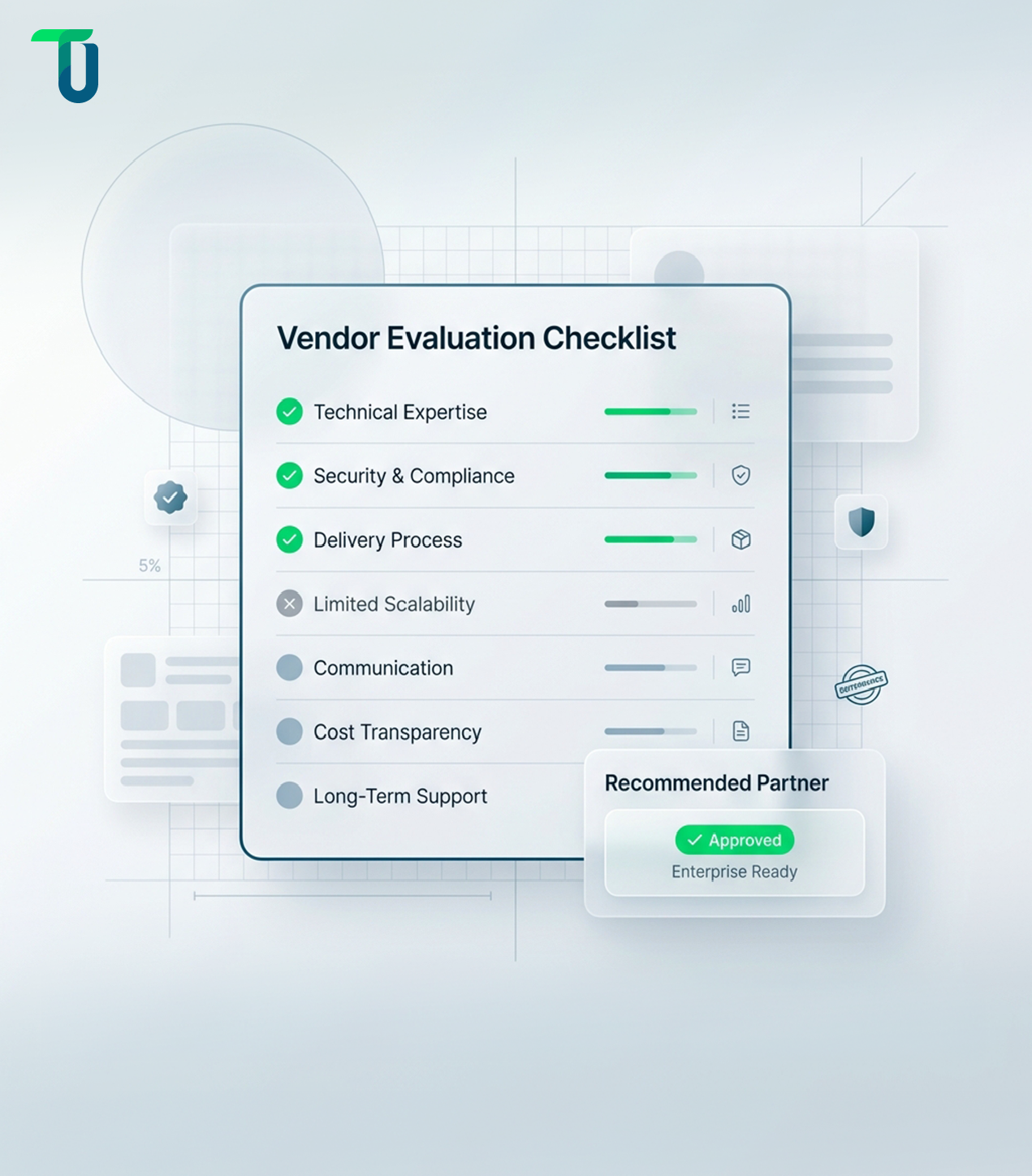
This blog covers 19 diagnostic questions across six evaluation categories: expertise, data practices, development process, post-launch support, governance, and commercial terms. If you're evaluating enterprise AI development services partners, these questions separate genuine capability from a polished pitch deck.
Why Standard Vendor Evaluation Fails for AI Projects
Reviewing the tech stack, timeline, and price works for software procurement. For AI, it produces the wrong shortlist.
AI is transforming how enterprises make decisions, and that changes what due diligence requires. AI is not a feature you ship. It is a decision system embedded into operations, one that requires data pipelines, model governance, retraining protocols, and workflow integration to deliver value. A vendor who builds a working model but ignores everything around it will cost you far more than their contract.
A failed AI engagement doesn't just waste budget. It makes leadership skeptical of AI for years, and that skepticism is harder to reverse than the technical debt it leaves behind.
Consider Epic Systems' sepsis prediction model, deployed across 15 US hospitals. A peer-reviewed study published in JAMA Internal Medicine found it missed 67% of actual sepsis cases. It collapsed because there was no monitoring, no retraining as clinical data evolved, and no integration into clinical workflows. The vendor delivered a model. The hospital needed a system.
That pattern repeats across healthcare, finance, logistics, and manufacturing. AI projects fail not because of bad algorithms but because AI was never embedded into how the business actually works.
Vendor selection determines whether AI delivers measurable outcomes or becomes a recurring cost with no ROI. Nineteen structured questions are the most reliable filter available.
Before You Interview Anyone: Clarify These 3 Things Internally
Decision-makers who skip this step hand scoping authority to the vendor. That is where misaligned projects begin.
Do you have a defined use case or just a direction?
"We want to use AI" is not a scoping input. Define the specific decision AI needs to influence and the workflow it must sit inside. A vendor cannot scope accurately without this, and will not tell you that until it becomes a problem.
Is your data ready?
In most enterprise AI projects, 60–70% of effort goes into data engineering, not model building. If you cannot describe your data's structure, volume, cleanliness, and labeling status, vendors fill that gap with assumptions that favor their approach, not your needs.
Do you know your build vs. buy boundary?
For startups evaluating AI for the first time, this carries extra weight. The wrong answer leads to a six-month custom build when a two-week API integration would have delivered the same outcome. Knowing where you need a custom model versus a pre-trained solution narrows the vendor pool before the first call.
Questions 1–4: Proving Real AI Expertise
Most vendors fail this filter. These four questions are why.
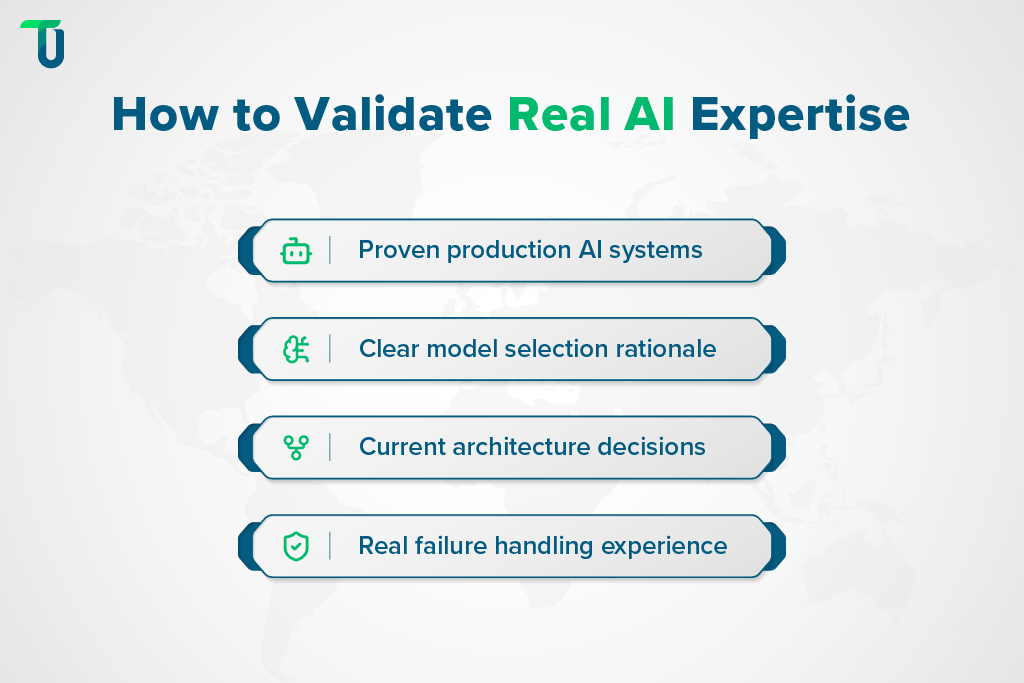
Q1: Can you show me production AI systems you have built, specifically within our industry or a comparable one, with documented ROI metrics?
The bar is not demos, mockups, or conference presentations. It is live systems with measurable outcomes: accuracy rates, uptime, throughput, cost reduction, revenue impact.
A vendor familiar with your sector already understands your data constraints, compliance requirements, and workflow logic. That context shortens timelines and reduces costly iteration.
Portfolio standard: "We deployed a claims-processing AI agent that reduced manual review time by 62% across 14,000 monthly transactions" clears the bar. "We built a chatbot for a healthcare client" does not.
Q2: Are you building a custom model, fine-tuning a pre-trained model, or wrapping a third-party API? What specifically drives that recommendation for our use case?
This is the clearest signal of whether a vendor will overengineer or underdeliver. Custom model builds, fine-tuning a pre-trained model, and API wrappers serve fundamentally different use cases. A vendor who defaults to the same answer regardless of the problem is fitting your requirements to their preferred approach.
Probe further: which AI technologies does the team build with natively, including machine learning, NLP, and computer vision, and what governs their stack selection? Ask about TensorFlow, PyTorch, Hugging Face, LangChain, and LlamaIndex. Stack choice rationale reveals engineering judgment. Default answers reveal a team that fits problems to tools they already know.
Q3: How do you stay current with fast-moving AI architecture developments, and how does that affect what you recommend to clients?
A vendor whose knowledge base is 18 months old will build solutions that age poorly within the first contract cycle. Probe how they evaluate when to adopt architectures like RAG versus LLM fine-tuning versus agentic workflows, and whether they can explain the tradeoff for your use case rather than defaulting to what they built last.
A strong answer explains why they would or would not use a specific architecture for your problem, with awareness of the cost and performance tradeoffs involved.
Q4: Walk me through a project where your AI model underperformed after launch. What went wrong and how did you resolve it?
This is the most powerful filter in the evaluation. A team that cannot answer it specifically has never maintained a model in production.
Good answers include a specific incident, a named root cause (data drift, distribution shift, integration failure, retraining lag), and documented changes to monitoring or pipeline design.
Red flag: generic references to "prompt tuning" or inability to name a specific post-launch incident.
Vendors who pass Q1–Q4 have shipped real AI and recovered from real failures. Everyone else has shipped demos.
Questions 5–7: Data Practices, Labeling Quality, and Infrastructure
The data gap kills most AI projects before a model is ever built.
Q5: How do you assess data readiness before scoping, including data labeling strategy, validation methodology, and the quality of any training data used in your models?
This is a three-part question. Most vendors only address one part.
Client side: what data structure, volume, labeling completeness, and pipeline maturity do they require before writing a line of code?
Labeling side: who labels training data, how is label quality validated, and how do they handle inconsistent or sparse labeling? A vendor's data labeling strategy determines model ceiling before a single training run begins. Data labeling quality is the most common hidden cost in AI projects and the gap most responsible for post-pilot performance disappointment.
Vendor side: if adapting a pre-trained model, what training data was used, how is its quality and bias profile validated, and does it reflect the distribution your system will encounter in production?
Any vendor who discusses models before discussing data is not ready to scope your project.
Q6: How do you handle projects where client data is insufficient, incomplete, or unstructured?
Data gaps are the rule in enterprise AI. A vendor without a documented protocol will either scope inaccurately or quietly reduce ambition mid-engagement without flagging the change.
Strong answers include: synthetic data generation, data augmentation, phased development tied to data maturity milestones, and honest re-scoping when data cannot support the original use case. This question reveals whether the vendor will tell you difficult truths before signing or after billing.
Q7: What does your cloud infrastructure setup look like for model training and inference? Who is responsible for GPU and compute costs, and how do you handle integration with our existing technology stack, including CRM, ERP, and data pipelines?
Hidden costs accumulate in two places: cloud infrastructure and system integration.
Cloud side: vendors without multi-cloud fluency across AWS, Azure, and GCP create infrastructure lock-in. GPU compute, vector databases, and LLM API calls commonly add 20-40% to quoted project costs. Ask who absorbs training overruns and who owns infrastructure decisions post-deployment.
Integration side: an AI system that cannot connect to your CRM, ERP, or data pipelines will never achieve adoption. Probe whether the vendor has deployed AI into environments with real integration complexity, not just standalone tools.
Most vendors price AI projects against model development time. The labeling and annotation work, which in enterprise computer vision engagements can exceed model training effort by a factor of three, rarely appears in a proposal until it becomes a scope dispute. Ask for a line-item breakdown of data preparation costs before signing.
In TenUp’s engagement with a US automotive photography client building a solution for Background Removal and Replacement Using Vision AI and Vision Engineering, labeling 20,000 4K images across 37 compositions required a 10-person annotation team under a two-week deadline. TenUp also evaluated foundation models, made the fine-tuning vs. custom model decision, and managed GPU infrastructure to deliver 90% daily processing cost savings.
Data problems discovered mid-build cost three to five times more to fix than problems identified during scoping. Vendors who skip the data assessment are deferring the most expensive conversation.
Evaluating an AI development partner and unsure where to start?
TenUp begins every engagement with a data and use case assessment, before any scoping proposal.
Questions 8–11: Development Process, Hallucination Handling, and Team Transparency
A vendor's development process reveals more about delivery risk than their portfolio does. These four questions expose the gap between structured methodology and well-intentioned improvisation.
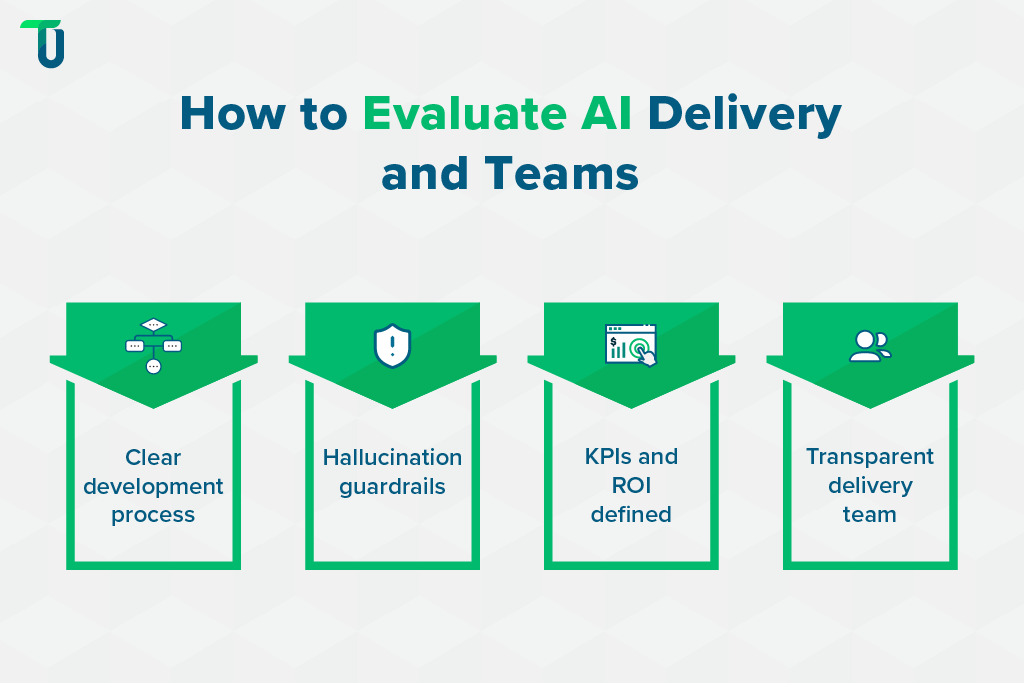
Q8: Walk me through your development process from data audit to production deployment. How do you handle scope changes or technically ambiguous requirements mid-project?
Require the full sequence: data audit, labeling, validation, model development, evaluation, staged rollout, optimization. Vendors who skip steps create downstream failures.
Scope change signal: rigid vendors charge excessive change fees. Flexible vendors without structure let scope creep destroy timelines. A defined change request process with cost and timeline impact assessment is the mark of delivery maturity.
The ambiguous requirements probe is the most underasked question in AI evaluations. How does the vendor behave when requirements are technically contested, or when data does not support the original use case? At enterprise scale, this situation is the norm. Vendors who have never faced it have never delivered production AI.
Vendors who exit at model delivery transfer all post-launch risk to your team. That is where most AI project failures occur.
Q9: How do you design guardrails against hallucinations and uncertain model outputs during the build, not just monitor for them after launch?
Build-time guardrails are architecturally different from post-launch monitoring and must be designed before deployment, not retrofitted after a production failure.
Strong answers include: output validation layers, confidence scoring, source citation for RAG-based generative AI systems, human-in-the-loop workflows for high-stakes decisions, and input filtering at the prompt layer.
Red flag: "we use a good prompt" or "GPT-4o doesn't hallucinate much." Both indicate a vendor who has not shipped AI where wrong answers have consequences.
Q10: How do you define project success, and will you help us build an ROI measurement framework before development begins?
AI projects without pre-defined KPIs cannot prove value internally. That kills budget approval for every subsequent phase.
Strong answers name measurable metrics: accuracy rate, time saved per task, cost reduction, ticket deflection rate, false positive reduction. Vendors who cannot engage with ROI framing before building are optimizing for delivery, not outcomes. Understanding AI development cost US vs India alongside projected ROI can help enterprises evaluate whether an AI investment makes financial sense.
Q11: Who will actually be working on this project, and can we meet the team before signing?
The person on the sales call is rarely the person writing the code. Ask which engineers are assigned, their seniority and AI experience, and whether they remain through delivery, not just kickoff.
Mid-project turnover is one of the most common and least discussed causes of AI initiative failure. Teams of generalists without deep ML, data engineering, or MLOps specialization cannot deliver production AI.
Strong answer: named team members, verifiable backgrounds, senior engineers leading architecture decisions throughout.
A vendor without defined KPIs, build-time hallucination controls, and a transparent team structure will deliver a model that cannot demonstrate business value, cannot be trusted in production, and cannot be maintained after they exit.
Questions 12–14: Post-Launch Support, Model Monitoring, and IP Ownership
Post-launch is where most AI vendor relationships quietly fail. Model drift goes undetected, retraining never happens, and IP disputes emerge after the contract has no leverage.
Q12: What does your post-deployment support model include, and what specifically triggers a retraining cycle?
Most vendors define support as bug fixes. Post-launch AI support requires model monitoring, performance tracking, prompt optimization, knowledge base updates, and a defined retraining cadence.
Retraining triggers must be pre-defined before launch: data distribution shift, accuracy degradation below a named threshold, regulatory change, business rule update. Strong vendors put these in the contract. Weak vendors make them a future conversation, which becomes a future invoice.
Probes included hours, response SLAs, and what constitutes an emergency versus a scheduled maintenance event.
Q13: How do you detect and respond to model drift, and what observability tooling do you deploy to surface it?
Model drift is silent ROI erosion. A model at 91% accuracy at launch may degrade to 74% six months later with no visible failure. LLM observability tooling surfaces it before users notice.
Probe specific tools: LangSmith, Langfuse, Wandb.ai, automated accuracy scoring, latency tracking. Vendors relying on manual review post-launch have not built production AI at scale. Drift detection must be automated.
Strong vendors design the full retraining feedback loop before deployment: flagged outputs feed annotation workflows, annotation feeds model training, ML experiment tracking captures performance comparisons, and the best-performing model deploys automatically.
TenUp built an end-to-end MLOps pipeline for a US automotive imaging client using Wandb.ai, CVAT.ai, and AWS SageMaker, reducing AI tool error rates by 20% and saving 65-75 hours of manual editing per week.
Q14: Who owns the model weights, training data pipelines, prompt libraries, inference infrastructure, and all IP after delivery? What are the exit terms if the engagement ends?
IP ownership is buried in the definitions of what "code" and "deliverable" include, not the contract headline. Full ownership means source code, trained model weights, training data pipelines, prompt libraries, deployment infrastructure, and documentation.
Exit terms matter as much as ownership clauses. Vendors who make exit terms difficult are building dependency into the contract.
Cross-reference with Q7: infrastructure ownership and IP ownership are directly related.
Without full IP ownership and pre-defined retraining protocols, a deployed AI model degrades silently while the vendor retains leverage over your most critical operational system.
Questions 15–16: Security, Compliance, and AI Governance
Non-negotiable in regulated industries. Increasingly non-negotiable everywhere.
Q15: How do you handle data security during model training? Specifically, will our data be used to train or improve your models or any third-party models, and what certifications govern your data practices?
Both concerns must be answered explicitly and in writing: data security protocols and whether client data trains vendor models.
Many vendors pass client data through third-party APIs that retain training rights. Many use it to improve their own models. This must be contractually defined, not assumed.
Certifications to verify: ISO 27001, SOC 2, GDPR, CCPA, HIPAA for healthcare, PCI-DSS for financial data. In healthcare and FinTech, data sovereignty, explainability, and audit trail design are non-negotiable.
TenUp built a compliance-driven AI watchlist screening system for a US FinTech client serving banks and financial institutions, enabling processing of 5M+ records daily against OFAC, OSFI, Interpol, and PEP watchlists, achieving under 1% false positives while maintaining 100% watchlist data freshness.
Q16: What is your approach to AI bias detection, explainability, and governance, and how do you document model behavior for audit purposes?
A biased or non-explainable model in a regulated environment is a legal and reputational liability, not a technical problem.
Probe: how they test for bias in training data, how model decisions are made interpretable to non-technical stakeholders, what governance framework governs production behavior, and how decisions are documented for audit.
Vendors without a documented governance framework are a compliance risk your legal team will flag before deployment. Deploying an ungoverned AI model in finance, healthcare, or HR exposes your organization to regulatory action. The vendor's governance posture becomes your liability the moment the model goes live.
Questions 17–19: Engagement Model, Scalability, and Communication
Engagement model, scalability, and communication cadence are the least-asked and most-revealing evaluation categories. They expose whether a vendor is structured to deliver a long-term outcome or a bounded contract.
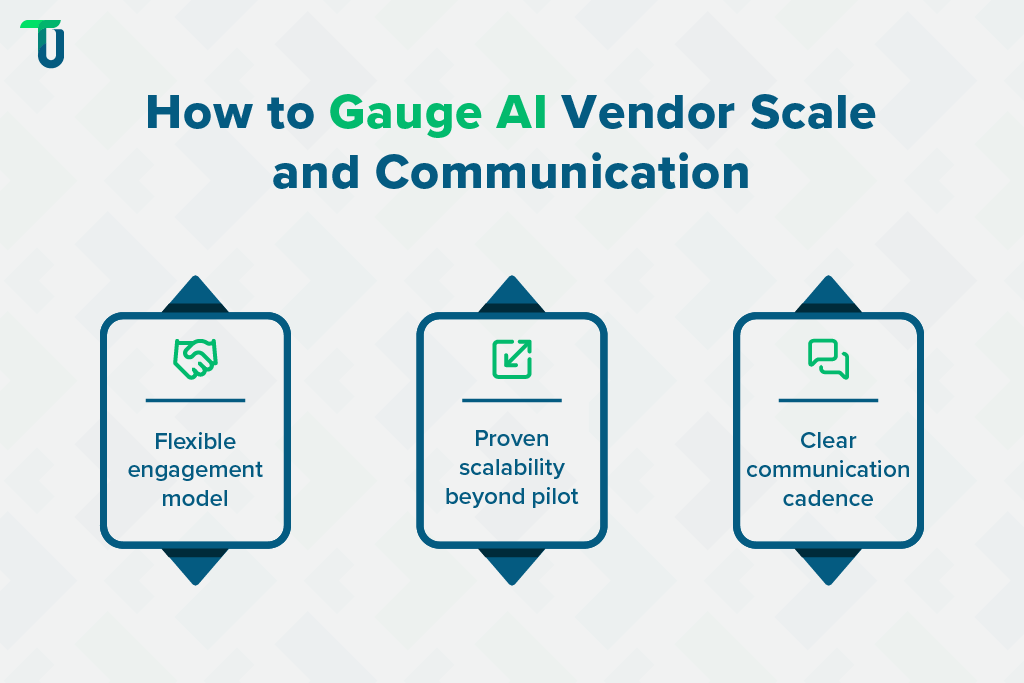
Q17: What engagement models do you offer, and how do you structure projects to accommodate AI's inherently iterative nature?
AI is not a fixed-scope project. Requirements evolve as you learn what the data actually supports. A vendor who cannot adapt will create friction at every sprint boundary.
Probe: dedicated teams, fixed-scope, staff augmentation, hybrid models, and whether they recommend a PoC before full-scale commitment. Sprint cadence, IP handoff timing, and stakeholder alignment protocols are where external AI collaborations most commonly break down.
Green signal: vendors who recommend starting with a bounded discovery or PoC before full contract commitment. The absence of this recommendation is a yellow flag.
Q18: Can you demonstrate a project where your AI solution scaled beyond the original scope? What did that require technically and operationally?
Vendors without cloud-native architecture experience across AWS, Azure, and GCP hit infrastructure ceilings as models and data volumes grow. Those ceilings appear suddenly.
Ask about horizontal scaling strategy, model routing, caching, and cost optimization at scale.
The operational dimension matters as much as the technical: did the team remain engaged through scale, or did involvement drop off after initial deployment?
Q19: What does your communication cadence look like (sprint reviews, written status updates, escalation protocols), and who is our primary point of contact from scoping through post-launch?
Poor communication kills AI projects through misalignment that compounds across sprints until a course correction costs more than a restart.
Probe: weekly progress updates, bi-weekly demo sessions, shared project management access, named escalation path, and whether the point of contact shifts between sales, delivery, and support phases. That shift, undisclosed before signing, is where most communication breakdowns begin.
Red flag: "we'll check in when there's something to show." Enterprise AI projects always hit friction. Vendors who cannot define their communication structure before signing will not be reachable when it does.
How to Score Your Evaluation: Turning 19 Answers Into a Decision
Red Flags: Walk Away Signals
- Cannot answer Q4 with a specific post-launch incident and named resolution
- Vague or deflected answers on infrastructure costs, IP ownership, data usage rights, or governance
- Only success stories with no acknowledgment of tradeoffs or what could go wrong
- Cannot introduce named senior team members who will remain through delivery
- Starts scoping before assessing your data
- Agrees with everything you say without pushing back on approach or feasibility
Yellow Flags: Proceed With Additional Scrutiny
- Strong technical answers but weak post-launch, governance, or ROI measurement responses
- Model-building expertise with no described MLOps or drift detection practice
- Flexible on engagement structure but vague on scope change and ambiguous requirements handling
- Security certifications present but cannot explain where client data goes or whether it trains vendor models
Green Signals: Strong Partner Indicators
- Challenges your assumptions before proposing a solution
- Asks about your data and use case before discussing models
- References specific failure-recovery examples with documented resolution
- Recommends a PoC before full contract commitment
- Introduces named senior team members with verifiable experience before signing
- Defines communication cadence, escalation path, and project management structure in the proposal
- Builds an ROI measurement framework before development begins
For startups and early-stage teams, green signals carry disproportionate weight. There is no second budget cycle to absorb a vendor misfit. The vendors most likely to protect your runway are the ones willing to tell you what your project actually requires before you sign.
Weighted Scoring Table
| Evaluation Category | Weight | Score (1–5) | Weighted Score |
|---|---|---|---|
| Production experience and portfolio quality | 20% | ||
| Technical depth and architecture judgment | 20% | ||
| Data practices, labeling, and infrastructure clarity | 15% | ||
| Development process and team transparency | 15% | ||
| Post-launch support and IP ownership | 15% | ||
| Security, compliance, and AI governance | 10% | ||
| Communication and engagement model fit | 5% | ||
| Total | 100% |
Score each vendor 1–5 per category, multiply by the weight, and sum the weighted scores. Run the same scorecard across all vendors you're evaluating for an objective side-by-side comparison.
The company that scores highest is almost always the right partner. Not the cheapest, not the most impressive deck, and not the one that agreed with everything you said.
Build With a Partner Who Can Answer Every Question on This List
The vendors worth hiring welcome every question on this list. The ones who deflect, generalize, or steer away from data, governance, or failure are telling you something before you sign.
TenUp Software Services is ISO 27001 certified and an AWS Partner, delivering Gen AI, Vision AI, Agentic AI, ML development, and AI integration for enterprises across the US and globally. Our client, a US-based manufacturing company, achieved a 98% reduction in PO processing time, an 85% shorter billing cycle, and a 20x faster inquiry response through AI-driven workflow automation.
Every TenUp engagement begins with a use case and data readiness assessment before any scoping proposal. You are not hiring a vendor. You are choosing a long-term AI capability partner.
Ready to put TenUp Software Services through all 19 questions?
We welcome the scrutiny because the right AI partner should be able to justify every decision across data, models, infrastructure, and outcomes with clarity.
Frequently asked questions
How do I know if a vendor has real AI expertise versus generic software development relabeled as AI?

Ask how they choose between custom models, fine-tuning, or API wrappers for your specific use case. Real AI teams justify decisions with data constraints, trade-offs, and problem-led reasoning. Generic vendors give tool-led answers. Also probe for MLOps capability, named frameworks like PyTorch or Hugging Face, and evidence of post-launch model monitoring, not just deployment.
What should I look for in an AI software development company's portfolio?
Look for documented outcomes with named metrics, not client logos or demo videos. Deployments in your industry with evidence of post-launch failure handling matter more than technology lists. Verified case studies showing measurable ROI, MLOps capability, and compliance handling are portfolio evidence. A 62% reduction in manual review time across 14,000 transactions is, a chatbot screenshot is not.
How much should a custom AI development project cost, and what drives the pricing?
Custom AI projects range from $40,000 for basic features to $500,000+ for enterprise-grade platforms. Key cost drivers are data readiness, labeling effort, model choice (API wrapper, fine-tuned, or custom), integration complexity, and retraining needs. Hidden costs: GPU compute, LLM API usage, and annual maintenance (20–30%), commonly add 40%+ beyond initial quotes. Never accept pricing before data assessment.
What are the hidden costs of AI development that vendors rarely disclose upfront?
Hidden AI development costs include data labeling (60-80% of project effort), GPU compute, LLM API usage at scale, vector database hosting, legacy system integration, retraining cycles, and annual model maintenance (15-20% of build cost). These consistently add 30-50% beyond initial vendor quotes. Any estimate that excludes data preparation and infrastructure is not a reliable total cost of ownership.
What are the biggest red flags when evaluating an AI development company?
Key red flags: vendors who discuss models before assessing your data, cannot answer Q4 (a specific post-launch failure with named resolution), avoid IP and data ownership clarity, won't introduce actual delivery engineers, or agree with everything without pushback. Credible AI partners challenge assumptions early, lack of scrutiny signals shallow expertise and significantly higher delivery risk.
What are the typical project timelines for enterprise AI software development?
Simple AI integrations take 4-6 weeks. Custom AI systems with ready data and clear scope take 3-6 months. Enterprise platforms with compliance, legacy integration, and multi-system complexity take 6-12 months. Data preparation and use case clarity, not coding, determine timeline accuracy. Add 4-8 weeks upfront if data is unstructured or requirements are undefined.
What industries benefit most from custom AI software solutions?
Industries with high data volume, complex decisions, and measurable outcomes benefit most. Financial services, healthcare, manufacturing, logistics, and retail lead, with use cases like real-time fraud detection, clinical diagnostics, predictive maintenance, demand forecasting, and personalization. These sectors gain the most because AI delivers accuracy, speed, and cost impact that rule-based or manual approaches cannot match.
What should enterprises look for in a long-term AI development partner?
Choose an AI partner that owns the full lifecycle: use case definition, data readiness, development, deployment, and retraining. Verify ISO 27001 or SOC 2 certification, regulatory experience, clear IP and exit terms, and outcome-based success metrics. The strongest signal: partners who challenge your assumptions and assess your data before proposing any solution.
Share the Article


