


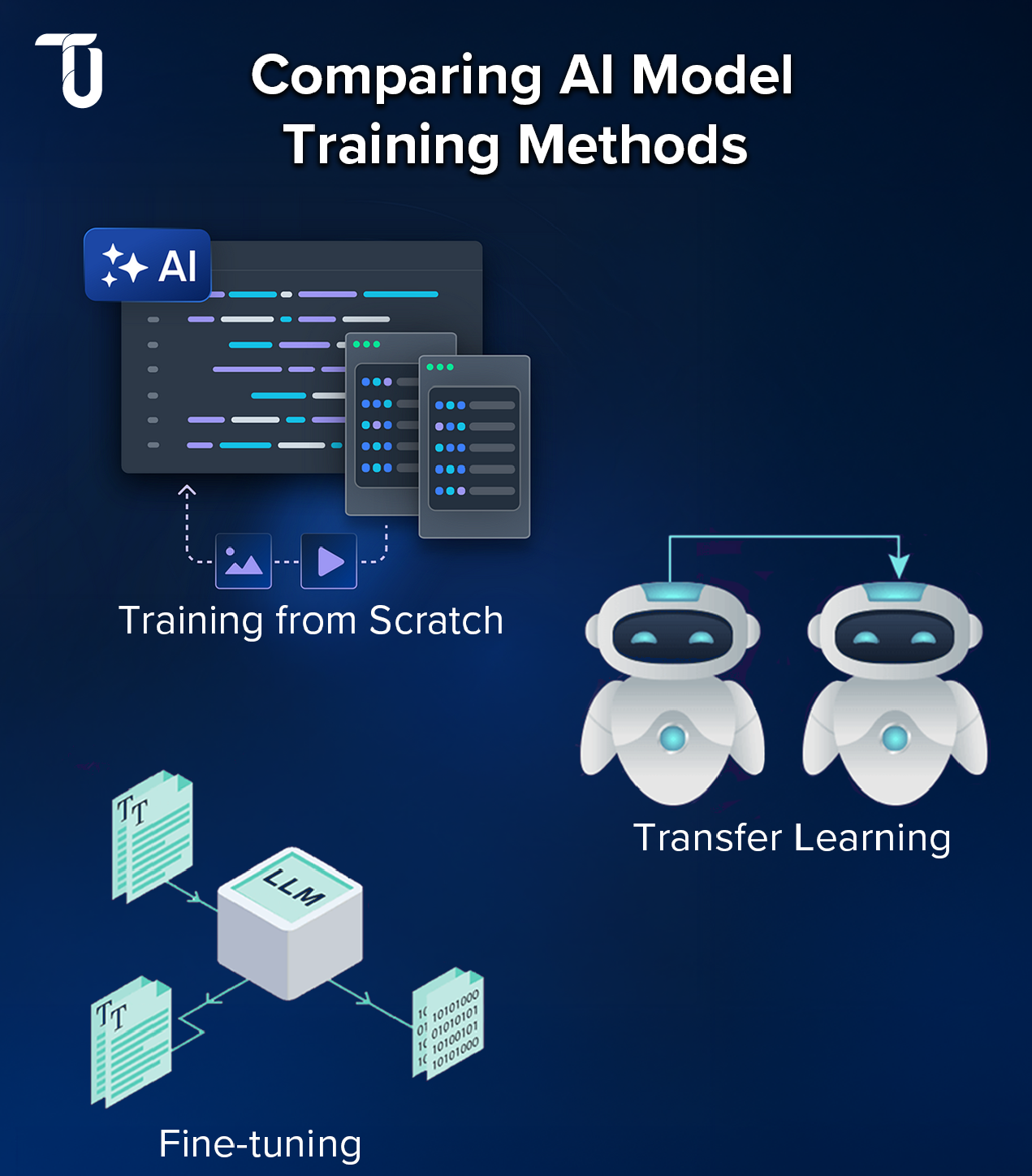
Have you ever wondered how various AI-based solutions perform completely different tasks across industries? They can diagnose diseases from medical imaging and even identify issues in legal contracts. So, does AI know it all? While this is the most common misconception, the reality is that AI models need relevant training to perform particular tasks. In fact, the performance of an AI model is directly related to the quality of training it has received.This brings us to the topic of training models, which is inevitable for AI development — and a foundational step in any generative AI development services engagement — requiring both time and resources. We’ll begin with the traditional approach of training a model from scratch and go on to discuss modern methods like transfer learning and fine-tuning, while making critical comparisons and learning when to use which. Depending on specific project requirements, you may want to opt for any one or a combination of these approaches, making it essential to learn about them. A common question people ask is: “What is the best AI model training process—should I build an AI model from scratch, or use transfer learning and fine-tuning?” In this blog, we provide an AI training methods comparison, outlining the trade-offs so you can decide which approach fits your needs.
Understanding the Training AI Model from Scratch Approach
Sometimes also referred to as Full Training, this is a traditional approach to training AI models. It begins with developing a new model and providing end-to-end training using large datasets to ensure it delivers the intended outcomes. The training starts by utilizing random or predefined initial weights. They are later optimized iteratively based on the input data and the output results, and by using relevant algorithms and optimization techniques.
Key components of the Training AI Model from Scratch approach include:
Data: As the model is being trained from scratch, using large datasets is essential. The model will likely suffer overfitting issues and perform poorly if trained on insufficient data.
Computational Power: This requirement is high because the model must train on all the parameters (sometimes running up to millions). It necessitates the use of very high-performance GPUs (Graphics Processing Units) or TPUs (Tensor Processing Units)
Time Frame: Considering the high training data volume and process complexity, using this approach requires more time compared to other methods like transfer learning and fine-tuning.
Costs: The costs for training AI models using this method are high because of its extensive requirement for both human and computational resources, and a longer time frame.
Flexibility: You get complete control of the model's architecture design, which you can modify to meet specific use cases. This approach also provides full flexibility in the training process to make necessary adjustments according to available data.
Performance: The model’s performance depends on its architecture, the size of training datasets, and the level of optimization.
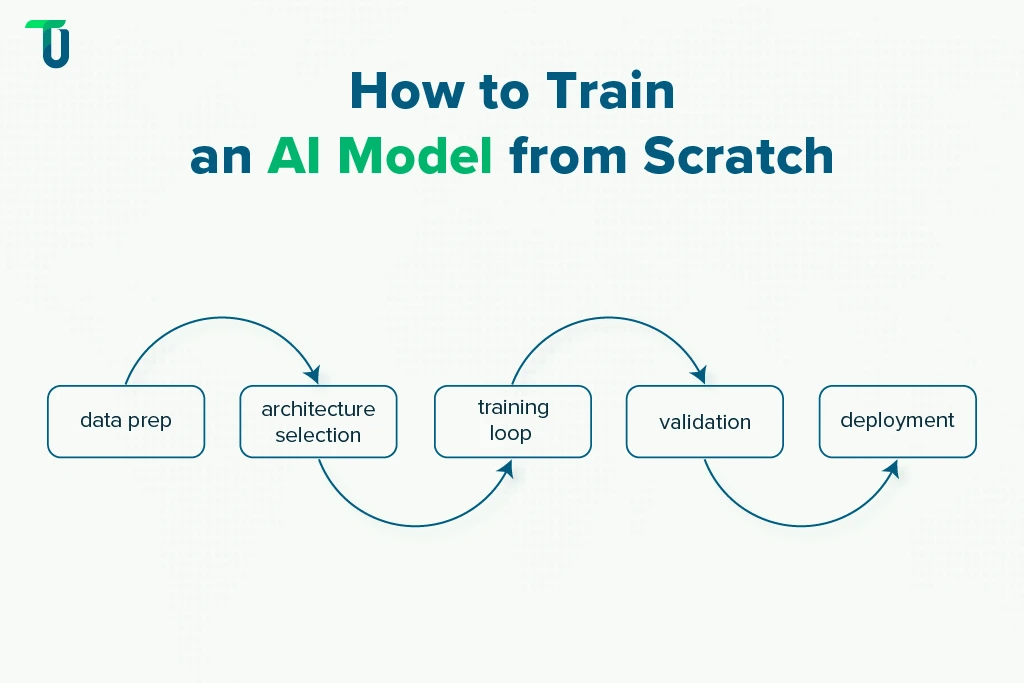
If you’ve ever wondered “how to train an AI model”, this approach represents the most resource-intensive but flexible option, especially when considering the importance of training AI models from scratch with proper data preprocessing and feature engineering. It is best when data is abundant, and the project demands a custom AI model training strategy.
When to use the ‘Training from Scratch’ approach?
Even though this approach is resource, time and cost-intensive, it is best suited in the following scenarios:
Unique Issues: Use this approach if you are working on a solution to resolve a highly specialized problem for which no pre-trained model is good enough.
Custom Architecture: If the solution demands that you customize the architecture design to attain desired outcomes, go for this approach.
Availability of large datasets: As discussed earlier, this approach cannot be used if the data is not sufficient for training. So, if the required amount of data is available and your project requires complete flexibility, use this approach.
TenUp’s fishing app built for a US-based startup shows this decision in practice. The client needed to identify a catch from a photo and tell the user whether it was legal to keep, based on species and location. The challenge wasn't generic object recognition; it was distinguishing over 72,000 fish subspecies with enough precision to be trustworthy. No pre-trained vision model's existing feature space was fine-grained enough to make that distinction reliably, so a custom model was trained from scratch using Fine-Grained Image Classification techniques on an AWS SageMaker pipeline. The result: 85% identification accuracy in under 2 seconds per scan.
While using this traditional approach of ‘Training from Scratch’ is suitable in certain scenarios, it is clearly not feasible when you have resource, cost, and time constraints. Thanks to the rise of pre-trained models like GPT, BERT, Llama, ResNet, and YOLO, you can utilize modern approaches to training AI models, like Transfer Learning and Fine-tuning, for your AI development projects.
Want to build a unique AI solution from the ground up?
Our experienced AI development team will create a custom architecture and training the AI model to deliver accurate outcomes.
Transfer Learning: The Approach of Using Pre-trained AI Models for Training
This AI model training approach utilizes a model pre-trained on large datasets to perform certain task/s and repurposes it to perform new yet related task/s. Pre-training refers to a model's original, large-scale training; fine-tuning and transfer learning both start from that pre-trained state rather than repeating it. Pre-training is the process that produces the "pre-trained" starting point in the first place: a model trained once on a very large, general dataset until it learns broad patterns, in language, images, or audio, before anyone adapts it for a specific task. That broad, general-purpose knowledge is exactly what transfer learning and fine-tuning reuse instead of rebuilding.
Suppose, you have a pre-trained Object Detection Model trained on general images like animals, plants, vehicles, etc., and you want to use it to detect food items. This model has already learned to recognize objects based on features like shapes, textures, edges, colors, etc., which are common in food items as well. Using the Transfer Learning approach, you can leverage this model to apply its ability to recognize objects in the new domain of food item detection. This is where the distinction of transfer learning vs pre-training comes in. While pre-training refers to the initial training of large models, transfer learning adapts those models for new domains.
This approach leverages transfer learning models that are already trained on large datasets. Instead of training everything again, you adapt knowledge from the pre-trained model to solve a related task. This method falls under the broader area of transfer learning and deep learning. Transfer learning is a technique within deep learning, not a separate field; it is one method deep learning practitioners use to reuse an already-trained model instead of training a new one.
So, the purpose of Transfer Learning is to utilize the knowledge learned by the model on one task to perform another task, even if the two tasks are not the same. This approach is especially useful when you have limited training data for the new task as it leverages the model's already learned features.
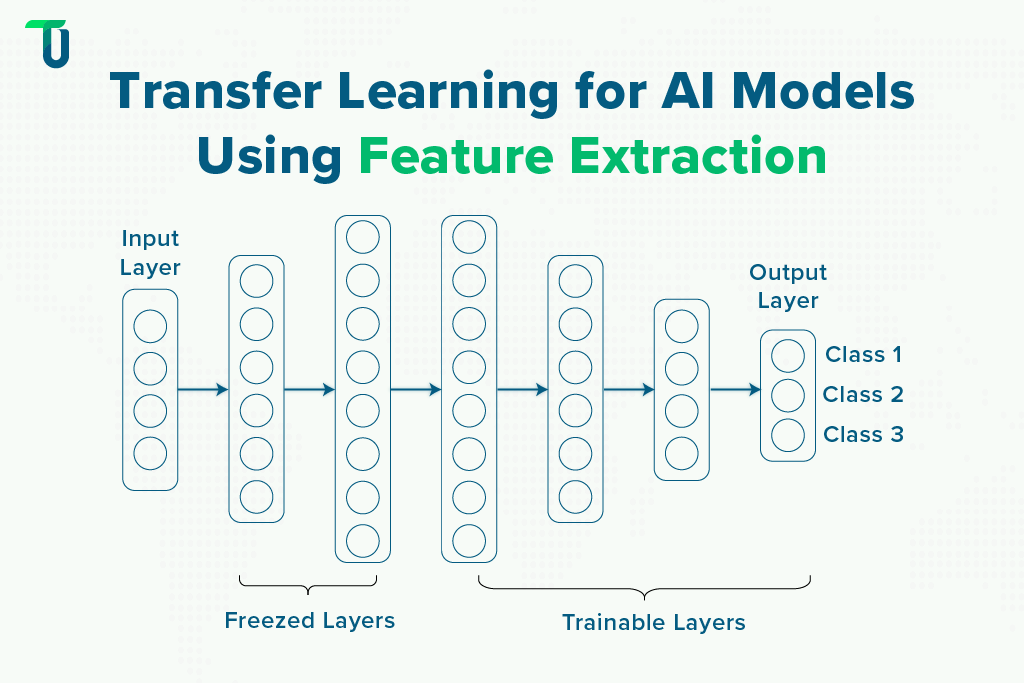
Let’s understand how Transfer Learning using Feature Extraction works for the above example of food item detection:
Pre-trained Model: The process starts with selecting your pre-trained Object Detection Model trained on all the features needed to recognize food items.
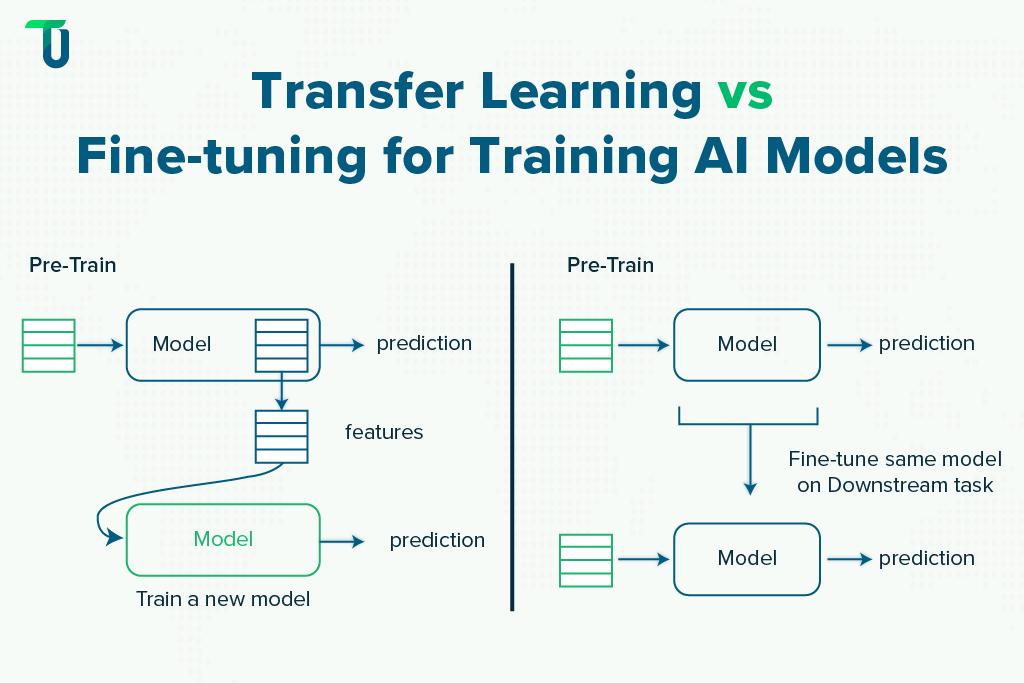
Feature Extraction: It involves using the pre-trained model as a feature extractor and freezing the initial layers of the model having features necessary for object detection like shapes, textures, etc. So, you are transferring the required features to the new task.
Limited Training: It includes training the final few layers of the model on a smaller dataset of food images and adjusting its output to focus on food categories using fewer computational resources.
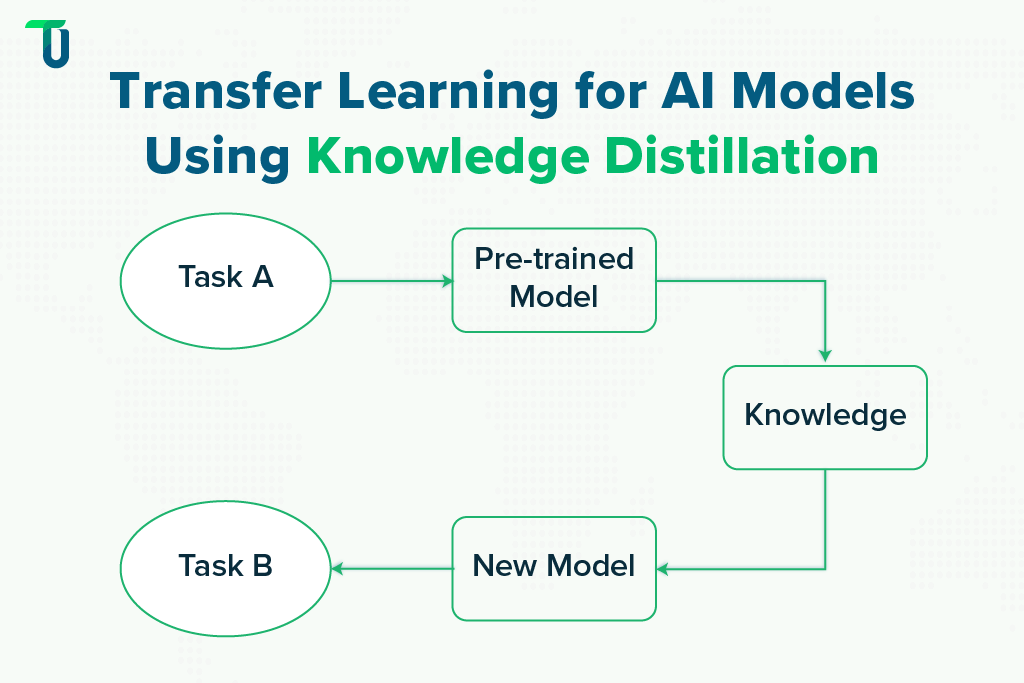
Another method to perform Transfer Learning is Knowledge Distillation.
Knowledge Distillation is one of the widely used transfer learning techniques, where the required knowledge is transferred from the pre-trained Object Detection Model (the large teacher model) to the new model (the small student model). Here knowledge includes the model’s parameters, learned patterns, and the ability to perform certain tasks (object detection). So, the student model mimics the behavior of the teacher model to perform the new task- in our example, food item detection.
The Knowledge Distillation technique is particularly useful when you need to keep the model size small while attaining the same level of performance for devices with limited resources. This is why many businesses compare transfer learning vs learning from scratch before starting projects.
Beyond object detection, transfer learning shows up across industries in similar form: a pre-trained language model adapted for legal-contract review, a pre-trained vision model repurposed for retail shelf-inventory tracking, or a speech model adapted for a specific industry's call-center terminology. In each case, the underlying model already understands the general shape of the problem, language, images, or audio, and only needs retraining on the narrower, industry-specific task.
When to use the ‘Transfer Learning’ approach for training AI models?
Limited Data: When you have a small training dataset for the new task and the pre-trained model is trained on a large yet relevant dataset and has features required for your new task.
Similar Tasks: Choose this approach when your new task is similar to the task your pre-trained model is proficient at performing.
Transfer Learning in Generative AI
Transfer learning underpins most generative AI development today. Foundation models like Llama and GPT-class models are pre-trained once on massive, general text corpora, then adapted through transfer learning or fine-tuning for narrower use cases, customer support, code generation, domain-specific chat, rather than trained fresh for each application. This is why generative AI development services rarely start with training a new base model: the economics only make sense when a project needs capabilities no existing foundation model offers.
Training from Scratch vs Transfer Learning
‘Transfer Learning’ saves time and costs as compared to ‘Training from Scratch’ and accomplishes the task of training AI models with limited resources. As training from scratch using a small dataset leads to overfitting issues, using ‘Transfer Learning’ significantly reduces these challenges by leveraging a model pre-trained on large datasets. The downside of ‘Transfer Learning’ is that it can be used only for similar tasks and provides limited flexibility. This comparison often sparks debate online about transfer learning vs fine-tuning or even model training vs fine tuning. The general consensus is that transfer learning is cost-effective, while fine-tuning offers higher accuracy.
Transfer learning costs less for a specific reason: the expensive part, learning general features from millions of data points, was already done during the pre-trained model's original training. Reusing that work means training on a smaller dataset, for fewer epochs, on far less GPU time than training from scratch requires.
Need An Entry-level AI Solution on a Budget?
Our team can build custom AI solutions for your business while meeting your cost and time requirements.
Fine-tuning AI Models: A Step Beyond Transfer Learning
Fine-tuning pre-trained models takes a step ahead of Transfer Learning in training AI models. It also involves leveraging a pre-trained model trained on large, generic datasets. But instead of freezing the initial layers and adjusting only the final ones (as in model Transfer Learning), the Fine-tuning approach allows unfreezing some of the initial layers as well and adjusting them along with the final layers to achieve performance accuracy in niche tasks.
In some cases, all the weights (parameters) of the pre-trained model are adjusted, giving more flexibility to align the model with the new task (called Full Fine-tuning). Parameter Efficient Fine-tuning (PEFT) is a modern and more feasible approach. Businesses adopting parameter efficient fine-tuning techniques to train open-source models can achieve cost savings while still deploying a high-performing fine-tuned model. If you’re wondering, what is parameter efficient fine tuning, read our dedicated blog discussing the concept of Fine-tuning pre-trained models in great detail with two PEFT techniques- LoRA and QLoRA are the two most common PEFT techniques. According to an estimate from Google Cloud, fine-tuning with LoRA runs roughly 66% faster and about 40% cheaper than QLoRA, though QLoRA's lower memory footprint makes it the better fit when GPU memory is the binding constraint.
Fine-tuning is also how enterprises adapt a model to a specific voice or standard rather than just a specific task, such as fine-tuning a customer-facing LLM on a company's own support transcripts and style guide so it responds in a consistent brand voice across every interaction. Building a custom model to achieve the same result would cost far more for a narrower, style-level outcome.
Transfer Learning vs Fine-Tuning
As the number of layers being trained in ‘Fine-tuning’ increases as compared to ‘Transfer Learning’, it utilizes moderate datasets and more computation resources. Depending on the level of Fine-tuning undertaken i.e. the number of parameters adjusted, the time and costs in this process increase. The benefit of using ‘Fine-tuning’ over ‘Transfer Learning’ is that even though the pre-trained model is chosen for similarities in the original and new tasks, it allows for a greater level of accuracy and performance optimization for new tasks. So, you get more flexibility in aligning the pre-trained model to your specialized, niche tasks. Some researchers even compare Transfer learning vs fine-tuning (retrieval-augmented generation vs tuning the model). RAG helps when continuous updates are needed, while fine-tuning is better for stable, specialized performance.
Transfer Learning vs. Fine-Tuning: Which Wins for Your Use Case?
| Factor | Transfer Learning | Fine-tuning |
|---|---|---|
| Layers trained | Final layers only | Deeper layers, sometimes all |
| Data needed | Small dataset | Moderate dataset |
| Compute cost | Lowest | Moderate to high |
| Training time | Days to weeks | Weeks to a few months |
| Best-fit task | Closely related to the pre-trained model's original task | Specialized or niche, needs precision beyond the original task |
| Output | Good performance on a related task | High performance on a specialized task |
Choosing transfer learning to save cost on a task that actually needed fine-tuning's precision is the most common version of this decision going wrong, since it means paying to redo the work once accuracy falls short in production.
Fine-Tuning vs. Training From Scratch: Why Enterprises Rarely Retrain From Zero
| Factor | Fine-Tuning | Training From Scratch |
|---|---|---|
| Starting point | Pre-trained model | No prior knowledge |
| Data needed | Moderate, labeled dataset | Large dataset |
| Compute cost | Moderate to high | Highest |
| Timeline | Weeks to a few months | Several months to over a year |
| Best-fit scenario | Specialized task with some data available | No pre-trained model fits, or a large proprietary dataset demands a custom architecture |
Fine-tuning is preferred over training from scratch for most enterprise use cases because it reaches comparable accuracy on a specific task at a fraction of the data, compute, and timeline. Training from scratch remains the right call only when no pre-trained model's feature space fits the problem closely enough, as covered above in the Training from Scratch section.
Gathered in one place, the case for transfer learning or fine-tuning over training from scratch comes down to four things: significantly less training data required, materially lower compute cost, a shorter path to production, and lower overfitting risk since the model isn't learning every pattern from zero. Training from scratch only wins when the task's novelty outweighs all four of those advantages.
Factors to Consider While Selecting Your AI Model Training Approach
A custom-trained model is one built or substantially retrained on your own data for your own problem. A pre-trained model is used largely as-is, adapted only through transfer learning or fine-tuning. The training-from-scratch approach above produces a custom model; transfer learning and fine-tuning both start from a pre-trained one.
We’ve discussed all three AI model training approaches, but which is right for your particular AI development project or to build your unique AI-based solution? Before making a major investment, read What would you ask an AI software development company before spending $100,000?. You need to select the most suitable approach based on the availability of resources, costs, time, and the nature of your intended AI-based solution. Let’s have a quick comparison of these approaches based on your consideration factors:
Model Utilization
Training From Scratch: A new model is given end-to-end training.
Transfer Learning: A pre-trained model is repurposed for a new task.
Fine-tuning: A pre-trained model is trained further to improve performance on a new task.
Data Requirements
Training From Scratch: Large datasets
Transfer Learning: Smaller datasets
Fine-tuning: Moderate datasets
Computational Resources
Training From Scratch: Maximum resource requirement
Transfer Learning: Minimum resource requirement
Fine-tuning: More than Transfer learning but much lesser than Training from Scratch
Time to Train
Training From Scratch: Long training time needed
Transfer Learning: Short time required
Fine-tuning: Shorter than Training from Scratch but longer than Transfer Learning
Flexibility in Training and Architecture
Training From Scratch: Complete Flexibility
Transfer Learning: Limited Flexibility
Fine-tuning: High Flexibility
Expected Performance
Training From Scratch: High performance on intended tasks
Transfer Learning: Good enough performance on similar tasks
Fine-tuning: High performance on specialized, niche tasks. In fact, when companies need parameter-efficient fine-tuning or RAG-based methods, fine-tuning delivers long-term value compared to retraining models.
| Training from Scratch | Transfer Learning | Fine-tuning | |
|---|---|---|---|
| Model Used | New | Pre-trained Model | Pre-trained Model |
| Datasets Utilized | Large | Small | Moderate |
| Computing Power | High | Low | Moderate |
| Time to Train | Long | Short | Moderate |
| Flexibility | Full | Low | High |
| Performance | High | Good | High |
Fine-Tuning vs. RAG: Two Different Ways to Customize a Model
Customizing a pre-trained model's behavior generally comes down to four options: prompt engineering, RAG, fine-tuning, or training a new model from scratch. Prompt engineering, improving the instructions given to a model at inference time, is the fastest and cheapest option, and should usually be tried before any of the other three. When prompt engineering isn't enough, the choice narrows to RAG and fine-tuning, which solve different problems even though both get proposed as ways to make a generic model behave like a specialized one.
Fine-tuning changes the model's weights permanently, teaching it new behavior, style, or task performance. RAG leaves the model's weights untouched and instead retrieves relevant information from an external knowledge base at query time, feeding it into the model's context before it generates a response.
Use RAG when:
Use fine-tuning when:
A useful way to frame it: RAG changes what the model has access to; fine-tuning changes what the model is. Many production systems end up using both, RAG for current information, fine-tuning for consistent behavior, rather than treating the decision as either-or.
Common Challenges in Implementing Transfer Learning and Fine-Tuning
Transfer learning and fine-tuning reduce cost and timeline, but they introduce risks that don't exist when training from scratch. These risks tend to surface after deployment, not during initial testing.
1. Domain Mismatch Between the Pre-Trained Model and the New Task
A pre-trained model's usefulness depends on how closely its original training data resembles the new task's data. When the domains diverge, medical imaging adapted from a model trained on general photography, for instance, the model's learned features may not transfer cleanly, and accuracy drops in ways that are hard to diagnose without deep model inspection.
2. Catastrophic Forgetting During Fine-Tuning
Catastrophic forgetting happens when fine-tuning on a narrow dataset overwrites general capabilities the pre-trained model originally had. This is a known risk with full fine-tuning specifically, since adjusting every weight gives the model more room to drift from its original training. Parameter-efficient fine-tuning techniques like LoRA reduce this risk by leaving most of the original weights untouched.
3. Licensing Restrictions on Pre-Trained Models
Not every pre-trained model is free to fine-tune and deploy commercially. Licensing terms vary by model and provider, and some restrict commercial use, require attribution, or prohibit certain downstream applications entirely.
4. Model Drift After Deployment
A fine-tuned or transfer-learned model's accuracy degrades over time as real-world data shifts away from what it was trained on. This is why continuous retraining pipelines matter after launch, not just at build time.
Leverage AI Development Expertise to Get High Performance Models
It’s not only about utilizing the correct technologies and tools, even the approach your AI development team adopts to train your models impacts your solution’s performance along with the cost and time needed. Even if you are building an entry-level AI application to perform one task, or a comprehensive AI-based system to automate several business processes, strategies and approaches in development are critical. This is where understanding methods like Transfer learning vs fine-tuning and leveraging the right model training solution—supported by strong foundations in data preprocessing and feature engineering—ensures success.
Our comprehensive AI Engineering Services focus on analyzing the client’s requirements, creating a strategy to build a custom solution, and adopting the right approaches to turn this plan into a reality. Please check out our success stories to see how we have developed AI solutions that deliver tangible results.
Want to Develop an AI System to Enhance Business Processes?
Don’t just build an AI system. We develop customized solutions that provide tangible results by automating your business processes.
Frequently asked questions
What is the difference between Training an AI model from Scratch, Transfer Learning, and Fine-tuning?

Training from Scratch builds a model from the ground up using large datasets. Transfer Learning adapts a pre-trained model for a related task by freezing some layers. Fine-tuning refines a pre-trained model for better accuracy by unfreezing & adjusting more layers.
Is Transfer Learning Different from Deep Learning?
Transfer Learning is a technique within Deep Learning. While Deep Learning trains models from scratch, Transfer Learning repurposes pre-trained models for new tasks, saving time and resources. It’s a method that makes Deep Learning more efficient.
What are the advantages of Transfer Learning over Training from Scratch?
Transfer Learning saves time, resources, and costs as compared to Training from Scratch. By leveraging pre-trained models, it becomes ideal for tasks with limited data or when the new task is similar to the original.
How does Fine-tuning differ from Transfer Learning?
Fine-tuning adjusts more (or all) layers of a pre-trained model for better task alignment, offering more flexibility & accuracy. Transfer Learning freezes most layers & trains only the final ones. Fine-tuning needs more resources but improves performance for specialized tasks.
What are the key factors to consider when choosing an AI model training approach?
Key factors include:
- Availability of data (large, small, or moderate)
- Computational resources and budget
- Time constraints
- Similarity between the new task and the pre-trained model’s original task
- Need for flexibility in model architecture
Can I use Transfer Learning for tasks unrelated to the pre-trained model’s original task?
Transfer Learning works best when the new task is related to the original task. If the tasks are unrelated, the pre-trained model’s features may not be useful, and Training from Scratch or Fine-tuning might be more effective.
What are the risks of training an AI model from Scratch?
Risks include:
- High computational and financial costs
- Longer training times
- Overfitting if the dataset is insufficient
- Poor performance if the model architecture or optimization techniques are not well-designed
Which AI model training approach is best for small businesses with limited resources?
Transfer learning is often the best choice for small businesses due to its lower resource requirements, faster implementation, and ability to deliver good performance with limited data. Fine-tuning can be considered if higher accuracy is needed for specialized tasks.
Does self-built AI learning require a lot of training?
Yes, if "self-built" means training from scratch. It requires large datasets, high compute, and a longer timeline than adapting a pre-trained model through transfer learning or fine-tuning, which need far less data and time.
What's the difference between learning and training in AI?
"Training" is the process of adjusting a model's parameters using data. "Learning" refers to what the model acquires through that process, the patterns and features it can recognize afterward. In practice, the terms are often used interchangeably.
Share the Article


