


According to McKinsey, large IT projects run 45% over budget and deliver 56% less value than predicted, and the root cause is rarely the technology. It is who was chosen to build it, and how that decision was made.
Yet most enterprises evaluate a custom software development company the same way they buy off-the-shelf tools: price, timeline, and a polished deck. At enterprise scale, that approach is precisely what turns a promising project into a budget overrun.
The difference between a development partner who delivers and one who stalls comes down to six decisions made before you sign: how clearly you define requirements, how deeply you assess technical judgment, how honestly you stress-test a portfolio, how rigorously you evaluate delivery process, how carefully you examine team continuity, and how precisely you structure the contract. This blog walks through each one, not as a checklist, but as a decision framework for CTOs, CEOs, and technical managers who need to get this right the first time.
Define Your Requirements Before You Evaluate Any Development Partner
The single most common reason enterprise software projects misalign with delivery is not development partner incompetence; it is requirements that were defined at the scope level but never documented at the architecture level. Scope tells a development partner what you want to build. Architecture dependencies tell them whether they can actually build it inside your environment. Before your first conversation, document four things:
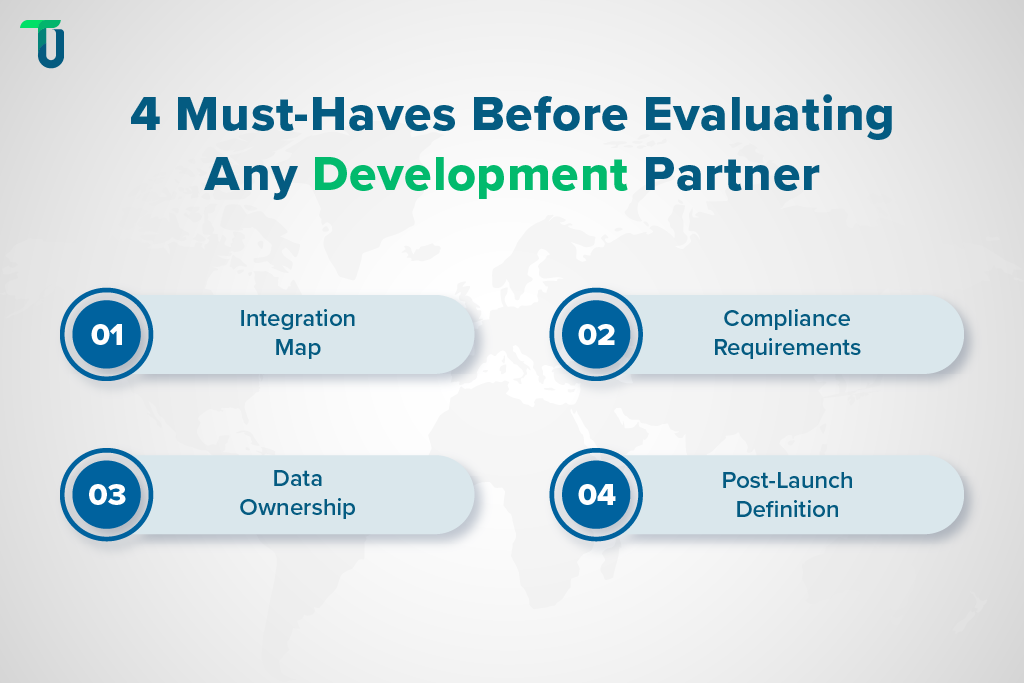
Integration map: Every system the new software must connect to, including ERPs, CRMs, identity providers, legacy platforms, and third-party APIs. Organizations handling regulated financial data can benefit from a Secure ETL pipeline for financial institutions to ensure reliable and compliant data movement across systems.
Compliance requirements: HIPAA, SOC 2, PCI-DSS, GDPR, or any industry-specific framework that governs how your data is stored, accessed, and audited.
Data ownership expectations: Who holds the data during development, where it lives during testing, and what happens to it at contract termination.
Post-launch definition: What "done" looks like beyond go-live, including SLA expectations, upgrade cadence, and who owns ongoing maintenance.
A development partner who receives this level of documentation responds with clarifying questions about your architecture. This is one of the key qualities to look for when selecting an offshore software development company. A development partner who receives it and jumps straight to pricing has not read it carefully enough to build what you need.
TenUp's Take: Requirements definition is not a pre-sales exercise; it is the first engineering decision of the project. Enterprises that treat it as administrative paperwork create the conditions for scope creep before development begins. Map your integration dependencies before you open a single development partner conversation.
The red flag most buyers miss at this stage is not a development partner who asks too many questions. It is one who asks too few.
How to Evaluate Technical Expertise, Stack Fit, and Legacy Readiness
The instinct to match a development partner's technology stack to your own is understandable but incomplete. Stack alignment matters far less than architectural judgment. A development partner who knows your stack but designs poorly will cost more to correct than one who learned your stack last year but reasons well about system boundaries, data flow, and failure modes.
What separates strong enterprise custom software development services from average ones at the technical level is not the language list on a capabilities deck. Teams with experience in Custom Real Estate Software Development also understand how to build scalable platforms that integrate complex workflows, property management systems, and third-party services. It is how the team approaches decisions under constraint: when the integration is messier than expected, when a legacy system does not expose clean APIs, when the compliance requirement conflicts with the chosen framework.
How Legacy Readiness Changes the Evaluation
Most enterprise environments are not greenfield. They involve legacy systems running critical workflows that cannot be taken offline during migration. Legacy system migration challenges like data schema inconsistencies, undocumented dependencies, and brittle integrations are not edge cases in enterprise projects. They are the default condition. A development partner who has not navigated legacy software modernization solutions at scale will treat these challenges as surprises. The one with genuine enterprise custom software migration strategy experience will surface them in the first architecture conversation.
TenUp did exactly that for giant logistics and warehouse management company, consolidating multiple disparate WMS platforms into a centralized system while maintaining 100% parallel operation throughout the migration, resulting in 5x improvement in warehouse efficiency.
Ask directly: "Describe a project where a legacy integration created a critical path dependency. How did you handle it?" The answer reveals more than any reference list.
Two Vetting Tools Most Buyers Skip
The first is the Architecture Decision Record request. Ask shortlisted development partners to share ADRs from a past project: documents that capture what architectural choice was made, what alternatives were considered, and why. ADRs reveal whether a team thinks systematically or reacts tactically.
The second is a paid architecture deep-dive session before contract commitment. A two to four hour session where your technical lead and their senior architect work through your integration map together costs a fraction of a bad hire and surfaces capability gaps that no demo will show.
The Yes-Partner Problem
A development partner who agrees to every requirement in discovery is not being accommodating. They are deferring hard conversations to the sprint where those conversations cost three times as much to resolve. Before evaluating vendors, review the Right questions before hiring an AI development company to strengthen your technical due diligence. If a development partner's response to a technically complex requirement is "yes, we can do that" without qualification, ask them to walk through how. Development partners with genuine architectural depth push back on feasibility, propose alternatives, and flag integration risks before they become budget items. That pushback is the signal you want.
A trial engagement: a bounded, paid workstream on a real component of your project is the most reliable pre-commitment vetting tool available. It tests architecture judgment, communication cadence, and delivery discipline under real conditions, not pitch conditions.
What a Strong Portfolio Actually Proves, and What It Doesn't
A portfolio answers one question: can this team build software that works? It does not answer the question that matters more to enterprise buyers: can this team build software that works at your scale, inside your compliance environment, integrated with your existing systems?
Domain relevance is a stronger signal than visual output. A trusted custom software development company that has delivered for a healthcare network understands data segregation, audit trail requirements, and clinical workflow constraints in ways that a development partner with an impressive fintech portfolio simply does not, regardless of how polished the UI screenshots look.
What Scale and Integration Complexity Actually Tell You
When reviewing a portfolio, filter by two criteria beyond industry:
Transaction volume and user concurrency: Has this development partner built systems that handle the load your environment demands?
Integration complexity: How many systems did the delivered software connect to, and were any of them legacy platforms or third-party APIs with limited documentation?
A development partner who has delivered a standalone SaaS product with a clean API surface is not the same as one who has delivered a multi-system enterprise platform where five legacy integrations run on undocumented SOAP services. Both might show equally polished case studies.
How to Stress-Test a Case Study
Most development partners present case studies as success narratives, so reviewing examples such as Moving Inventory Management Software can help buyers evaluate how a team handles real-world industry requirements and technical complexity. The question that reveals actual capability is not "what did you build?" It is "what went wrong on this project, and how did you resolve it?" A development partner who cannot answer that question honestly either did not encounter meaningful complexity or has not built a culture of technical transparency. Neither is a good sign for an enterprise engagement.
Struggling to evaluate development partners beyond the pitch deck?
TenUp builds enterprise software with the transparency your evaluation process demands, from architecture reviews to documented delivery frameworks.
SDLC Maturity Is the Clearest Predictor of Delivery Reliability
A development partner's software development lifecycle maturity predicts delivery reliability more accurately than their technology stack, portfolio, or sales narrative, making a disciplined software product development process one of the strongest indicators of long-term project success. How a team plans, executes, documents, and hands over work determines whether your project lands on time and on scope, or becomes a recovery exercise six months in.
SDLC maturity is not the same as having an Agile methodology slide in the deck. Most development partners claim Agile. The differentiator is how disciplined that practice actually is when the project hits friction.
What to Evaluate Across the Delivery Lifecycle
A polished demo does not reveal how a team handles a failed sprint or a missed deadline. These five criteria do.
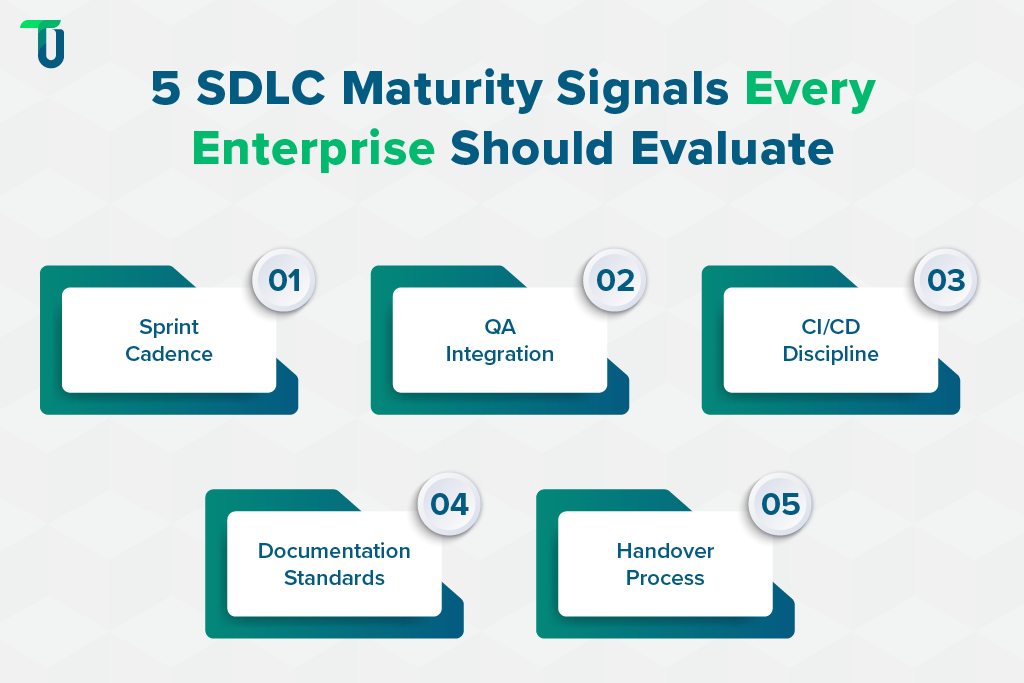
Sprint cadence discipline: Does the team run consistent sprint cycles, or do sprints compress and extend based on pressure?
QA integration: Is testing embedded at the sprint level, or batched at the end of the build?
CI/CD discipline: Is deployment automated and version-controlled, or manual and environment-dependent?
Documentation standards: Are decisions captured in writing as the project progresses, or reconstructed after the fact?
Handover process: When the engagement ends, does your internal team receive clean documentation and repository access, or a tribal knowledge gap?
The question that surfaces SDLC maturity faster than any technical interview is this: "Walk me through what happens when a sprint fails to meet its acceptance criteria." A mature team describes a defined process: retrospective format, root cause documentation, backlog adjustment, stakeholder communication protocol. An immature team describes a reaction.
The Code Quality Problem Nobody Audits Until It's Too Late
Poor code quality from an outsourced team rarely surfaces at delivery. It surfaces twelve to eighteen months later when your internal team inherits a codebase they cannot maintain, or when a new feature requires rebuilding a foundation that was never designed for extension. Engineering communities consistently flag this as the primary hidden cost of outsourced enterprise development; not the development partner fee, but the rework cost.
Phased delivery with built-in monitoring prevents exactly this: TenUp's AI Purchase Order Processing engagement for a US-based distributor used phased development with AI performance monitoring and fallback mechanisms, reducing PO processing errors by 30-35% and cutting manual reporting effort by 60%.
TenUp's Take: Engineering oversight from your side is not optional on an outsourced project. Assign a technical lead who reviews sprint outputs against acceptance criteria and architecture standards throughout the engagement, not just at milestone checkpoints. Development partners who resist that oversight are the ones accumulating the technical debt your next team will inherit.
The connection between SDLC discipline and custom software development companies with agile methodology expertise is direct: agile works when the underlying delivery process is mature enough to support it. Agile methodology claimed on a pitch deck without SDLC discipline in practice produces fast iterations of poorly architected work.
Communication Model, Team Continuity, and Engagement Structure
Time zone gaps and asynchronous communication are manageable constraints in enterprise software development. Unclear escalation paths are not. The communication failure that derails enterprise projects is rarely "we couldn't reach them." It is "we didn't know who owned the decision, so nothing moved."
What to Evaluate Before You Sign
Escalation structure: When a critical integration blocker surfaces on a Friday afternoon, who makes the call and how fast?
Reporting cadence: Are sprint reviews structured events with documented outcomes, or informal check-ins that leave no record?
Feedback loop design: How does a business stakeholder concern reach the engineering team without losing fidelity through three layers of project management?
The answers to these questions reveal whether a development partner has built communication infrastructure for enterprise complexity or for simpler, single-team projects.
Team Continuity Is an Underrated Evaluation Criterion
High turnover among offshore development teams resets institutional knowledge. Every developer who rolls off your project takes context about your integration decisions, your data model edge cases, and your stakeholder preferences with them. That context is not fully recoverable from documentation.
Ask directly:
- What is the average tenure of team members on long-term engagements?
- How is project knowledge documented so that a team member transition does not create a delivery gap?
- What is the process when a key engineer rotates off mid-project?
Development partners who have thought carefully about knowledge continuity will answer with specifics. Those who have not will answer with reassurances.
Engagement Model Fit Matters as Much as Capability
Fully outsourced, hybrid, and internal-led models each suit different enterprise contexts. A fully outsourced model works when your internal team lacks the capacity or specialization for the build and you have strong requirements documentation. A hybrid model works when you need an external team to execute while an internal technical lead owns architecture decisions and stakeholder alignment. An internal-led model with staff augmentation works when you have senior engineering leadership but need to scale delivery capacity without permanent headcount.
The best practices for managing projects with a custom software development company consistently point to the same conclusion: the engagement model that works is the one matched to your internal oversight capacity, not the one that minimizes your involvement.
Security, IP Ownership, Contract Terms, and the Red Flags That Only Show Up Here
Most IP disputes in custom enterprise software development do not surface at contract signing. They surface at one of three moments:
- When you try to scale internally and discover the development partner retains rights to core modules.
- When the engagement ends and repository access is contingent on final payment disputes.
- When a security audit reveals that your development partner's subcontractors handled sensitive data under terms you never reviewed.
These outcomes are predictable and preventable. They require contract precision, not just contract existence.
What to Lock In Before You Sign
A development contract that is vague on these five terms is not a contract. It is a liability waiting for the right moment to surface.
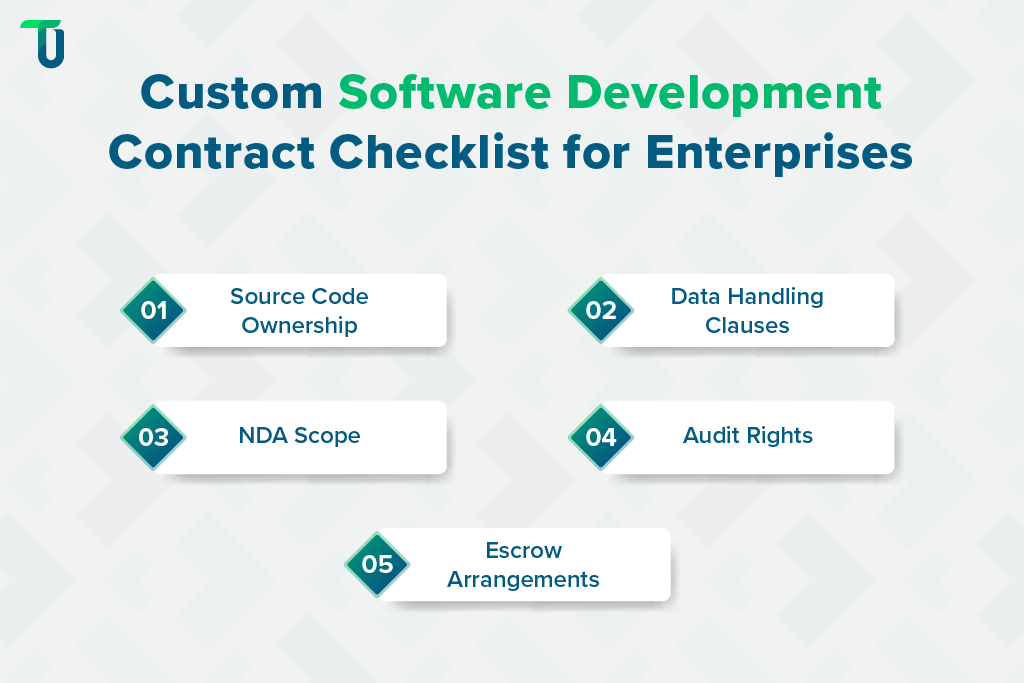
Full source code ownership: Every line of code, every module, every integration script must transfer to you at project completion. Confirm this includes work produced by subcontractors if the development partner uses them.
Data handling clauses: Specify where data lives during development and testing, who has access, and what happens to it at contract termination, including test datasets that may contain production-derived records.
NDA scope: Confirm it covers not just your business logic but your architecture decisions, integration design, and system dependencies.
Audit rights: Enterprise compliance frameworks including SOC 2 and ISO 27001 may require you to audit your development partner's security practices. Confirm the contract permits this.
Escrow arrangements: For long-term engagements, source code escrow ensures access continuity if the development partner becomes unavailable.
ISO 27001 certification is a meaningful baseline security signal when evaluating a custom software development agency. It confirms the development partner has implemented a documented information security management system. It is a floor, not a ceiling; the certification does not guarantee secure coding practices, but its absence in an enterprise context is a gap worth explaining.
What sits above that floor is implementation depth: cryptographic architecture, distributed key management, and data protection that holds even in breach scenarios. TenUp implemented Split Key Cryptography for a SaaS platform managing sensitive personal and financial documents, using RSA-AES hybrid encryption and AWS KMS-protected credentials, ensuring data remains unreadable even if the underlying storage is compromised.
When to Request a Proposal and What to Include
When you reach the proposal stage, the quality of what you send determines the quality of what you receive. A proposal request that includes your integration map, compliance requirements, IP ownership expectations, and post-launch SLA requirements upfront filters out development partners who cannot meet enterprise terms before you invest evaluation time in them. Development partners who respond to a detailed proposal request with a generic capability overview have already answered your most important question.
Red Flags That Appear at the Contract Stage
Resistance to escrow arrangements: Signals that the development partner views code ownership as leverage.
Restricted repository access during the engagement: Your team cannot view the codebase without development partner permission, creating a dependency that compounds over time.
Vague SLA language: "Best efforts" response commitments without defined timelines means the SLA is decorative.
IP ownership tied to "full payment": Any contract that defines IP transfer this way without defining what constitutes full payment in a disputed scope scenario is a risk that will not be visible until it is expensive.
Post-launch support terms deserve the same scrutiny as development terms. Confirm the maintenance pricing model, the upgrade pathway, and whether the team that built the system is available for ongoing support or whether you are handed to a different, lower-cost maintenance team at go-live.
The Evaluation You Do Before Signing Determines Everything That Follows
Choosing the right custom software development company for an enterprise project is a decision with an eighteen-month blast radius in either direction. A disciplined evaluation process reduces that risk to a set of structured decisions:
- Requirements documented at the architecture level before development partner conversations begin
- Technical capability tested through ADRs and paid architecture sessions rather than demos
- Portfolios stress-tested by asking what went wrong rather than what succeeded
- SDLC maturity evaluated through sprint failure protocols rather than methodology slides
- Team continuity probed through specific tenure and knowledge transfer questions
- Contracts reviewed for IP ownership precision before the relationship begins
Each of these decisions is available to every enterprise buyer. Most skip at least three of them.
TenUp is a custom enterprise software development company built to hold up across every dimension of that evaluation: from requirements architecture and legacy system expertise to SDLC delivery discipline, team continuity, and ISO 27001-certified security and contract practices.
If your enterprise is evaluating software development partners and needs a team that holds up under the framework above, start the conversation.
Could your shortlisted partner answer these six questions?
TenUp's team can walk through your requirements, your integration map, and your architecture from day one.
Frequently asked questions
What is the difference between a custom software development agency and an enterprise software development company?

A custom software development agency builds tailored apps for startups and mid-market clients using specific technologies. An enterprise software development company handles large-scale systems for big organizations with complex integrations, compliance (SOC 2, ISO 27001), and mature SDLC processes.
How do legacy system migration challenges affect development partner selection?
Legacy migration challenges like undocumented dependencies, schema inconsistencies, and brittle integrations demand partners with hands-on enterprise migration experience. Prioritize partners who demonstrate phased migration capability, rollback planning, and compliance continuity. During evaluation, ask them to describe a legacy project where a critical dependency surfaced mid-build. Specificity in their answer confirms real experience.
What should be in a custom software development services contract?
A custom software development services contract must include full source code ownership, data handling clauses for development and testing environments, NDA covering architecture decisions, defined SLA terms with resolution timelines, audit rights, and escrow arrangements. Avoid any contract tying IP transfer to "full payment" without a dispute resolution clause — it is a structural risk.
How do you evaluate a development partner's technical expertise before committing?
Request Architecture Decision Records from past projects to verify real decision-making depth. Run a paid architecture deep-dive with your integration map pre-contract. A partner who reasons through your specific constraints in real time demonstrates genuine architectural judgment. A partner who defaults to a capabilities deck does not. Pilot engagements confirm what interviews cannot.
What are the biggest risks of outsourcing enterprise software development?
The three highest-cost outsourcing risks are poor code quality surfacing as rework 18 months post-delivery, team turnover resetting institutional knowledge mid-project, and IP ownership ambiguity creating leverage at contract termination. All three are identifiable before signing through SDLC maturity assessment, team continuity questions, and contract review. No post-signature discovery required.
How long does it take to build custom enterprise software?
Custom enterprise software typically takes 4 to 8 months for a focused module with 3 to 5 integrations, and 12 to 24 months for multi-system platforms replacing legacy infrastructure. Timeline depends on integration complexity, compliance requirements, and legacy dependencies. Any partner quoting timelines without reviewing your integration map is not providing a real estimate.
How should enterprises estimate budget when evaluating a custom software development company?
Estimate total cost of ownership, not just the build fee. Budget for legacy integration costs (20 to 50% of total), 3 to 5 year maintenance (15 to 25% annually), compliance requirements, and a contingency buffer of 15 to 20%. Enterprises budgeting only for the build face unplanned rework costs in year two.
What should enterprises look for in a long-term custom software development partner?
Look for three non-negotiables in a long-term partner: architectural ownership where decisions are made with long-term system health in mind, knowledge continuity where documentation and repositories stay handover-ready, and commercial transparency where pricing and post-launch terms are defined upfront. Partners missing any one of these create compounding problems after launch.
Share the Article


