


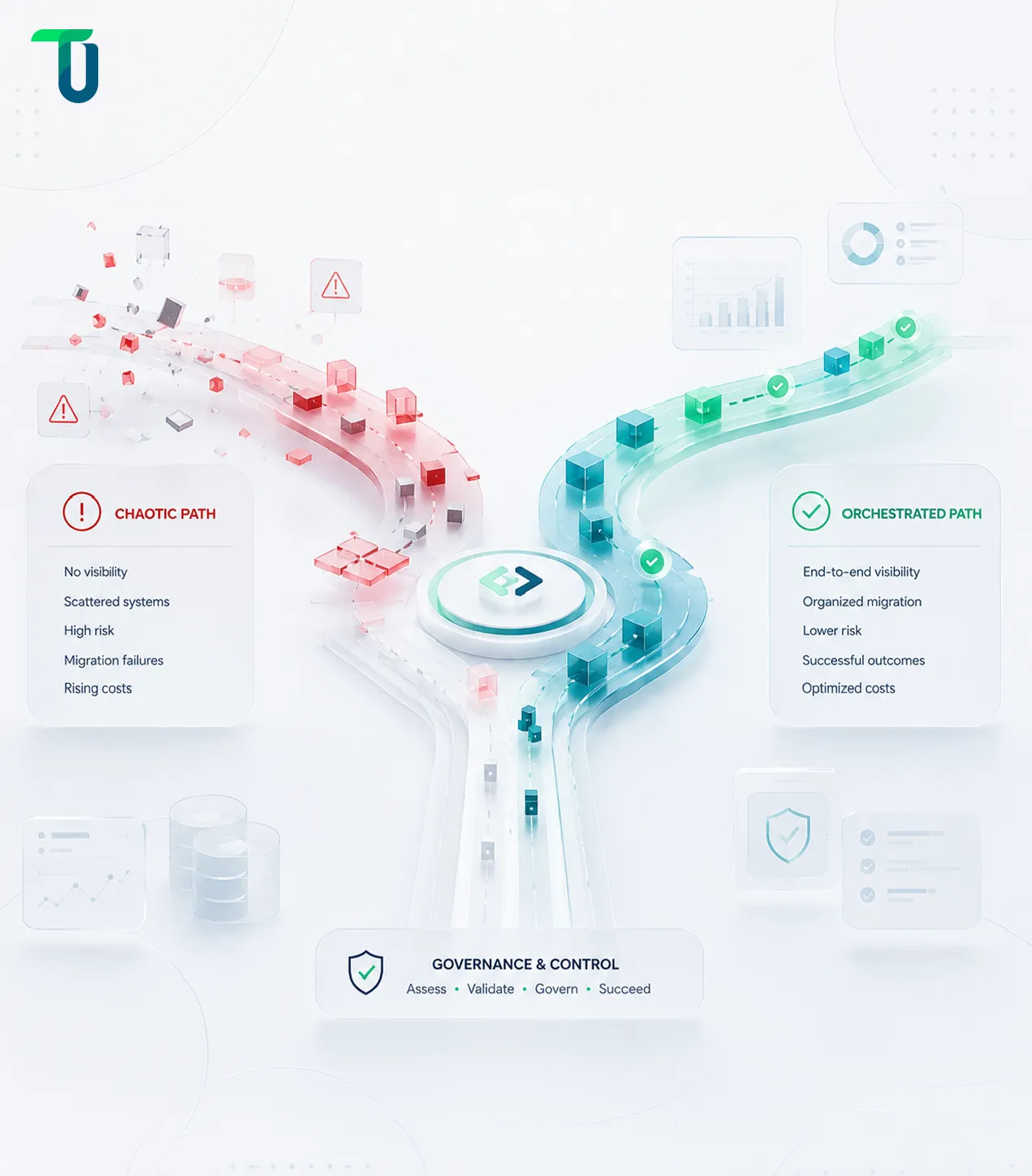
71% of software projects are delivered late, over budget, or missing critical features. The Standish Group Chaos Report puts successful delivery at just 29%, a number that has not improved in decades despite better tools and more experienced teams.
This failure pattern is not limited to AI initiatives. It applies across software product development broadly. AI projects are simply the most visible and most expensive recent example of a problem that has existed for decades.
The failure cause is rarely technical. Teams fail because of structural breakdowns in how requirements are gathered, how business and technology teams communicate, how scope is governed, and how adoption is planned.
This blog covers the root causes and the disciplines that separate the 29% that succeed from the majority that don't; not as a list of principles, but as a decision framework you can act on at every stage of your software product development process.
Software Product Development: Why Most Teams Define It Too Narrowly
Software product development is the end-to-end process of defining, designing, building, testing, deploying, and maintaining software that solves a specific business problem for a defined set of users. It is not the same as software development.
Software development refers to writing code. Software product development encompasses the full lifecycle, from discovery and requirements architecture through roadmap planning, iterative delivery, quality assurance, user adoption, and long-term optimization. Teams that treat it as a coding exercise consistently underestimate what it takes to deliver software a real organization can use.
What the SDLC Actually Governs
The SDLC is not a checklist. It is a strategic framework governing four decisions at every stage:
- What gets built first: Sequenced by risk reduction, not stakeholder preference
- How requirements are validated: Against measurable business outcomes, not capability descriptions
- How risk is managed: Identified and owned in discovery, not encountered in delivery
- How scope is controlled: Through change control gates, not ad hoc decisions
Teams that treat the SDLC as an administrative formality encounter requirements collapse, scope explosion, and adoption failure.
Two Principles That Belong in the SDLC From Day One
Security-by-design: Regulatory requirements, access controls, and data governance are architectural inputs, not post-launch audit items. Organizations that defer security pay remediation costs that far exceed the original build budget.
Discipline over talent: Talent contributes to project failure, but rarely drives it. The discipline gap, absent discovery structure, ungoverned scope, late QA, and no adoption planning is what separates successful software product development engagements from failed ones.
The Real Reasons Software Product Development Projects Fail
Most failure postmortems point to symptoms: the timeline slipped, the budget ran out, users did not adopt the product. The root causes sit upstream in decisions made or avoided during discovery, planning, and delivery governance. The table below maps each failure cause to its corresponding countermeasure. The sections that follow deliver the decision depth behind each row.
1.Vague or Unstable Requirements, Including Data Availability
Teams that skip a data availability audit during discovery build systems on assumptions that collapse in production. This is not an AI-specific concern; any software product dependent on existing organizational data faces this risk, and most enterprise products do.
Requirements gathering failure is the single most common upstream cause of project failure. The Standish Group Chaos Report consistently identifies unclear or shifting requirements as the primary driver of budget overruns and timeline collapse. When requirements are unclear at the start, every downstream decision, like architecture, scope, timeline, and cost, is built on an assumption that may not hold.
The Denver International Airport's automated baggage system landed 16 months late and $560 million over budget. The failure was not technical. It was a requirements and governance failure that compounded at every subsequent stage.
The decision signal: If your requirements document doesn't include a data availability audit, your discovery phase is incomplete.
2.The Business-Technology Alignment Gap, And the Wrong Problem Trap
Two distinct failure modes destroy business-technology alignment, and teams consistently confuse them. Misalignment happens when business and technology teams disagree on objectives. Wrong problem definition happens when both teams agree on the wrong objective. The second is harder to catch and more expensive to fix.
A practical illustration: a business team defines success as "build a customer reporting dashboard." The engineering team delivers exactly that. At launch, the actual problem surfaces; a four-hour weekly manual reporting process that a dashboard alone does not eliminate. Both teams agreed. Both were wrong about what the product needed to do.
A BCG survey of global C-suite executives found that projects where technology leaders are involved from strategy development have 154% higher success rates than those where they are not. Every feature in a requirements architecture document must map to a measurable business outcome, not a capability description.
The decision signal: If your CTO is not in the room when business objectives are set, you are already building toward the wrong target.
3.Scope Creep Without a Change Control Process
Scope creep is not a planning failure. It is a governance failure. Each uncontrolled addition does not just add work; it shifts timelines, reallocates engineering capacity, and introduces regression risk into previously stable modules.
A pattern observed consistently across software product development engagements is the misuse of Agile methodology. Teams treat Agile's flexibility as justification for accepting scope changes without formal evaluation. Agile is a delivery framework, not a change approval system. Every scope change should pass through a change control gate, assessed for impact on timeline, budget, and existing sprint commitments before it enters the backlog.
The decision signal: If your Agile process has no change control gate, scope creep is already in progress.
4.Poor MVP Strategy and Big-Bang Deployment
Big-bang deployment, building the full product before any user validation, is the most common and most expensive expression of a poor MVP strategy. Teams spend months building a complete product, only to discover at launch that users do not need what was built, do not use it as designed, or will not adopt it at all.
The Healthcare.gov launch illustrates the cost. Unclear goals, uncoordinated contractors, and insufficient pre-launch testing produced a system that collapsed under real-world load within hours, requiring months of rework before it functioned as intended.
A BCG benchmark provides a practical guardrail: limit initial design and production to what can be launched in three to four months, then expand scope after the first version proves out with real users. The validation sequence that replaces big-bang deployment is: hypothesis → prototype → user signal → build decision. The user signal must be measurable: a conversion rate benchmark, a prototype engagement threshold, or a pilot sign-up count.
One criterion determines what belongs in an MVP: does this feature test the core hypothesis? If not, it is deferred, not negotiated. Customer feedback collected during MVP validation determines whether the product is ready to build, not just whether it was built correctly.
The decision signal: If your product cannot be validated with real users within three to four months, your MVP scope is already a big-bang deployment in disguise.
5.QA Treated as a Phase, Not a Practice
Late-stage QA is one of the most predictable and preventable causes of software product development failure. When testing follows development rather than running inside it, defects surface after significant engineering investment has already been made.
IBM Systems Sciences Institute research found that fixing a defect post-release costs four to five times more than catching it during design, and up to 100 times more than catching it during requirements. Late defect discovery is not a theoretical risk; it is the primary driver of post-launch budget overruns.
Embedded QA lives inside every sprint, reviews every feature increment, and feeds directly into the CI/CD pipeline. Outsourced testing serves a different purpose: surge coverage, specialist security audits, or independent validation, but it is not a substitute for process-integrated quality assurance.
QA debt accumulates the same way technical debt does. It is harder to see, harder to quantify, and harder to recover from.
The decision signal: If QA is scheduled after development in your project plan, you are already paying for defects you have not yet found.
6.Organizational Resistance and Missing Change Management
Products built without involving end users fail at adoption, not delivery. A product can be architecturally sound, on time, and within budget, and still fail if the organization was never prepared to use it.
Change management is not an HR function. It is an implementation risk with direct cost consequences. Organizational resistance surfaces when teams hand users a finished product rather than involve them in shaping it. Users with no input into design decisions have no ownership of the outcome, and adoption reflects that.
TenUp's Healthcare IoT application for a US-based technology company achieved 60% daily active users within the first three months and 75% of discharged patients using the app for ongoing remote monitoring, outcomes only possible when user-centric design and change management are built into the process from the start, not bolted on at launch.
The customer feedback loop must close before scaling begins. Feedback collected during development and pilot stages determines whether a product is ready to scale, not just whether it was built to specification.
The decision signal: If your rollout plan starts after build, adoption failure is already likely.
7.Internal Skill Gaps and Pilot-to-Production Failure
BCG research found that fully staffed teams with cross-disciplinary capabilities deliver 76% higher project performance than organizations with multiple key positions vacant. The implication is direct: skill gaps inside the client organization, not just the vendor, determine whether a product moves from pilot to production.
A technically excellent product fails when the organization cannot maintain, extend, or operationalize what was delivered. The vendor can meet every technical specification. If the internal team cannot operate, extend, or champion the product after handover, it will not reach production.
BCG further found that product managers bridging technical and business domains improved project success rates by 30%. Teams that underestimate internal capability requirements during discovery cannot operationalize what gets built.
The decision signal: Skill gap assessment belongs in discovery, not post-launch.
| Failure Cause | Key Countermeasure |
|---|---|
| Vague or unstable requirements | Data availability audit in discovery, no assumption-based build |
| Business-technology misalignment | CTO in strategic objective-setting, OKR-tied roadmap |
| Scope creep without governance | Agile with change control gate, no uncontrolled additions |
| Poor MVP and big-bang deployment | 3-4 month MVP, hypothesis-first feature selection |
| QA as a phase, not a practice | QA embedded in every sprint plus CI/CD integration |
| Adoption failure, no change management | User feedback loop pre-scale, rollout plan starts before build |
| Pilot-to-production skill gaps | Internal skill gap assessment in discovery, not post-launch |
Avoid most software product development failures in the discovery phase
TenUp's structured product development process addresses every failure point in this guide by design. Let's talk about your build.
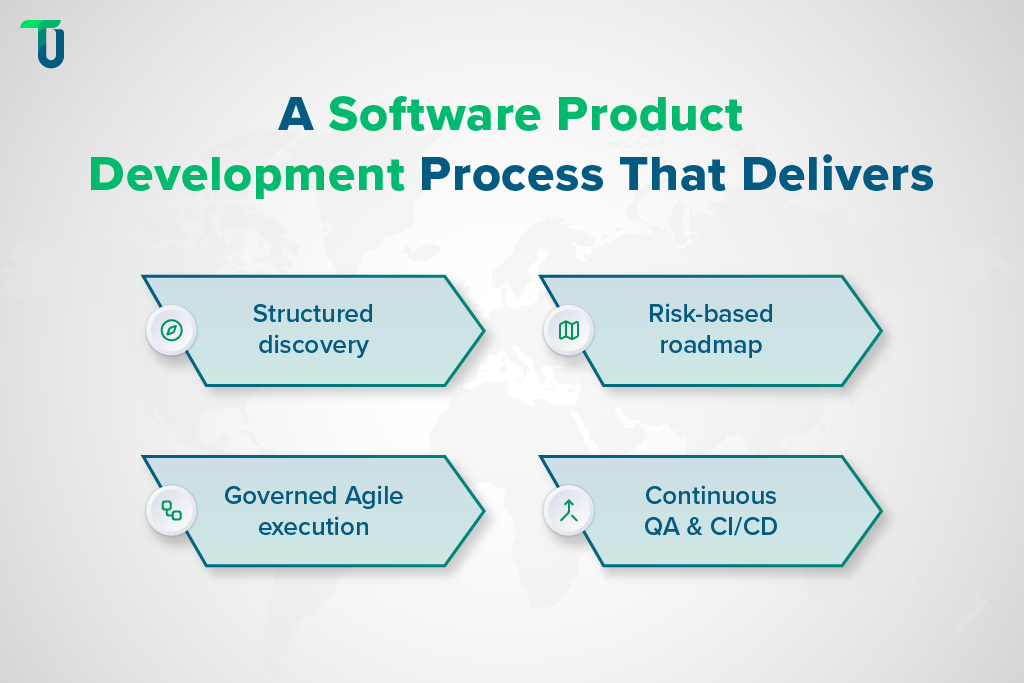
The Software Product Development Process That Actually Works
Understanding why projects fail is only half the decision. The other half is knowing what a disciplined software product development process looks like, what decisions get made at each stage, and what the consequences are of deferring them.
Discovery and Requirements Architecture
Discovery is the most consequential investment of the entire engagement. Decisions made on requirements, architecture, framework selection, risk mapping, and data availability determine the ceiling of everything that follows.
Five outputs are mandatory before the first sprint begins:
- Data availability audit: Confirms that the data the product depends on exists, is structured, and is accessible
- Stakeholder communication structures: Established before requirements are written, not after misalignment surfaces
- Risk ownership: Every identified failure point gets an owner and a mitigation plan
- Support and maintenance planning: Support and maintenance planning: Teams that define maintenance responsibilities and support budgets in discovery avoid post-launch cost escalation, including unexpected vibe coding maintenance costs associated with reviewing, refactoring, and maintaining AI-generated code.
- Infrastructure decisions: Cloud platform and architecture choices deferred past discovery create debt that compounds with every new feature or user tier
The deliverable is a requirements architecture document where every feature maps to a measurable business outcome.
Roadmap Design and Prioritization Discipline
The product roadmap is a strategic contract between business and engineering. It sequences work by risk reduction, not by stakeholder preference, design appeal, or competitive pressure. High-risk dependencies are surfaced and resolved early. Trade-offs are documented explicitly.
OKRs are one structured method for ensuring every roadmap item connects to a measurable business result, a named framework option for teams that need a repeatable structure for connecting engineering work to business outcomes.
A roadmap without explicit trade-off documentation is a liability, not a plan.
Agile Execution With Governance Guardrails and Performance Tracking
Agile is a delivery framework, not a strategy for managing ambiguity. Change control within Agile is not a contradiction; every scope change passes through an impact assessment before it enters the backlog. Sprint velocity is tracked as a business metric: the rate at which the product delivers measurable value, not just the rate at which tickets are closed.
BCG research found that effective early warning systems, those that surface delivery problems before they compound, increase project success rates by up to 16 percentage points. In an Agile context, this means tracking sprint velocity against business outcome milestones. When velocity diverges from the roadmap plan, the system alerts leadership before the divergence becomes a delay.
Continuous QA, CI/CD, and Technical Documentation
Three practices define a disciplined delivery pipeline:
- Embedded QA: Lives inside every sprint, reviews every feature increment, and catches defects before they compound into post-launch remediation cost
- CI/CD integration: Automates the path from code commit to validated, deployable build, compressing defect discovery cycles
- Version control and documentation: Part of the governance layer, not optional infrastructure; documentation gaps are the most common and most preventable cause of post-launch cost escalation
TenUp's enterprise SaaS platform, built using the Twelve Factor App methodology, achieved 99.99% system uptime and a 15% increase in team productivity, outcomes directly attributable to disciplined CI/CD implementation and architecture decisions made at the start of the engagement, not retrofitted after delivery.
Custom Software Product Development vs. Off-the-Shelf: The Decision Framework
The buy-vs-build decision is not a cost decision. It is a workflow decision. Custom software product development is justified when workflows, compliance requirements, or integration dependencies are specific enough that adapting a generic tool creates more cost and risk than building for exact requirements.
Four Decision Criteria; Each With a Specific Consequence
- IP ownership: If competitive advantage depends on proprietary workflows, building on a platform another company controls is a strategic liability.
- Workflow complexity: The more interconnected and organization-specific the processes, the higher the cost of forcing a generic tool to approximate them.
- Integration requirements: Deep dependencies on legacy systems, proprietary databases, or regulated data flows require custom middleware that generic tools cannot reliably provide.
- Long-term scaling trajectory: A platform that cannot grow without vendor renegotiation is a ceiling, not a foundation.
The Hidden Cost of Off-the-Shelf Adaptation
Licensing fees are visible. These are not:
- Engineering hours spent forcing a generic tool to approximate a specialized workflow
- Productivity loss from workarounds
- Data quality degradation from mismatched integrations
- Vendor dependency that constrains the roadmap
These costs accumulate over years and rarely appear in the original procurement comparison.
When Custom Is the Only Viable Path
TenUp's AI-powered Watchlist Screening Software for a US-based FinTech company illustrates this directly. AML compliance workflows, real-time screening against OFAC, PEP, and Interpol lists with under 1% false positives across 5 million daily records require customization, configurability, and regulatory precision no off-the-shelf compliance tool can match.
The three primary cost drivers in custom software product development are scope, team model, and QA investment. For a detailed cost framework covering SDLC phase breakdowns, pricing models, and total cost of ownership analysis, read TenUp's guide to Custom Software Development Cost Estimation.
TenUp's Take: The buy-vs-build conversation should be driven by workflow uniqueness and data ownership, not upfront cost. A build that costs more today and eliminates vendor dependency, licensing risk, and workflow compromise over five years is almost always the better investment.
How to Outsource and Choose the Right Software Product Development Company
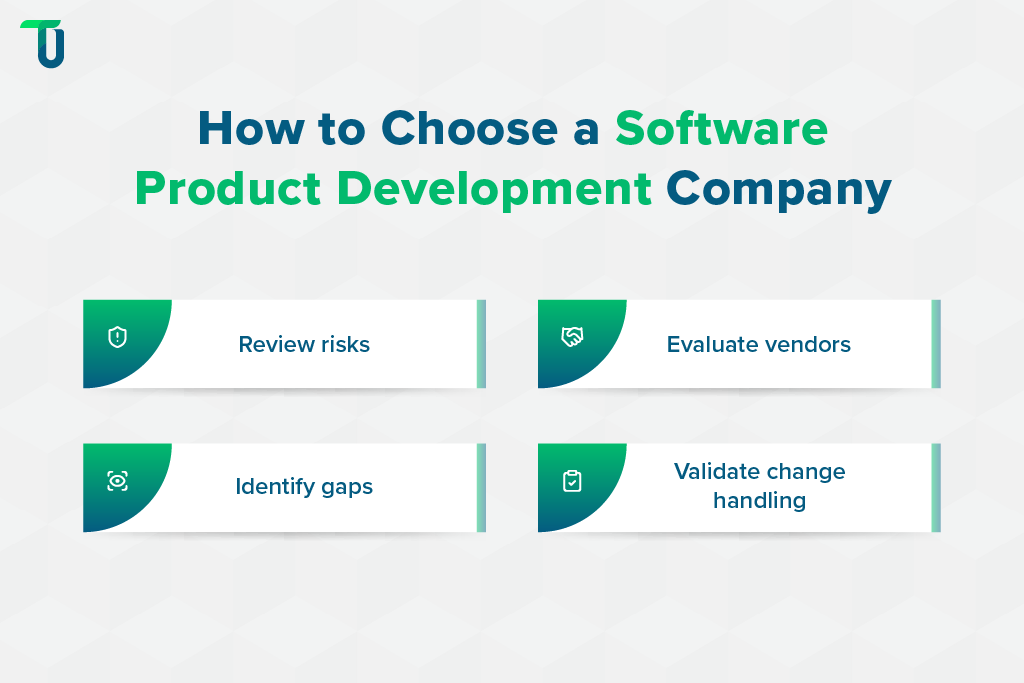
The difference between a software product development company and a transactional delivery vendor is not portfolio size. It is discovery process maturity. Outsourcing introduces risks that standard vendor checklists consistently miss.
What Outsourcing Risk Actually Looks Like
Three risks determine whether an outsourced engagement succeeds or fails; none appear on a standard vendor scorecard.
- IP protection clauses: Determine who owns the code after delivery.
- Requirements handoff quality: Determines whether the vendor builds what was intended or what was assumed.
- Communication cadence: Determines whether problems surface early enough to fix cheaply or late enough to be expensive.
What to Evaluate Before You Sign
Four criteria separate capable vendors from capable-looking ones.
- Discovery process maturity: Does the vendor offer a formal discovery phase with documented deliverables?
- QA integration model: Is QA embedded in every sprint or treated as a separate phase?
- Roadmap co-ownership: Does the vendor share accountability for business outcomes or just feature delivery?
- Post-launch support structure: Are maintenance responsibilities and escalation paths defined before the engagement begins?
The vendor who surfaces internal capability gaps during onboarding reduces your risk of pilot-to-production failure. A technically excellent product fails when the internal team cannot maintain, extend, or champion it after handover.
Red Flags That Should End a Vendor Evaluation
- No formal discovery phase offered
- Agile used as justification for unassessed scope changes
- No technical documentation standard in the delivery process
- No CI/CD discipline in the pipeline
The One Question That Reveals More Than Any Portfolio Review
"Show me how you handle a requirement to change mid-sprint."
The answer tells you whether the vendor has a governance process or just a process document.
Vendor selection at the requirements stage costs less than vendor replacement at the delivery stage.
Software Product Development Challenges CTOs Must Plan For in 2026
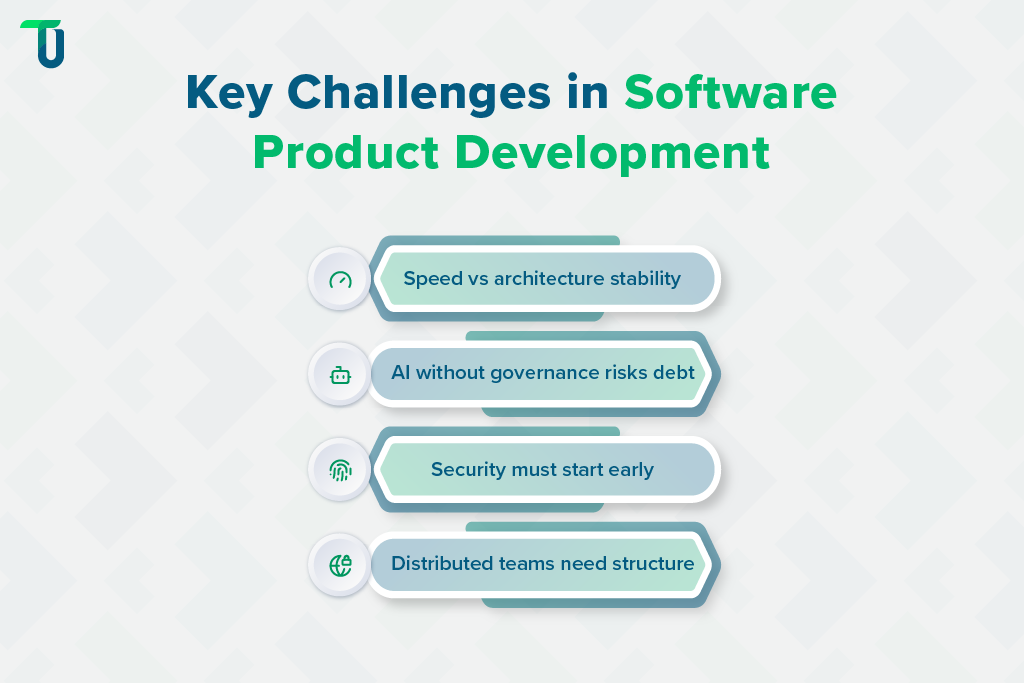
The structural failure causes in this guide apply regardless of when a project is undertaken. 2026 introduces compounding pressures CTOs must account for in discovery, not encounter mid-delivery.
Rapid Iteration Pressure vs. Architecture Stability
The pressure to ship faster is real. Deferring architecture decisions to meet it creates technical debt that compounds with every subsequent release.
Framework decisions made without a scalability lens create refactoring costs that multiply across three dimensions:
- User growth: A framework serving 500 users creates a rearchitecting crisis at 50,000
- Data volume: Architectures not designed for scale degrade under load before teams realize the cost
- Feature expansion: Each new capability added to an under-architected system increases regression risk
Deferred architecture decisions resurface as emergency rework at the worst possible moment, when the product is under load and the cost of change is highest.
For a deeper analysis of architecture model choices and their long-term implications, read TenUp's guide to Application Architecture Models and Their Evolution.
AI-Assisted Development: Acceleration or Complexity Multiplier?
AI-driven projects fail for the same structural reasons as traditional software product development, compounded by poor data quality and misuse of generative outputs. AI does not introduce new failure modes. It amplifies existing ones.
Two governance gaps consistently turn AI acceleration into AI debt:
- Undocumented, untested code: AI tools accelerate output and accumulate technical debt at the same speed when the governance layer is absent
- Ethical review gaps: AI-generated outputs without ethical review create legal and reputational exposure that goes beyond technical debt. It belongs in the discovery-phase risk register alongside security and compliance requirements
TenUp's AI Purchase Order Processing Software demonstrates what governed AI development produces: built-in monitoring, fallback mechanisms, and leadership dashboards reduced manual reporting effort by 60% and PO processing errors by 30–35%.
Security and Compliance Entering the SDLC Earlier
Three implementation practices define security-by-design in 2026; all are discovery and architecture inputs, not pre-launch activities:
- Threat modeling: Conducted in discovery before architecture is committed
- Access controls: Defined at the architecture stage, not configured post-build
- Automated security scanning: Integrated into the CI/CD pipeline, not run as a pre-launch audit
Teams that treat compliance as a pre-launch gate rather than a design constraint consistently encounter remediation costs that exceed the original build budget.
Distributed Team Coordination at Scale
Distributed teams amplify every process gap across three predictable failure points:
- Requirements drift: Asynchronous clarification slows decisions and introduces interpretation gaps
- QA fragmentation: Testing responsibilities distributed without clear ownership produce coverage gaps
- Documentation degradation: Knowledge siloed across time zones compounds onboarding cost and rework
The outsourcing governance layer, communication cadence, requirements handoff protocols, and sprint review structures determine whether distributed execution succeeds or compounds the failure modes in this guide.
BCG's research identifies a consistent pattern: teams without incentives tied to business outcome delivery default to technical milestone completion. Delivering a feature is not the same as delivering the business value that feature was supposed to create.
The teams that plan for these challenges in discovery outperform those that encounter them in delivery.
Conclusion: Build Software That Delivers, Not Just Launches
Organizations that succeed at software product development are not the ones with the largest budgets or the most experienced developers. They are the ones with the most disciplined processes, starting in discovery, sustained through delivery, and extending into adoption.
Every failure caused in this guide, unclear requirements, misaligned objectives, uncontrolled scope, big-bang deployment, late-stage QA, missing change management, and post-launch skill gaps, is preventable through governance disciplines applied at the right stage.
TenUp has demonstrated these disciplines in practice. Our Healthcare IoT apps achieved 75% post-discharge patient adoption and 60% daily active users within three months. Our enterprise SaaS application delivered 99.99% uptime through architecture discipline and CI/CD rigor from day one. Process, not circumstance, produced both outcomes.
TenUp's end-to-end software product development services are built around discovery rigor, continuous QA, roadmap co-ownership, and AI integration capability. ISO 27001 certified and an AWS Partner, TenUp delivers software that organizations can operate, extend, and scale, not just launch.
Are you unknowingly compounding risk in software product development?
TenUp manages all the disciplines discussed in this guide and helps enterprises build software that succeeds at delivery and adoption.
Frequently asked questions
What is software product development and how does it differ from general software development?

Software product development covers the full lifecycle — discovery, requirements, design, build, QA, deployment, and adoption — focused on measurable business value. General software development refers only to coding. The distinction matters: teams that treat product development as a coding exercise consistently underestimate requirements validation, governance, and change management, the disciplines that determine real-world success.
Why do most software product development projects fail?
Most software product development projects fail due to weak pre-build decisions, not execution. Unvalidated requirements, ungoverned scope, poor MVP definition, and late QA involvement create compounding downstream failures. The Standish Group Chaos Report confirms structural breakdowns in discovery, planning, and governance drive 71% of late, over-budget, or incomplete deliveries — not coding quality.
What does a reliable software product development process look like?
A reliable software product development process starts with structured discovery and requirements tied to business outcomes. It prioritizes work by risk reduction, controls scope through change control gates, embeds QA inside every sprint, integrates CI/CD automation, and plans user adoption before build begins. Governance consistency across all stages determines delivery predictability and measurable post-launch value.
How do you prevent scope creep in custom software product development?
Scope creep is a governance failure, not a planning one. Every scope change must pass through a formal change control gate, assessed for timeline, budget, and sprint impact before entering the backlog. Agile's flexibility is for delivery adaptation, not uncontrolled scope expansion. Without this gate, each addition compounds into budget overruns and delivery delays.
When does it make sense to invest in custom software product development over off-the-shelf tools?
Custom software is justified when workflows, compliance requirements, or integration dependencies are too specific for off-the-shelf tools to approximate without costly workarounds. Key decision factors are IP ownership, workflow uniqueness, integration depth, and scalability over a 3–5 year horizon. If adapting a generic tool adds more long-term cost than building, custom is the right call.
How do enterprises estimate the cost of custom software product development?
Enterprises estimate custom software costs through structured discovery, not hourly rate multiplication. Scope, team model, and QA investment are defined upfront, then mapped across SDLC phases. This approach surfaces hidden costs like scope creep, post-launch fixes, and annual maintenance (15–25% of build cost) — delivering a more accurate total cost of ownership than surface-level estimates.
What should enterprises look for in a software product development company?
Prioritize vendors with a formal discovery process, documented requirements architecture, and QA embedded in every sprint — not treated as a final phase. Look for teams that co-own the roadmap and flag risks early. Avoid vendors who start coding without requirements clarity or use Agile to justify uncontrolled scope changes without formal impact assessment.
How do you measure success in a software product development engagement?
Success in software product development is measured by business outcomes, not feature delivery. Key metrics include user adoption rates, process efficiency gains, revenue impact, and speed-to-value — such as MVP adoption within 90 days. A product delivered on time but unused is a failure. Real success is measurable post-launch impact, not go-live milestones.
Share the Article


