


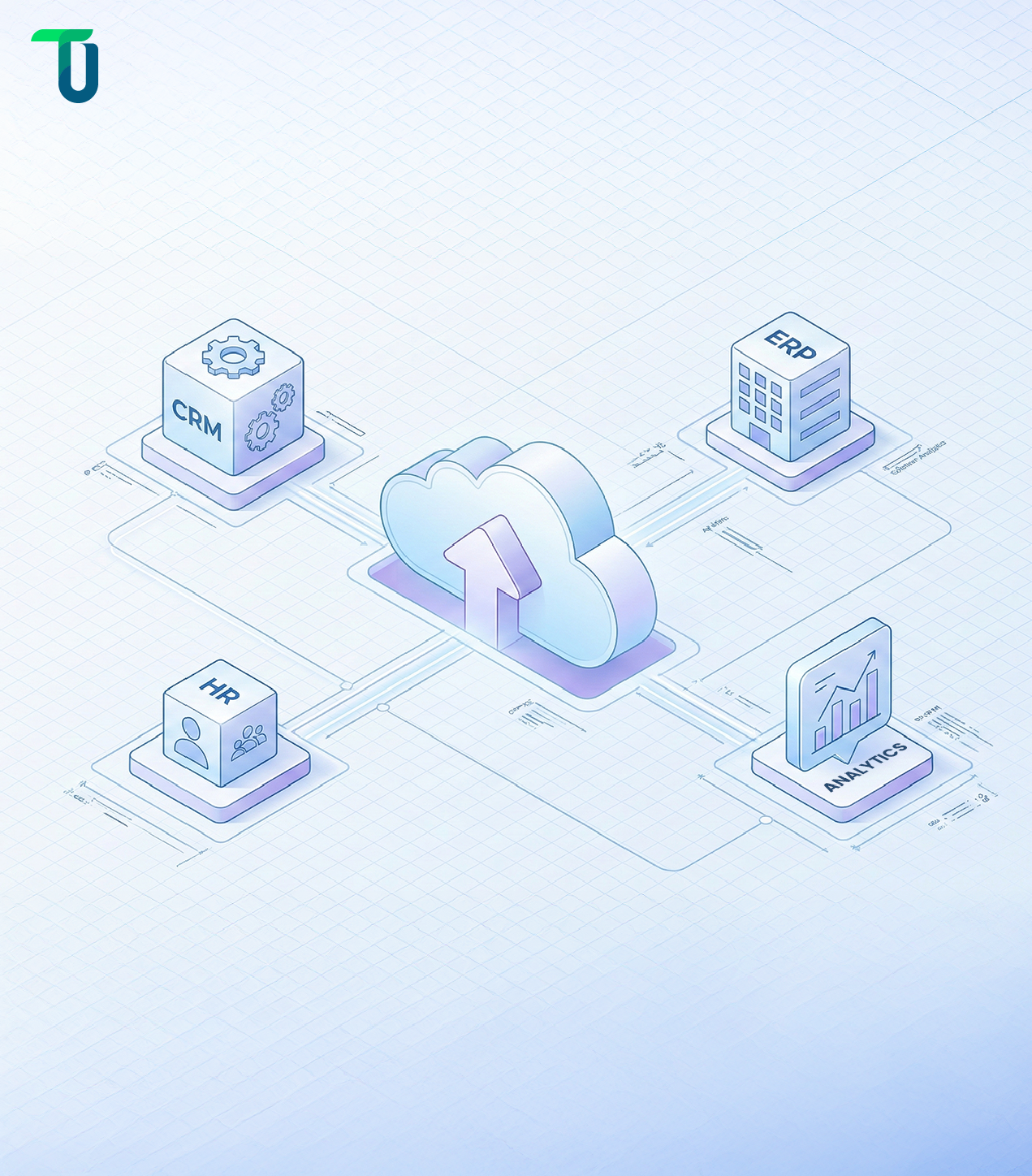
Understanding the Shift: Middleware vs. Cloud Integration Services
Before we move further, let’s quickly look at what traditional middleware is, what cloud integration services are, and how the two differ in enterprise use.
What is Traditional Middleware?
Traditional middleware is a software layer that helps different applications, databases, and operating systems communicate with each other. It was a key solution for integration in the 1990s and 2000s.
Here are some important aspects of traditional middleware:
- It includes enterprise service buses (ESBs), message brokers, and application servers used for system integration.
- It provides structured and centralized ways to connect ERP systems, databases, and custom applications.
- It relies heavily on on-premise environments, static architectures, and expensive licensed software.
In short, traditional middleware helped enterprises reduce manual integration efforts, but it struggles to support today’s dynamic, cloud-driven IT environments.
What are Cloud Integration Services?
Cloud integration services are platforms that connect applications, data, and processes across cloud and on-premise systems, enabling seamless cloud application integration—if you’re new to the concept, this Cloud integration guide explains the fundamentals in simple terms. They represent the modern approach to integration in cloud computing, ensuring enterprises unify workflows across diverse environments. They are typically delivered as-a-service through iPaaS and designed for modern IT environments.
Below are the key aspects of cloud integration services:
- They offer iPaaS platforms with pre-built connectors, APIs, low-code integration tools, and cloud integration hubs that simplify integration.
- They enable real-time data integration and synchronization between SaaS applications, cloud databases, and legacy system integration.
- They support hybrid cloud integration and multi-cloud strategies, giving enterprises flexibility without infrastructure burden.
In short, cloud integration solutions provide a scalable, lightweight, and future-ready alternative to enterprise service bus (ESB) middleware, offering cloud-native integration that meets the demands of modern enterprises undergoing digital transformation.
Related Read: Cloud-Native vs. Cloud-Based Applications: What’s the Difference?
Middleware Vs Cloud Integrations: Key Differences
To better understand the difference between traditional middleware and cloud integration services, check out the table below.
| Aspect | Traditional Middleware | Cloud Integration Services |
|---|---|---|
| Deployment | Installed on on-premise servers | Delivered as a cloud-based service |
| Scalability | Needs more setup, hardware, and licenses to scale | Scales easily on demand |
| Integration Speed | Projects can take months to complete | Pre-built connectors speed up delivery |
| Architecture | Static and centralized | Flexible and cloud-native |
| Cost Model | High upfront cost with ongoing maintenance | Subscription model with lower entry cost |
| Compatibility | Works best with legacy and on-premise systems | Designed for SaaS, hybrid, and multi-cloud |
| Maintenance | Requires dedicated staff for upgrades and patches | Handled by the service provider |
All in all, while middleware still has a place in legacy environments, cloud integration services clearly deliver the flexibility and scalability enterprises require for future growth.
Optimize Your Enterprise Integrations Today
Connect your applications, unify data, and reduce IT headaches with expert cloud integration guidance from our team.
Key Advantages of Cloud Integration Services for Enterprises
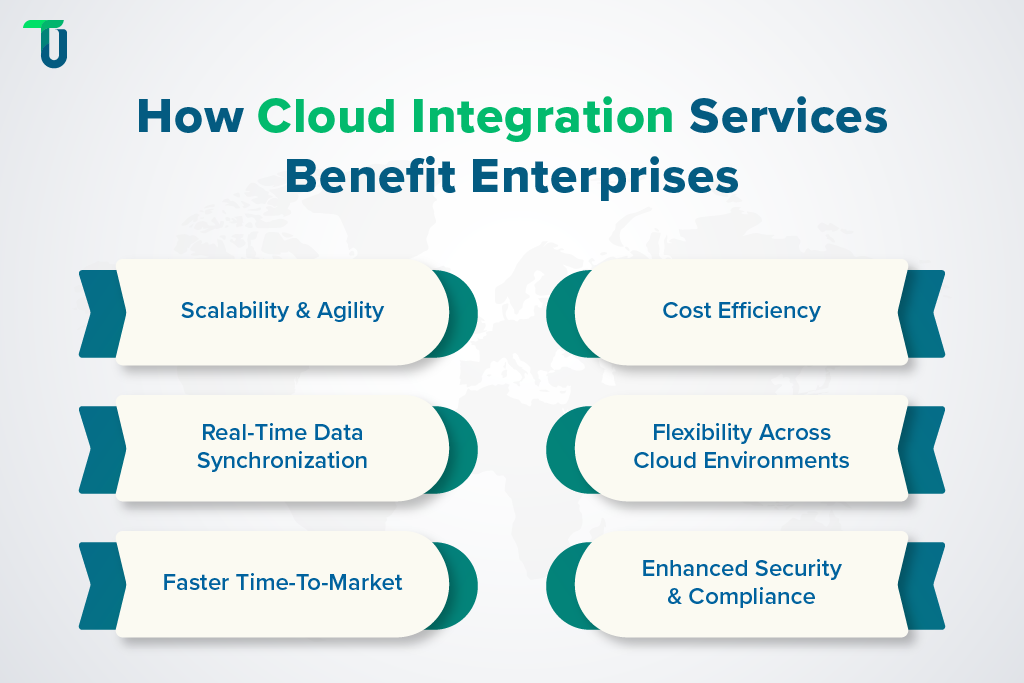
Cloud integration services are transforming enterprise IT by replacing traditional middleware with flexible, cloud-native, and real-time integration solutions. Here’s how enterprises benefit:
1. Scalability and Agility
One of the biggest advantages of cloud integration services is their ability to scale seamlessly with enterprise workloads. Enterprises can add or remove applications, services, or users without complex reconfiguration, thanks to cloud-native integration and cloud-based integration software that adapts quickly to changing workloads. Gartner and Forrester predict that by 2028, 75% of enterprises will rely on enterprise cloud integration platforms such as MuleSoft or Workato for mission-critical operations.
2. Cost Efficiency
The next notable advantage lies in cost reduction. Unlike traditional middleware, which requires heavy upfront investment in hardware, licenses, and IT staff, iPaaS-based cloud integration services operate on a subscription model. Enterprises save significantly on maintenance, upgrades, and infrastructure costs, while also gaining access to low-code automation that reduces operational overhead.
3. Real-Time Data Synchronization
Another important benefit is real-time data integration across applications. Updates in CRM, ERP, or marketing platforms appear instantly in other connected systems. IDC reports that enterprises with real-time integration see up to 30% improvement in operational efficiency, faster decision-making, and more accurate data. This level of cloud data integration is crucial for modern businesses.
4. Flexibility Across Hybrid and Multi-Cloud Environments
The fourth advantage is flexibility. Cloud integration platforms work across cloud deployment models including public clouds, private clouds, and on-premise systems simultaneously. Enterprises can adopt the best cloud services without vendor lock-in, and they can adjust architecture as business needs evolve without major disruptions.
5. Faster Time-to-Market
The next benefit of cloud integration services is speed. Pre-built connectors, APIs, and low-code tools allow enterprises to deploy integrations quickly. Projects that would take months with traditional middleware can now be completed in weeks, enabling faster launch of new services, products, or operational workflows.
6. Enhanced Security and Compliance
Cloud integration services also provide robust security and compliance controls. Encryption, access management, and adherence to standards like GDPR, HIPAA, and SOC 2 allow enterprises to handle sensitive data confidently while meeting regulatory requirements, reducing risk and operational overhead.
To encapsulate, cloud integration services give enterprises flexibility, speed, cost savings, and security while supporting real-time operations across modern IT environments.
Expert Advice: Enterprises should treat cloud integration services as a strategic tool, not just a technical solution. Focus on real-time data flow, hybrid cloud compatibility, and automation to reduce errors. A clear integration roadmap ensures that systems, teams, and data align with business objectives for faster, smarter decision-making.
6 Key Enterprise Use Cases for Cloud Integration Services
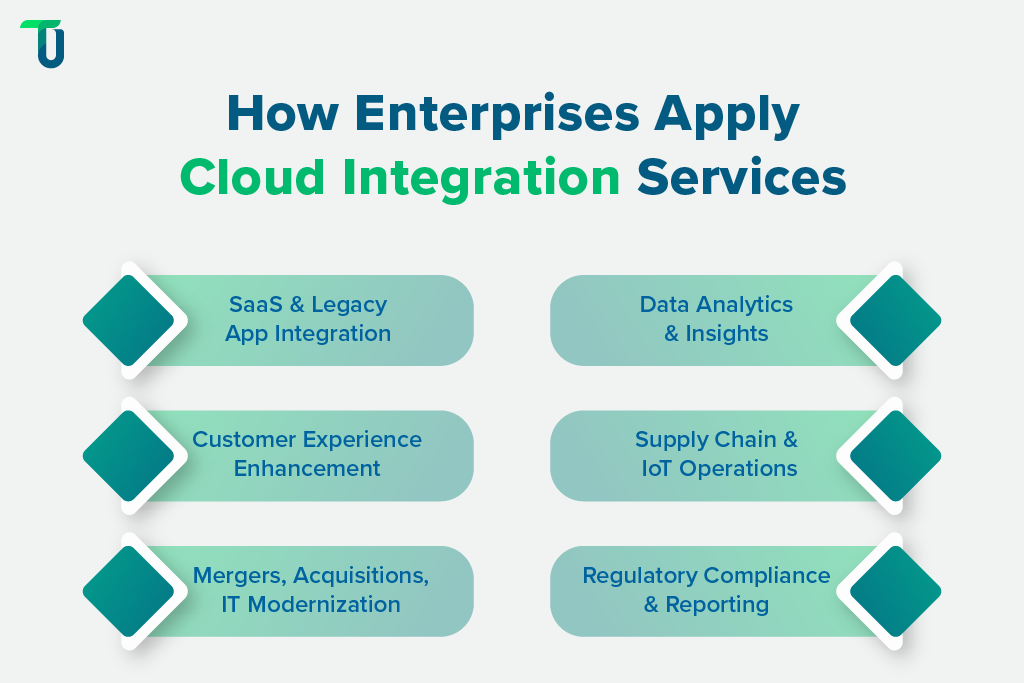
Cloud integration services help enterprises connect applications, data, and processes across cloud and on-premise systems. They simplify operations, support growth, and enable enterprises to respond quickly to business needs. Here are the main use cases:
A. SaaS and Legacy Application Integration
Enterprises use a combination of SaaS platforms and legacy applications, which often operate separately. Cloud integration tools and cloud integration software connect these systems seamlessly, so data flows reliably between CRM, ERP, HR, and marketing platforms. This reduces errors and allows teams to work efficiently. Native integration capabilities of cloud integration solutions are crucial for bridging the gap between modern and legacy systems.
B. Real-Time Analytics and Data Insights
Enterprises need accurate data for decision-making. Cloud integration solutions consolidate data from multiple sources, including databases, applications, and IoT devices, into analytics platforms and cloud data warehouses, supporting real-time decision making through data ingestion. This provides real-time insights, supports strategic decisions, and helps enterprises spot trends faster. Data integration solutions play a crucial role in this process, breaking down data silos and enabling a holistic view of business operations.
Also Read: What is Data Integration? Benefits, Challenges, and their Solutions
C. Customer Experience Enhancement
Maintaining a consistent customer experience requires accurate data across all touchpoints. Cloud integration tools synchronize customer information between sales, support, and marketing tools. This ensures enterprises deliver timely responses, personalized communication, and a seamless service experience. Business process automation is often a key component of these integrations, facilitated by enterprise automation platforms.
D. Supply Chain and IoT Operations
Supply chains and IoT networks produce large volumes of data that need constant monitoring. Cloud integration services connect sensors, logistics platforms, and inventory systems, allowing enterprises to track performance, detect issues quickly, and optimize processes across the supply chain.
E. Mergers, Acquisitions, and IT Modernization
When enterprises merge or acquire companies, IT environments become complex with different applications and databases, making it essential to follow best practices for legacy modernization to ensure smooth integration. Cloud integration services unify these systems, reducing downtime, preventing data loss, and supporting smooth IT modernization while maintaining business continuity. This process often involves cloud modernization strategies and the use of a cloud integration hub to centralize data flows.
F. Regulatory Compliance and Reporting
Enterprises must comply with standards like GDPR, HIPAA, and industry-specific regulations. Cloud integration services consolidate data across systems and regions, providing structured access for audits and reports. This helps enterprises stay compliant while reducing operational risk.
All in all, cloud integration services address both internal efficiency and external customer demands, making enterprise IT systems more responsive and manageable.
Traditional Middleware in Modern Enterprises: Challenges and Solutions
Traditional middleware played an important role in enterprise IT, but it struggles to meet modern business needs. Let's take a closer look at the key challenges enterprises face with middleware and how cloud integration services provide practical solutions to overcome them.
A. Infrastructure Lock-In and High Costs
Middleware often locks enterprises into specific hardware and licensed software. Expanding or scaling systems requires additional infrastructure and significant investment.
How to Tackle It: Cloud integration services offer subscription-based models that scale with business needs. Enterprises can avoid upfront costs and expand resources without being tied to hardware or licenses.
B. Complexity of Integration
Traditional middleware requires specialized skills and extensive configuration. Integrating multiple applications or data sources can take months and involves significant manual effort.
How to Tackle It: Cloud integration platforms simplify connections with pre-built connectors, APIs, and low-code workflows. This allows enterprises to link systems faster and reduce errors by adopting microservices design patterns for scalable APIs. API integration and application programming interface management become much more straightforward.
C. Limited Cloud Compatibility
Middleware was designed for on-premise systems and struggles with SaaS applications or multi-cloud environments. Enterprises face difficulties connecting new cloud-based tools to legacy systems.
How to Tackle It: Cloud integration services support hybrid and multi-cloud environments natively, enabling Multi-cloud and hybrid cloud storage architectures that seamlessly connect cloud and on-premise applications. Enterprises can integrate cloud and on-premise applications without complex customization, facilitating hybrid cloud integration.
D. Maintenance and Upgrade Bottlenecks
Middleware demands continuous maintenance, patching, and periodic upgrades, which can disrupt operations and require dedicated IT teams.
How to Tackle It: Cloud integration services shift maintenance and upgrades to the provider. Enterprises receive automatic updates, managed infrastructure, and reduced operational overhead.
Why Enterprises Are Betting on Cloud Integration Services
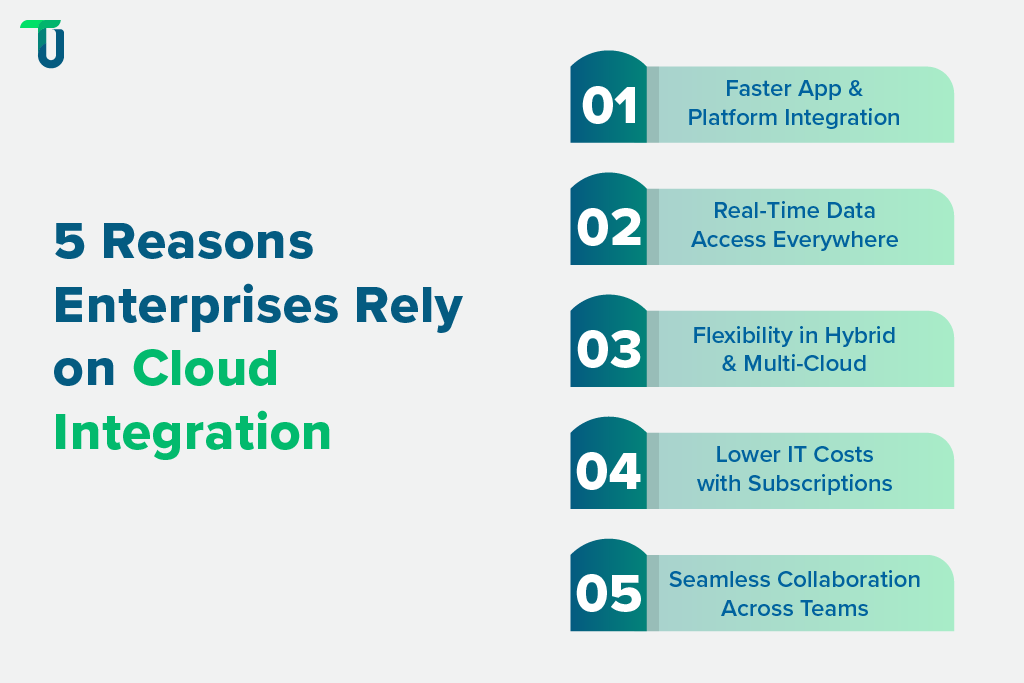
Enterprises use cloud integration services to connect apps, unify data, and streamline workflows. They reduce errors, cut costs, and boost agility. Here are five reasons businesses are betting on them.
1. Faster Integration of Multiple Enterprise Applications and Platforms
Cloud integration solutions allow enterprises to link multiple applications, databases, and platforms quickly, while also evaluating cloud application development services for transformation to ensure scalable and future-ready IT architectures. Teams can integrate CRM, ERP, HR, and marketing systems with minimal manual effort. This accelerates deployment, reduces errors, and ensures data flows reliably across all systems. Integration products like Informatica cloud integration offer robust capabilities for connecting diverse enterprise systems.
2. Access to Real-Time Data Across Cloud and On-Premise Systems
With cloud integration solutions, enterprises get instant access to data from various sources, including on-premise and cloud applications. Real-time data enables faster analysis, improves decision-making accuracy, and allows teams to respond to market changes without delays by leveraging cloud data engineering for real-time insights. This is where cloud data integration truly shines, breaking down data silos and creating a unified view of business operations.
3. Enhanced Operational Flexibility in Hybrid and Multi-Cloud Environments
Cloud integration solutions support hybrid and multi-cloud environments. Enterprises can adopt new tools, replace outdated systems, and scale operations up or down without hardware constraints. By 2028, 75% of enterprises will prioritize backup of SaaS applications as a critical requirement, compared to just 15% in 2024. This flexibility reduces dependency on legacy infrastructure and provides future-ready IT architecture, supporting a robust multi-cloud strategy.
4. Cost Efficiency Through Subscription Models and Reduced IT Overhead
Enterprises save on licensing, maintenance, and infrastructure costs with cloud integration services. Subscription-based models remove large upfront investments, while managed updates and automated workflows reduce ongoing IT overhead, allowing resources to be redirected to strategic initiatives.
5. Improved Collaboration Across Teams, Departments, and Geographies
Cloud integration services connect teams across departments and geographies. Unified workflows, shared data, and automated processes enhance collaboration, streamline communication, and improve alignment between business and IT functions, driving productivity and innovation.
In short, cloud integration services help enterprises work faster, smarter, and more efficiently while connecting systems, data, and teams across modern IT landscapes.
Where Cloud Integration Is Heading: Trends & Future Landscape
Let us finally look at the industry trends and future outlook shaping cloud integration services. This will help us see how they will guide future digital strategies.
1. Digital Transformation Priority
Enterprises aim to digitize faster to stay competitive. Cloud integration services unify applications and workflows, giving teams real-time data for quick decisions. This reduces manual effort, supports automation, and accelerates digital transformation goals across the enterprise.
2. Expansion of iPaaS Platforms
Integration Platform as a Service (iPaaS) is becoming mainstream, powering integration in cloud computing strategies for enterprises worldwide. Valued at $13.9 billion by 2026, iPaaS delivered through cloud integration services offers pre-built connectors, APIs, and low-code tools that simplify adoption and reduce reliance on specialized IT skills.
3. Growth of APIs and Microservices
APIs and microservices architecture in cloud application development are central to modern IT. Cloud integration services help enterprises manage APIs securely and connect microservices with legacy and cloud systems. This modular approach gives flexibility, supports faster updates, and avoids major disruptions when scaling. API management becomes a critical component of integration strategies.
4. Security and Compliance Focus
Data privacy and compliance remain critical. Cloud integration services provide encryption, role-based access, and alignment with regulations like GDPR and HIPAA. Centralized integration helps enterprises reduce risks, simplify audits, and maintain secure operations across geographies.
5. Future-Ready IT Landscape
The next phase of cloud integration services will include AI-driven recommendations, error detection, and low-code tools for business users. Enterprises adopting these services today gain a head start, with agility, faster deployment, and readiness for evolving digital demands.
Cloud-to-cloud integration and cloud-to-on-premises integration will become increasingly seamless, supported by advanced data management cloud capabilities.
All in all, industry trends show that cloud integration services are no longer optional. They have become a foundation for agility, security, and modern enterprises.
You Might Also Like:
Cloud Deployment Models: Public, Private, Hybrid, and Multi-Cloud
7 Rs of Cloud Migration: Strategies for Moving Apps to the Cloud
Partner with TenUp for Future-Ready Cloud Integration Services
All in all, cloud integration services give enterprises a way to finally break free from the limits of traditional middleware. They simplify cloud application integration, enable real-time data flow, and support hybrid and multi-cloud strategies, creating more agile and innovative IT landscapes.
At TenUp, we specialize in enterprise cloud integration, cloud engineering, DevOps, and data solutions, helping organizations implement cloud engineering solutions for enterprises that future-proof IT ecosystems. Our experts can guide your organization through iPaaS adoption, API management, and cloud-based integration strategies, helping you leverage the best cloud integration software for a future-ready IT ecosystem. Get started with our cloud integration services today to unify your systems, accelerate workflows, and future-proof your enterprise IT.
Build a Next-Gen IT Landscape with TenUp
Let us help you simplify cloud integration, boost agility, and accelerate your digital transformation journey.
Frequently asked questions
What problem do cloud integration services solve for enterprises?

Cloud integration services solve the problem of disconnected applications and data silos by creating a unified ecosystem across SaaS, legacy, and hybrid cloud systems. They improve real-time visibility, automate workflows, ensure data consistency, and enable faster, more secure decision-making at scale.
How are cloud integration services different from traditional middleware?
Cloud integration services are cloud-native, scalable, and subscription-based, unlike traditional middleware that is on-premise, hardware-dependent, and costly to scale. They use APIs, pre-built connectors, and low-code tools to enable faster, more flexible integrations across SaaS, hybrid, and multi-cloud environments.
Why are enterprises choosing cloud-based integration over custom-built integrations?
Enterprises choose cloud-based integration because it cuts development time, lowers costs, and scales automatically with business needs. Pre-built connectors, automation, and centralized management simplify workflows, improve real-time data access, and free IT teams to focus on innovation.
What are the most common use cases for cloud integration services?
Cloud integration services are used for SaaS-to-legacy application integration, real-time data synchronization, hybrid and multi-cloud workflows, customer experience automation, IoT and supply chain visibility, and regulatory compliance reporting. They streamline data, unify applications, and enable faster, smarter business decisions.
How do cloud integration tools support hybrid and multi-cloud environments?
Cloud integration tools unify applications and data across on-premises, private, and multiple public clouds. They prevent vendor lock-in, ensure secure and real-time data flow, optimize workloads, and enable flexible, resilient, and cost-efficient hybrid and multi-cloud operations.
What is the role of APIs and microservices in cloud integration?
APIs and microservices enable modular, flexible cloud integration by connecting independent services, legacy systems, and cloud applications. They support hybrid and multi-cloud environments, ensure secure data flow, and allow enterprises to scale, update, and innovate faster.
How do cloud integration services improve real-time decision-making?
Cloud integration services unify data across all systems in real time, breaking silos and feeding accurate, up-to-date information to CRM, ERP, and analytics tools. This enables faster, data-driven decisions and improves organizational agility.
Why are more companies using cloud-based computing instead of server-based computing?
Companies choose cloud computing because it cuts infrastructure costs, scales on demand, and provides secure access to data and applications from anywhere. Unlike server-based setups, it removes hardware maintenance, supports remote work, and accelerates innovation.
Share the Article


